Gujarat BJP President Labels Congress as a '4-C' Party
Synopsis
In a recent gathering, Gujarat BJP chief Jagdish Vishwakarma criticized Congress, branding it as a '4-C' party linked to corruption, communal riots, and more, while emphasizing the BJP's commitment to development and trust.
Key Takeaways
Congress has been labeled a '4-C' party by BJP leaders.
BJP emphasizes corruption-free governance .
Significant infrastructure projects are underway in South Gujarat.
BJP focuses on welfare measures for all sections of society.
Party workers are committed to engaging with the public consistently.
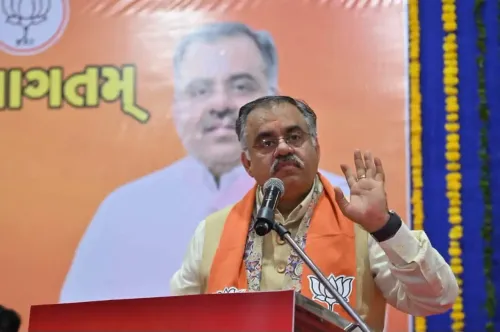
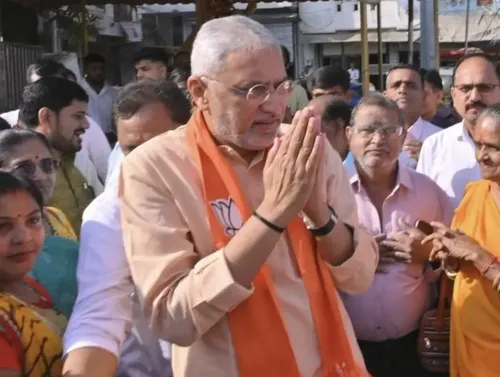
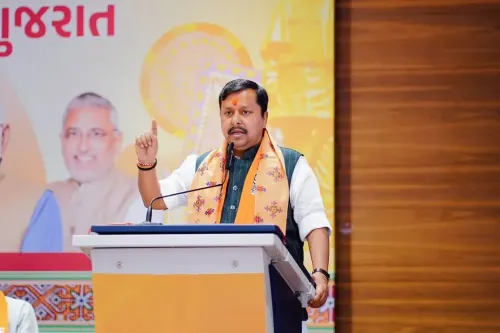
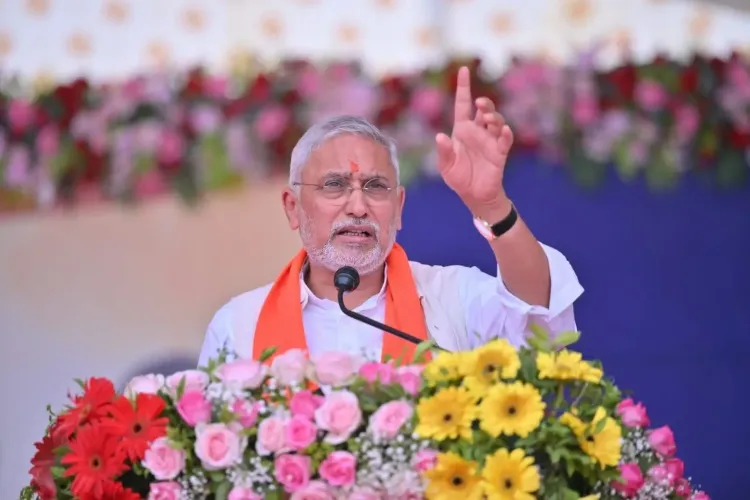
Surat, March 15 (NationPress) The president of the Gujarat Bharatiya Janata Party (BJP), Jagdish Vishwakarma, referred to the Congress as a “4-C” party during a significant booth workers’ conference in Mahuva, Surat district. This term represents corruption, commission, communal riots, and criminal politics.
Addressing attendees on the third day of the party’s organizational tour in South Gujarat, Vishwakarma criticized the opposition's lengthy tenure in power without addressing the public's needs.
“For us, Congress embodies ‘4-C’ — corruption, commission, communal riots, and criminal politics,” he emphasized, contrasting this with what he claimed to be the BJP's corruption-free governance.
He also accused opposition figures of disseminating false information and concentrating on protests instead of engaging in meaningful parliamentary discussions.
In light of recent discussions surrounding LPG pricing, he alleged that Congress members were perpetuating misinformation and criticized an instance where opposition members were spotted sitting on the Parliament steps.
“Rather than addressing the public's issues in Parliament, opposition leaders prefer to spread rumors and protest outside,” he stated.
Vishwakarma informed party workers that the BJP advocates for governance devoid of casteism, dynastic politics, and appeasement.
He noted that the party's organizational workers consistently engage with the public rather than only during election periods.
Under the leadership of Prime Minister Narendra Modi, Union Home Minister Amit Shah, and Chief Minister Bhupendra Patel, the government is committed to doubles farmers’ income, he asserted.
Vishwakarma highlighted South Gujarat's pivotal role in agriculture and cooperative initiatives, stating that the region's accomplishments in the cooperative sector serve as a national model.
Discussing development efforts, he pointed out that over the last decade, approximately 76 small and large bridges have been constructed in the local Assembly segment, costing more than Rs 500 crore.
He cited the construction of a four-lane road from Bardoli to Anaval, costing Rs 376 crore, and a tribal Adarsh Residential School in Nalotha village built for Rs 51 crore as examples of infrastructure growth.
Furthermore, he mentioned a new bridge currently being built to link Samba with the Brahmadev Temple area.
Recalling Surat’s rich historical significance, he remarked: “The city has historically been a vital trading port, and its entrepreneurial spirit remains relevant today.”
The BJP leader noted that the cooperative models of Amul and Sumul are well-regarded nationwide, with over 150 products from the sector being exported internationally.
“The government is promoting natural farming and striving to secure better prices for agricultural products,” he added.
Among notable welfare initiatives, Vishwakarma highlighted the Ayushman health card scheme, LPG cylinders offered under the Ujjwala program, financial aid via the PM Kisan Samman Nidhi scheme, and marketing support for tribal millet such as nagli.
He also announced an increase in the income eligibility limit for Scheduled Caste students from Rs 2.5 lakh to Rs 6 lakh to assist those from middle-income and poorer families in pursuing higher education.
“Today, for the residents of Gujarat and the nation, the BJP symbolizes development and represents trust,” he stated, emphasizing that party workers are dedicated to realizing the vision of a developed India by 2047.
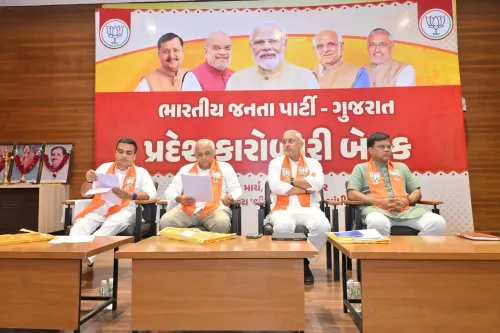
Earlier in the day, Vishwakarma convened an organizational meeting with district-level BJP officials, MPs, MLAs, the district panchayat president, campaign heads, secretaries, and local leaders to evaluate organizational issues.
Point of View
The statements made by Gujarat BJP chief Jagdish Vishwakarma underscore the ongoing political rivalry in India. His critique of Congress highlights the BJP's strategy to position itself as a party of governance and development, while also challenging the opposition's credibility. This reflects the current political climate where party narratives play a significant role in shaping public opinion.
NationPress
8 Oct 2026
Frequently Asked Questions
What does the '4-C' refer to?
The '4-C' refers to corruption, commission, communal riots, and criminal politics, as described by Gujarat BJP president Jagdish Vishwakarma.
What are some of the development projects mentioned?
Vishwakarma mentioned the construction of bridges and roads, as well as the establishment of a tribal Adarsh Residential School in Nalotha village.
How does the BJP differentiate itself from Congress?
The BJP emphasizes a governance model free from casteism, dynastic politics, and appeasement, contrasting it with Congress's alleged shortcomings.
What welfare measures were highlighted?
The Ayushman health card scheme, Ujjwala program for LPG cylinders, and financial support through the PM Kisan Samman Nidhi scheme were among the initiatives mentioned.
What is the BJP's vision for the future?
The BJP aims to achieve a developed India by 2047, focusing on trust and development for the people of Gujarat and the nation.