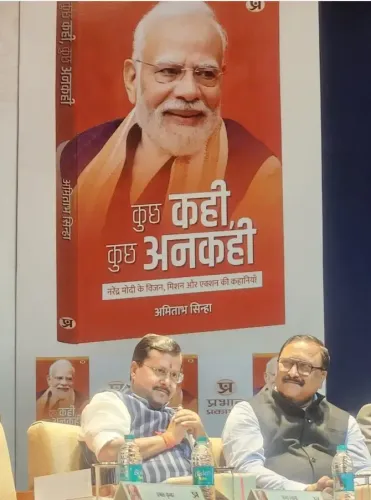
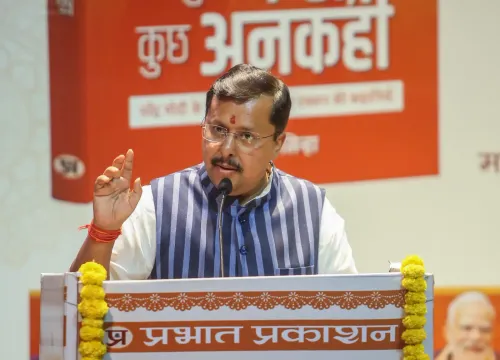
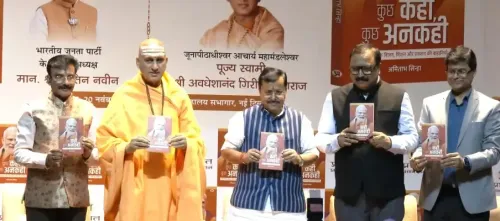
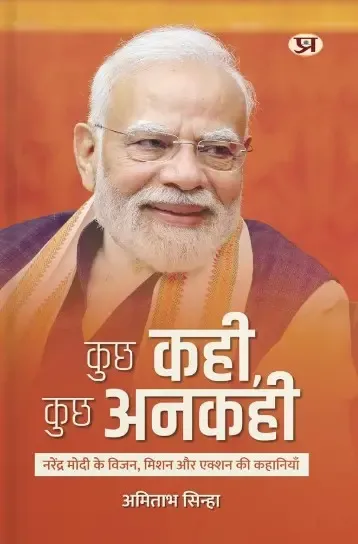
Book 'Kuch Kahi Kuch Ankahi' reveals how PM Modi reshaped Delhi politics
Synopsis
A new book by journalist Amitabh Sinha, 'Kuch Kahi, Kuch Ankahi', pulls back the curtain on Narendra Modi's formative political years — from evening tea sessions with journalists in 1997, to personally overseeing Gujarat earthquake relief in 2001 with little institutional support, to building the PRAGATI governance framework as PM. The through-line: a leader who learned by doing, long before he governed a nation.
Key Takeaways
Amitabh Sinha's book 'Kuch Kahi, Kuch Ankahi' compiles little-known anecdotes from PM Narendra Modi's political journey since 1997 .
As a BJP General Secretary in Delhi in 1997 , Modi held regular tea sessions with journalists, stressing factual, public-interest reporting.
During the 2001 Gujarat earthquake , Modi bypassed rest and headed to the BJP office in Khanpur, Ahmedabad to coordinate relief, reportedly with minimal institutional support.
After becoming Prime Minister, Modi admitted past wariness of IAS officers and launched PRAGATI to drive accountability in governance.
The book traces a consistent pattern: Modi converting hands-on field experience — from earthquake relief to Covid-19 mobilisation — into governance philosophy.
When Prime Minister Narendra Modi arrived in New Delhi after stepping down as Gujarat Chief Minister, the message from the capital's corridors of power was pointed: 'Mr Modi, this is Delhi, not Gujarat.' Yet Modi, by all accounts, was not a leader who would let an entrenched political culture dictate his style. He came armed with his own instincts, experiences, and a clear determination to govern differently.
The Book and Its Author
These insights emerge from Amitabh Sinha's new book, 'Kuch Kahi, Kuch Ankahi', which stitches together lesser-known anecdotes from Modi's political journey spanning nearly three decades. Sinha, a veteran television journalist who first encountered Modi in 1997 when Modi was a Bharatiya Janata Party (BJP) General Secretary in Delhi, draws on personal observations to offer a ground-level view of the leader's evolution from party functionary to Prime Minister.
Early Lessons: Truth in Journalism and Tea with a Future PM
One episode dates to 1997, when Modi — despite a punishing travel schedule — made time for evening tea sessions with journalists at his modest Delhi office. Sinha, then at the beginning of his television journalism career, was a regular visitor. Modi's message to journalists was consistent: 'Don't go around the story. Show what is true.' Years later, Sinha reflects that these conversations offered an early window into Modi's emphasis on public interest and factual accountability.
The 2001 Gujarat Earthquake: Governance Under Pressure
A defining episode in the book centres on the 2001 Gujarat earthquake, one of India's deadliest natural disasters. Modi, then Gujarat Chief Minister, was dispatched from Delhi to oversee relief and rehabilitation amid mounting criticism of the state administration's response. Sinha recalls sharing a flight to Ahmedabad with him — the aircraft nearly empty, Modi visibly shaken by the scale of devastation in his home state.
Upon landing, Modi bypassed any rest and headed directly to the BJP office in Khanpur, Ahmedabad, to begin assessing the ground situation. According to Sinha, he received scant institutional support from either the state government or local administration, yet travelled extensively across the state to ensure that relief material arriving from across India and abroad reached victims in Kutch. The experience, the author writes, left a lasting impression on Modi: that determination and a spirit of service can sustain governance even when formal institutional backing is absent.
Reforming the Bureaucracy: From Apprehension to PRAGATI
The book also sheds light on Modi's evolving relationship with India's civil services. After becoming Prime Minister, Modi reportedly admitted that he had been particularly wary of Indian Administrative Service (IAS) officers during his Gujarat years. Over time, however, he sought to reshape the traditional administrative mindset. The initiative Pro-Active Governance And Timely Implementation (PRAGATI) — through which the Prime Minister directly reviewed stalled projects and addressed bottlenecks with senior officials — is cited as a reflection of his emphasis on punctuality, accountability, and citizen-centric governance.
From Press Release Distribution to Covid-19 Mobilisation
Sinha also recalls Modi speaking at a Holi gathering with journalists about his early Delhi days, noting that 'before becoming Prime Minister, he had distributed press releases and even arranged chairs for journalists during press conferences.' This detail, modest as it sounds, underscores a continuity in his approach: direct engagement with the public and media, regardless of rank. That same instinct for mass mobilisation, the author argues, resurfaced during the Covid-19 pandemic, when Modi's appeals — from the nationwide clapping initiative for frontline workers to the nationwide vaccination drive — became central to the government's crisis communication strategy.
For Sinha, who has tracked Modi since 1997, these episodes collectively reveal a recurring pattern: a leader who absorbs every role as a learning exercise, adapts to adversity, and converts small field experiences into larger administrative doctrine. The book positions these anecdotes not as hagiography but as source material for understanding how a distinctive governance philosophy was forged over decades.
Point of View
The chair-arranging, the tea sessions — are vivid, but the selection is uniformly flattering. The more instructive question is whether Modi's field-level instincts, evident in 2001 Kutch, translated into scalable institutional reform or remained a personal leadership style that is difficult to replicate downstream. PRAGATI is a credible data point; the broader record on bureaucratic reform is contested. Readers will get the texture of the man — but should also ask what the book chooses not to tell.
NationPress
21 Nov 2026
Frequently Asked Questions
What is the book 'Kuch Kahi, Kuch Ankahi' about?
'Kuch Kahi, Kuch Ankahi' is a book by journalist Amitabh Sinha that documents lesser-known episodes from PM Narendra Modi's political journey, from his 1997 days as a BJP General Secretary in Delhi to his tenure as Prime Minister. It draws on Sinha's personal observations spanning nearly three decades of covering Modi.
What does the book reveal about Modi's time during the 2001 Gujarat earthquake?
According to Sinha, Modi — then Gujarat Chief Minister — flew to Ahmedabad after the 2001 earthquake and went directly to the BJP office in Khanpur without seeking rest, coordinating relief efforts despite receiving little support from the state government or local administration. The experience in Kutch reportedly became a formative lesson in governance under adversity.
What is PRAGATI, and how does the book connect it to Modi's governance style?
PRAGATI (Pro-Active Governance And Timely Implementation) is a government initiative through which the Prime Minister directly reviews stalled infrastructure and welfare projects with senior officials. The book presents it as an institutional expression of Modi's longstanding emphasis on punctuality, accountability, and bypassing bureaucratic bottlenecks.
Who is author Amitabh Sinha, and what is his connection to PM Modi?
Amitabh Sinha is a veteran television journalist who first met Modi in 1997 when Modi was a BJP General Secretary in Delhi. Sinha has followed and reported on Modi for nearly three decades, and 'Kuch Kahi, Kuch Ankahi' is based on his personal interactions and observations over that period.
What was the 'This is Delhi, not Gujarat' episode referred to in the book?
The phrase refers to the implicit signal Modi received from Delhi's established political class when he arrived in the capital after resigning as Gujarat Chief Minister — a suggestion that he would need to conform to the capital's entrenched political culture. The book uses it as a framing device to illustrate how Modi chose instead to operate on his own terms.