BRICS New Delhi Declaration endorses Guwahati anti-drug pact, CM Sarma hails global recognition

Synopsis
A regional anti-drug pact born in Guwahati has just been endorsed by the BRICS New Delhi Declaration — a rare instance of a state-level initiative breaking into a major multilateral summit document. Chief Minister Himanta Biswa Sarma says the endorsement signals that Assam, long a frontline in narcotics trafficking corridors, is now a recognised actor in global counter-drug cooperation.
Key Takeaways
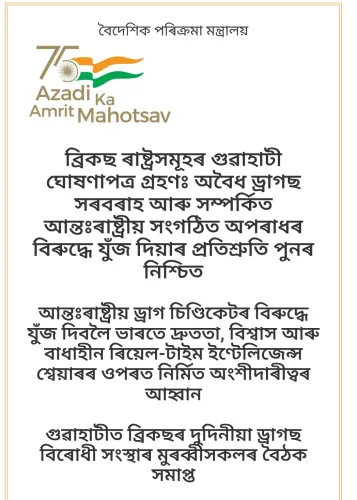
The Guwahati Declaration , adopted by Heads of Anti-Drug Agencies of BRICS member countries, has been formally referenced in the BRICS New Delhi Declaration .
Assam Chief Minister Himanta Biswa Sarma hailed the development on 14 September 2026 as a global recognition of the state's counter-narcotics efforts.
The declaration focuses on dismantling transnational narcotics networks, intelligence-sharing, and operational and technical cooperation among BRICS enforcement agencies.
Sarma highlighted Assam's position along a critical trafficking corridor in Northeast India as central to regional and international anti-drug efforts.
The BRICS endorsement is seen as elevating a regional initiative into a framework with multilateral weight across major global economies.
Assam Chief Minister Himanta Biswa Sarma on Monday, 14 September 2026, welcomed the formal endorsement of the Guwahati Declaration within the BRICS New Delhi Declaration, calling it a landmark moment that places Assam's anti-narcotics campaign firmly on the global stage. The inclusion elevates a regional anti-drug framework into an instrument of multilateral cooperation among some of the world's largest economies.
What the Guwahati Declaration covers
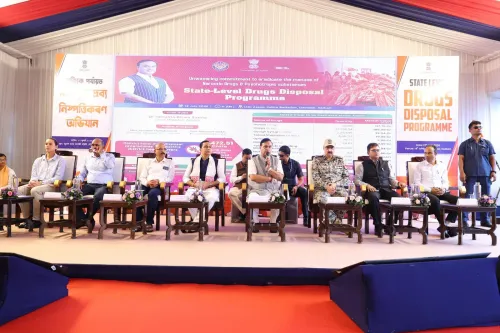
The Guwahati Declaration was originally adopted at a meeting of the Heads of Anti-Drug Agencies of BRICS member countries held in Guwahati. It focuses on dismantling transnational narcotics networks, improving intelligence-sharing among enforcement agencies, and deepening operational and technical cooperation to counter emerging threats in the global drug trade. Its formal reference in the BRICS New Delhi Declaration has now conferred wider international significance on what began as a regional initiative.
Assam's strategic position in drug trafficking corridors
Chief Minister Sarma underlined that Assam's geographical location places it along a critical trafficking corridor in Northeast India, making the state a frontline zone in disrupting narcotics networks. 'From our position in Northeast India, we are strengthening our role in building a safer and more secure region,' he said. According to Sarma, the state's role extends well beyond enforcement within its own borders — spanning intelligence-sharing, coordinated operations, and systematic efforts to counter organised drug trafficking syndicates that span multiple countries.
BRICS backing for operational cooperation
Sarma also welcomed the increased emphasis within BRICS on operational and technical cooperation among member states, noting that stronger inter-agency coordination would help identify and dismantle narcotics networks more effectively. He stressed that international cooperation is particularly critical in addressing the growing threat posed by drug trafficking and in shielding young people from the consequences of narcotics abuse. The Chief Minister described the recognition as evidence that Assam's local counter-narcotics efforts were now drawing attention on a genuinely global platform.
Significance for Assam and Northeast India
Notably, the endorsement represents one of the most prominent instances of a state-level anti-drug initiative being absorbed into a multilateral summit declaration of the BRICS grouping — which now includes major economies from Asia, Africa, Latin America, and the Middle East. For Guwahati and the wider Northeast, the development is being read as an acknowledgement of the region's strategic importance in regional and global counter-narcotics architecture. Sarma said the recognition would further strengthen his government's resolve to build a safer Assam while contributing to broader international efforts against the drug trade.
Point of View
Shared intelligence protocols, and measurable disruption of the transnational networks that route narcotics through Northeast India. Chief Minister Sarma's framing is politically astute — connecting Assam's local enforcement record to global geopolitics — but the gap between declarations and drug-seizure outcomes will be the metric that ultimately matters. Assam's ability to sustain this visibility will depend on whether the declaration produces binding mechanisms or remains aspirational language.
NationPress
14 Sept 2026
Frequently Asked Questions
What is the Guwahati Declaration and why is it significant?
The Guwahati Declaration is an anti-narcotics framework adopted at a meeting of the Heads of Anti-Drug Agencies of BRICS member countries held in Guwahati, Assam. It focuses on dismantling transnational drug networks, intelligence-sharing, and operational cooperation. Its formal reference in the BRICS New Delhi Declaration gives it multilateral recognition among major global economies.
How has the BRICS New Delhi Declaration endorsed the Guwahati Declaration?
The BRICS New Delhi Declaration — the summit-level document of the BRICS grouping — formally references the Guwahati Declaration, lending it recognition beyond its original regional scope. This effectively places an Assam-hosted anti-drug initiative within the framework of one of the world's most significant multilateral groupings.
What is Assam's role in counter-narcotics efforts according to CM Sarma?
Chief Minister Himanta Biswa Sarma says Assam sits along a critical narcotics trafficking corridor in Northeast India, making it a frontline state in disrupting drug networks. He says the state's role covers not just domestic enforcement but also intelligence-sharing and coordinated operations across borders.
Who is affected by the Guwahati Declaration?
The declaration is primarily relevant to BRICS member nations' anti-drug enforcement agencies, which are expected to deepen operational and technical cooperation. Within India, it is particularly significant for Assam and the Northeast, regions directly exposed to cross-border drug trafficking routes.
What happens next after the BRICS endorsement of the Guwahati Declaration?
The endorsement is expected to strengthen the institutional basis for intelligence-sharing and joint operations among BRICS member countries' anti-narcotics agencies. Chief Minister Sarma indicated that the recognition would reinforce his government's resolve to intensify counter-drug operations in Assam and contribute to regional and international enforcement efforts.