Cabinet Approves NIPU-2026 to Boost Domestic Urea Output
Synopsis
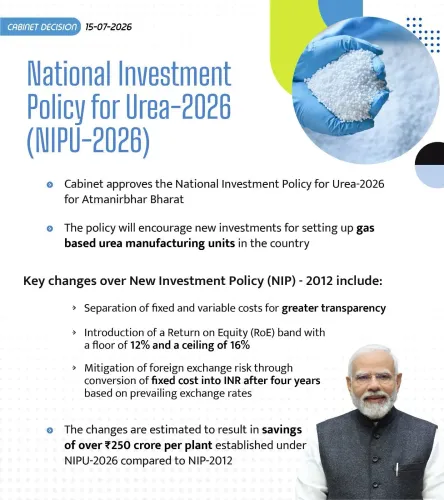
The Union Cabinet chaired by PM Modi approved NIPU-2026 on 15 July 2026, a new investment policy to set up gas-based urea plants in India. The move targets self-sufficiency in urea, reducing costly imports and shielding farmers from global price volatility under the Atmanirbhar Bharat framework.
Key Takeaways
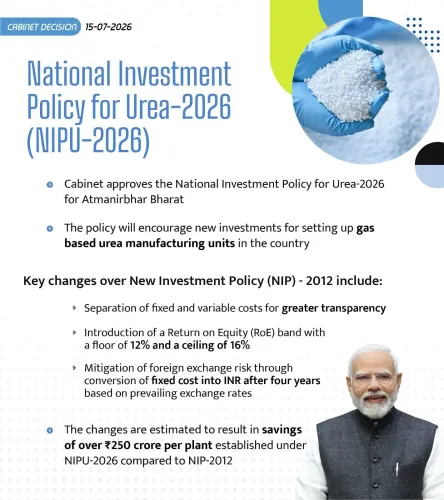
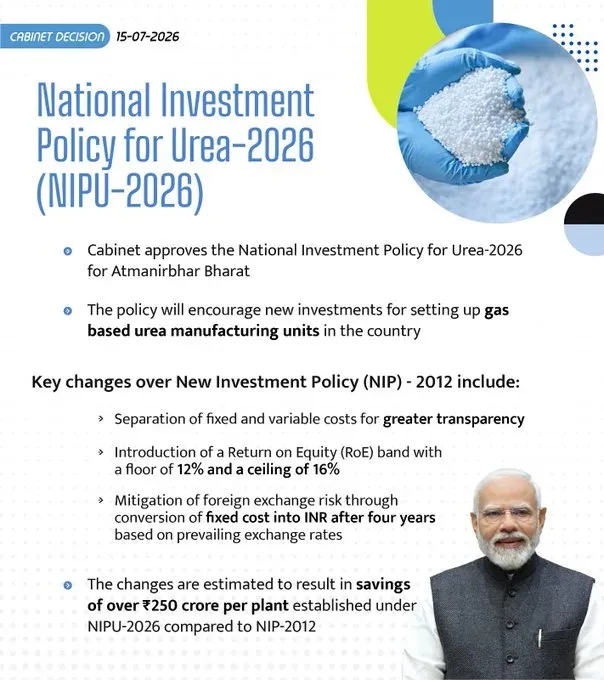
The Union Cabinet approved the National Investment Policy for Urea-2026 (NIPU-2026) on 15 July 2026 .
The policy is designed to attract fresh investments specifically in gas-based urea manufacturing units in India.
NIPU-2026 is framed under the Atmanirbhar Bharat self-reliance programme launched in 2020.
Key beneficiaries include fertilizer companies , natural gas suppliers , and farmers dependent on urea.
India's reliance on urea imports has historically exposed farmers to global commodity price volatility, which the policy aims to reduce.
The Department of Fertilizers is expected to issue detailed notifications on incentives and timelines under the new policy.
Union Science and Technology Minister Dr. Jitendra Singh announced on Wednesday, 15 July 2026 that the Union Cabinet, chaired by Prime Minister Narendra Modi, has approved the National Investment Policy for Urea-2026 (NIPU-2026), a dedicated framework to attract fresh investments into gas-based urea manufacturing plants across India, advancing the government's Atmanirbhar Bharat self-reliance agenda.
Context
Dr. Jitendra Singh shared the Cabinet decision on X, stating the policy is aimed at 'encouraging new investments in the urea sector for setting up gas-based urea manufacturing units in the country, helping achieve the goal of self-sufficiency.' The announcement was part of a broader set of Cabinet Decisions cleared at the meeting. Urea is the most widely consumed nitrogenous fertilizer in India, and domestic production has historically lagged behind demand, leaving the country reliant on imports that expose farmers to global price swings.
Policy Backdrop
India's push for urea self-sufficiency has a multi-decade lineage. The New Urea Policy of 2015 revised pricing norms and investment incentives to spur higher indigenous output. When Prime Minister Modi launched the Atmanirbhar Bharat programme in May 2020, fertilizer capacity expansion was explicitly listed among the strategic sectors earmarked for domestic strengthening. NIPU-2026 extends that arc, with a specific focus on gas-based plants — a technology preference driven by cleaner feedstock requirements and India's expanding domestic natural gas infrastructure. Successive administrations have favoured gas-based urea manufacturing because it aligns production economics with the country's growing pipeline and LNG terminal network.
Stakeholders and Impact
Fertilizer companies stand to benefit directly from the new investment policy, which is designed to de-risk capital commitments in a sector historically subject to subsidy uncertainty. Natural gas suppliers — both state-run and private — are likely to see incremental demand as new plants come online. Most critically, farmers across the country stand to gain from more stable urea availability and reduced exposure to import-driven price volatility, which has periodically disrupted agricultural input planning. The policy also carries broader macroeconomic implications by potentially reducing India's fertilizer import bill, which runs into tens of thousands of crore rupees annually.
What's Next
Attention will now turn to the Department of Fertilizers for detailed notifications spelling out the specific investment incentives, eligibility criteria, and timelines embedded in NIPU-2026. Industry stakeholders will watch for the first round of investment proposals received under the policy and any announced timelines for new plant commissioning. The policy's success will ultimately be measured by how quickly it translates Cabinet intent into operational urea manufacturing capacity on the ground, a process that typically spans several years from approval to production.
Point of View
Treating urea not merely as a subsidy line item but as a national security concern. By anchoring the policy to gas-based technology, the Cabinet is simultaneously nudging the fertilizer sector toward cleaner production and leveraging India's growing domestic gas infrastructure — a two-for-one policy bet. The move fits a recognisable pattern: successive Atmanirbhar Bharat interventions in sectors where import dependence creates both fiscal and geopolitical vulnerability. Whether NIPU-2026 delivers on its promise will depend entirely on execution — specifically, how quickly the Department of Fertilizers converts the Cabinet's intent into actionable investment windows and how responsive private capital proves to be.
NationPress
15 Jul 2026
Frequently Asked Questions
Why did the Cabinet approve a new urea investment policy?
India has long depended on imported urea to meet domestic demand, exposing farmers to global price volatility. The Cabinet approved NIPU-2026 to encourage domestic gas-based urea manufacturing, reduce import dependence, and advance the Atmanirbhar Bharat self-reliance agenda.
What is the connection between NIPU-2026 and Atmanirbhar Bharat?
Atmanirbhar Bharat, launched by PM Modi in May 2020, set out to build domestic capacity in strategic sectors including fertilizers. NIPU-2026 is a direct extension of that programme, specifically targeting urea self-sufficiency through new investment incentives.
Who benefits from the NIPU-2026 urea policy?
The primary beneficiaries are Indian farmers who will gain more stable and affordable urea supplies, fertilizer companies that receive a clearer investment framework, and natural gas suppliers who stand to see higher demand as new gas-based urea plants are set up.
Why does India prefer gas-based urea plants?
Gas-based urea plants use cleaner feedstock compared to older naphtha or coal-based alternatives, and they align well with India's expanding domestic natural gas pipeline and LNG infrastructure, making them both environmentally preferable and economically viable for new investments.