Kishan Reddy: Cabinet Clears NIPU-2026 for Urea Self-Reliance
Synopsis
The Union Cabinet has approved NIPU-2026, a national investment policy to end India's urea import dependence by accelerating gas-based domestic manufacturing, ensuring farmer access to fertilisers, and cutting the government's subsidy burden.
Key Takeaways
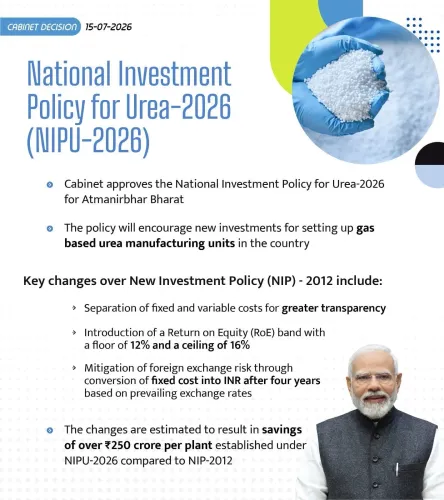
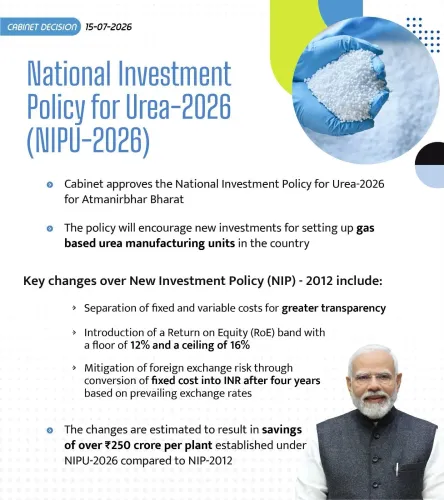
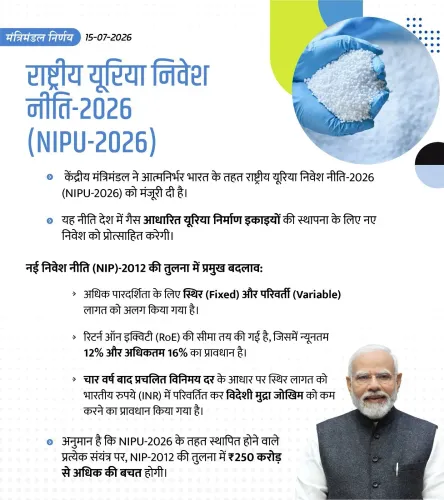
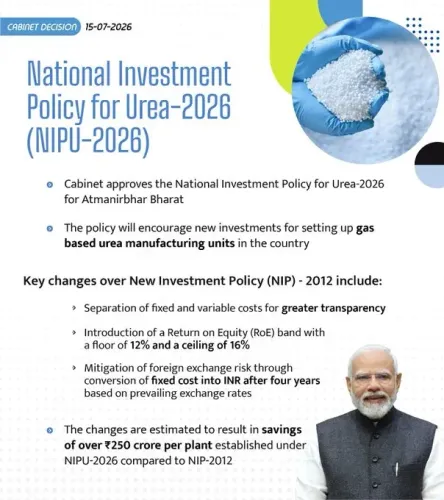
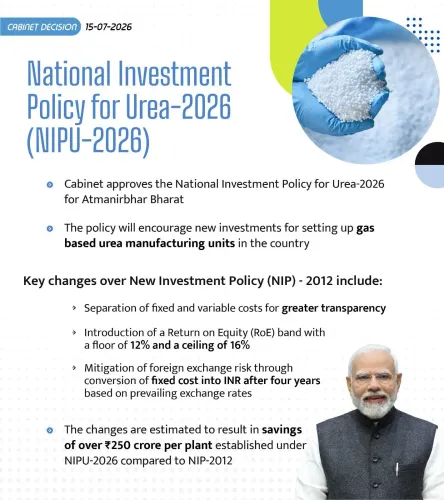
The Union Cabinet under PM Narendra Modi has approved the National Investment Policy for Urea 2026 (NIPU-2026) .
The policy targets 100 per cent domestic coverage of India's urea demand, eliminating reliance on foreign imports.
New gas-based urea manufacturing units will be established using modern, eco-friendly technology.
Farmers across India are expected to receive timely, quality fertiliser supply without seasonal shortages.
The government anticipates a significant reduction in its fertiliser subsidy and transportation expenditure as domestic production rises.
NIPU-2026 follows the earlier New Urea Policy 2015 and aligns with the Atmanirbhar Bharat self-reliance mission.
Union Coal and Mines Minister G. Kishan Reddy announced on Friday, 17 July 2026 that the Union Cabinet, under Prime Minister Narendra Modi, has approved the National Investment Policy for Urea 2026 (NIPU-2026) — a flagship initiative aimed at eliminating India's dependence on imported urea and achieving 100 per cent domestic coverage of national demand.
Context
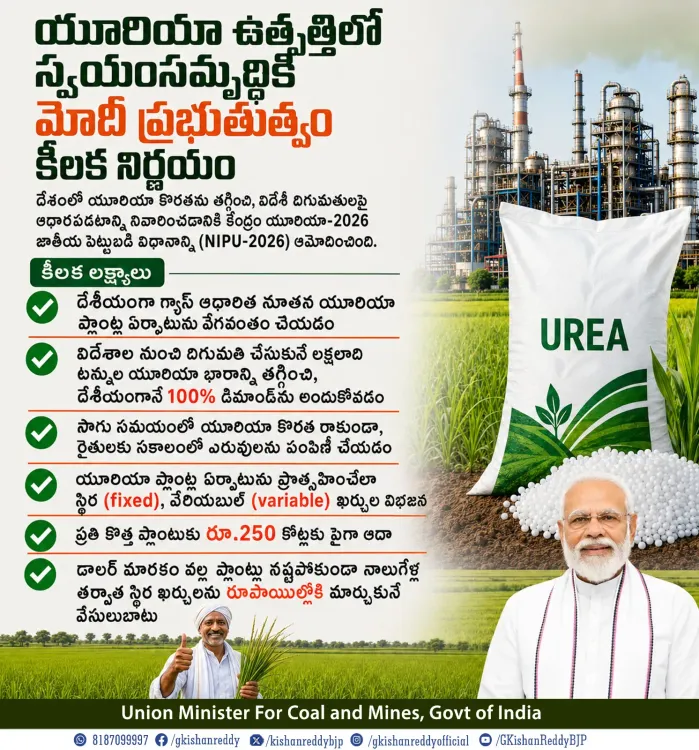
Posting in Telugu on X, Kishan Reddy described the policy as a landmark step toward ending the country's chronic urea shortage. Translated, his post reads: 'The Central Government led by respected Prime Minister Shri Narendra Modi has approved the prestigious National Investment Policy for Urea — NIPU-2026 — to completely overcome the domestic urea shortage and avoid dependence on foreign imports.'
The minister listed five key objectives of the policy: accelerating the establishment of gas-based urea manufacturing units; meeting 100 per cent of domestic demand indigenously; promoting modern, eco-friendly gas-based technology in new plants; ensuring timely, quality fertiliser supply to farmers across the country; and significantly reducing the fertiliser subsidy and transportation burden on the government through higher domestic production.
Policy Backdrop
India has been a structurally large importer of urea for decades, making the agriculture sector vulnerable to global price swings and supply disruptions. An earlier New Urea Policy (NUP-2015), approved by the Union Cabinet, had sought to rationalise subsidies and incentivise fresh investment in gas-based urea capacity, but import dependence persisted.
The Atmanirbhar Bharat Abhiyan, launched in 2020, explicitly identified fertilisers as a critical sector where self-reliance was essential. NIPU-2026 is positioned as the next major policy step in that continuum, targeting both new plant construction and the adoption of cleaner, more efficient gas-based technology aligned with India's broader energy-transition goals.
Stakeholders and Impact
Indian farmers stand to benefit most directly: the policy aims to eliminate seasonal urea shortages that have historically disrupted crop cycles, particularly during the kharif and rabi sowing seasons. Reliable domestic supply is expected to reduce the logistical delays and black-market price spikes that small and marginal farmers face.
For the government, higher domestic urea production is projected to bring down the fertiliser subsidy bill — one of the largest recurring expenditure items in the Union Budget — as well as reduce the foreign-exchange outflow associated with importing millions of tonnes of urea annually. Domestic fertiliser manufacturers are expected to be the primary investment beneficiaries, with the policy designed to attract large capital inflows into new gas-based plant capacity.
What's Next
Attention will now shift to Cabinet and ministry notifications detailing the investment incentive framework, eligibility criteria for new plant approvals, and the timeline for capacity additions under NIPU-2026. Analysts will track whether urea import volumes begin to decline in subsequent seasons and how fertiliser-subsidy allocations are adjusted in future Union Budgets.
If implemented as announced, NIPU-2026 would mark a structural shift in India's fertiliser economy — moving the country from a position of chronic import dependence to one of domestic sufficiency, with downstream benefits for farm-input affordability and the government's fiscal position.
Point of View
The Centre is betting on both energy security and agricultural stability simultaneously. The political optics are significant: framing fertiliser self-reliance as farmer welfare ahead of any election cycle carries considerable rural appeal. Whether the policy translates into actual new capacity — the consistent weak point of past urea investment frameworks — will be the real test.
NationPress
16 Oct 2026
Frequently Asked Questions
Why does India import so much urea?
India's domestic urea production capacity has historically fallen short of agricultural demand, forcing the country to import millions of tonnes annually. Successive policies have tried to bridge this gap, but high capital costs and feedstock constraints slowed new plant construction.
How will NIPU-2026 benefit farmers?
By increasing domestic urea availability, NIPU-2026 aims to eliminate the seasonal shortages that disrupt sowing cycles. Farmers should receive timely, quality fertiliser at stable prices without the supply disruptions caused by import delays or global price spikes.
Will NIPU-2026 reduce the government's fertiliser subsidy bill?
Yes, that is one of the stated objectives. Higher domestic production reduces the need for expensive imports and cuts logistics costs, which are expected to lower the overall fertiliser subsidy and transportation burden on the Union government over time.
What technology will new urea plants use under NIPU-2026?
The policy promotes modern gas-based technology that is described as both eco-friendly and highly efficient, aligning with India's broader push toward cleaner industrial processes and reducing the carbon footprint of fertiliser manufacturing.