CM Himanta Credits ₹5/Litre Subsidy for Assam Dairy Surge
Synopsis
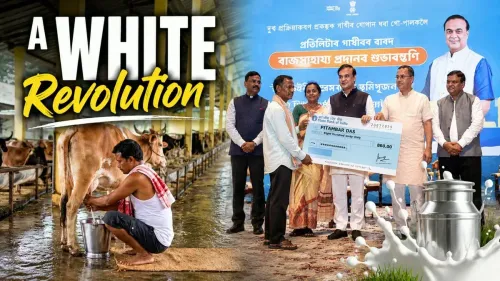
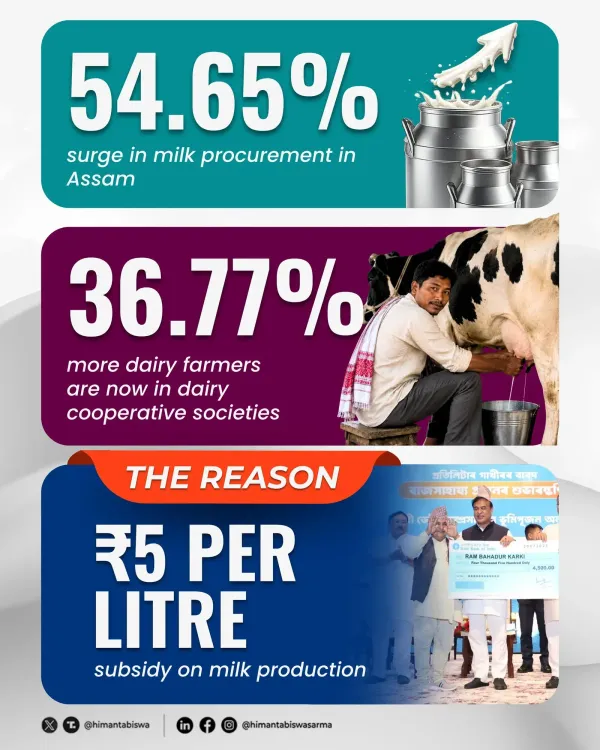
Assam Chief Minister Himanta Biswa Sarma has credited the state's ₹5 per litre milk subsidy with a 54.65% jump in milk procurement and a 36.77% rise in cooperative membership, signalling a significant expansion of the state's dairy ecosystem and rural income support framework.
Key Takeaways
Assam's ₹5 per litre milk subsidy is the policy instrument cited for the dairy sector's recent growth.
Milk procurement in Assam has reportedly surged by 54.65% under the scheme.
Dairy cooperative membership has risen by 36.77% , broadening the state's formal dairy network.
CM Himanta Biswa Sarma announced the figures on 17 July 2026 , framing them as evidence of a strengthened dairy ecosystem.
The scheme aligns with a national pattern of state governments using direct per-litre subsidies to integrate small producers into cooperative channels.
Future budget allocations and potential linkages with NDDB or central dairy schemes will determine the programme's long-term trajectory.
Assam Chief Minister Himanta Biswa Sarma on Friday, 17 July 2026, highlighted the impact of the state's ₹5 per litre milk subsidy, citing a 54.65% surge in milk procurement and a 36.77% rise in cooperative membership as evidence of a strengthening dairy ecosystem in the state.
Context
In his post, CM Sarma stated: 'Our ₹5/litre subsidy has driven a 54.65% surge in milk procurement and a 36.77% increase in cooperative membership, significantly strengthening the dairy ecosystem.' The announcement positions the subsidy as a direct policy lever that has drawn more small producers into formal cooperative channels, a goal that has historically eluded Northeastern India.
Assam has long recorded per-capita milk availability below the national average. The state's push to close that gap through targeted per-litre support reflects a broader sub-national trend of using direct price incentives to integrate marginal dairy farmers into organised supply chains.
Policy Backdrop
India's dairy cooperative architecture traces its origins to Operation Flood, launched in 1970, which created the national framework that states later adapted for local procurement and marketing. The National Dairy Development Board (NDDB), established in 1965, has since served as the statutory backbone supporting state-level milk procurement drives across the country.
More recently, central schemes such as the Rashtriya Gokul Mission have complemented state-level efforts by targeting breed improvement and productivity. Assam's ₹5/litre subsidy fits squarely within this layered policy tradition, adding a direct income-support dimension that incentivises farmers to channel milk through cooperatives rather than informal markets.
Stakeholders and Impact
Dairy farmers and milk cooperatives across Assam are the primary beneficiaries of the scheme. For small and marginal producers — who make up the bulk of the state's dairy workforce — a guaranteed per-litre subsidy reduces price-risk and makes cooperative membership economically attractive.
A 36.77% increase in cooperative membership is significant because it expands the institutional base through which quality standards, veterinary services, and credit can be delivered to rural households. The 54.65% procurement surge, if sustained, would also increase the volume of formally marketed milk, potentially improving food security and rural incomes simultaneously.
What's Next
Attention will now turn to Assam's state budget allocations for 2026-27 to see whether the subsidy is expanded, extended, or linked with NDDB or central dairy development programmes. Any such convergence could unlock matching central funds and technical support, amplifying the scheme's reach.
The data cited by CM Sarma is also likely to feature in the state government's case for continued or enhanced central assistance under national dairy missions, making the political and fiscal stakes of these numbers considerable for Assam's rural economy.
Point of View
Using precise percentage figures to lend credibility to what is fundamentally a rural-welfare and cooperative-strengthening argument. The choice to highlight cooperative membership growth alongside procurement numbers is telling: it signals that the Assam government is not merely chasing volume but is trying to build institutional depth in a region historically underserved by formal dairy networks. This fits a broader BJP-governed state pattern of deploying direct-benefit subsidies and then anchoring them in measurable outcome data ahead of budget cycles and electoral cycles. The real test will be whether the numbers hold up to independent audit and whether the state can sustain the fiscal outlay as procurement volumes — and therefore subsidy payouts — continue to rise.
NationPress
18 Jul 2026
Frequently Asked Questions
What is Assam's milk subsidy scheme?
Assam's milk subsidy scheme provides ₹5 per litre directly to dairy farmers who supply milk through cooperative channels, with the stated aim of boosting procurement volumes and expanding cooperative membership across the state.
How much has milk procurement increased in Assam?
According to CM Himanta Biswa Sarma , milk procurement in Assam has surged by 54.65% since the ₹5/litre subsidy was introduced, though independent verification of this figure is pending.
What has happened to dairy cooperative membership in Assam?
Cooperative membership in Assam's dairy sector has reportedly risen by 36.77% , indicating that more farmers are entering the formal cooperative network as a result of the subsidy incentive.
Why does Assam need a dairy subsidy?
Northeastern India , including Assam, has historically recorded per-capita milk availability below the national average. The subsidy is designed to make cooperative membership financially attractive for small and marginal farmers, integrating them into formal supply chains.
Is the Assam milk subsidy linked to any central government scheme?
The subsidy is a state-level initiative by the Assam government. Potential linkages with the National Dairy Development Board (NDDB) or central programmes such as the Rashtriya Gokul Mission are being watched, particularly in the context of the 2026-27 budget cycle.