Puri hails ₹2,814 Cr Cabinet nod for critical mineral push
Synopsis
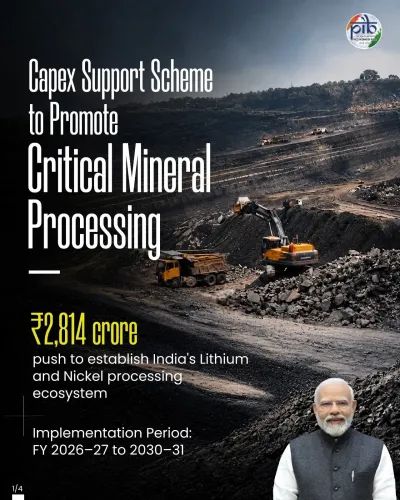
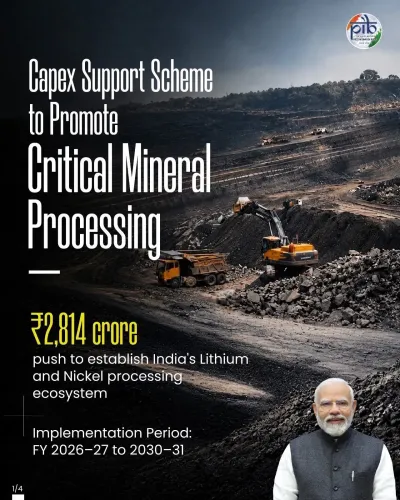
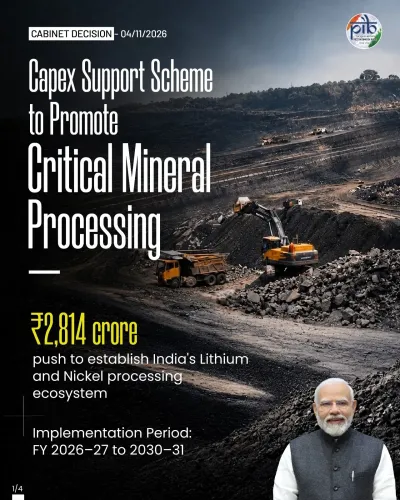
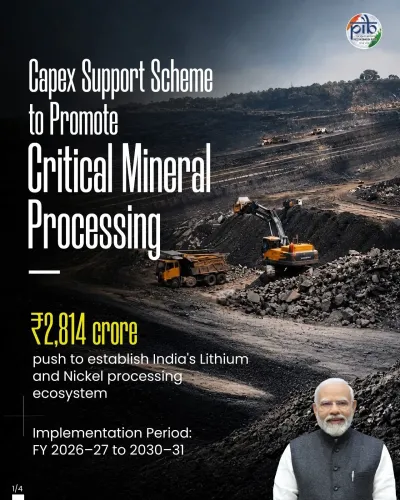
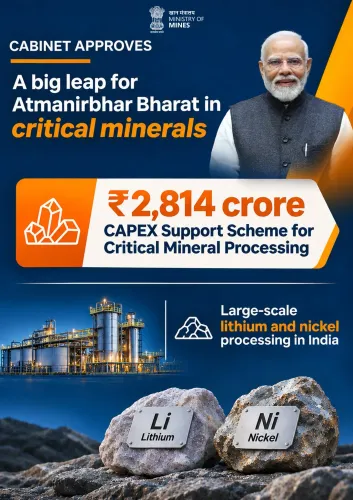
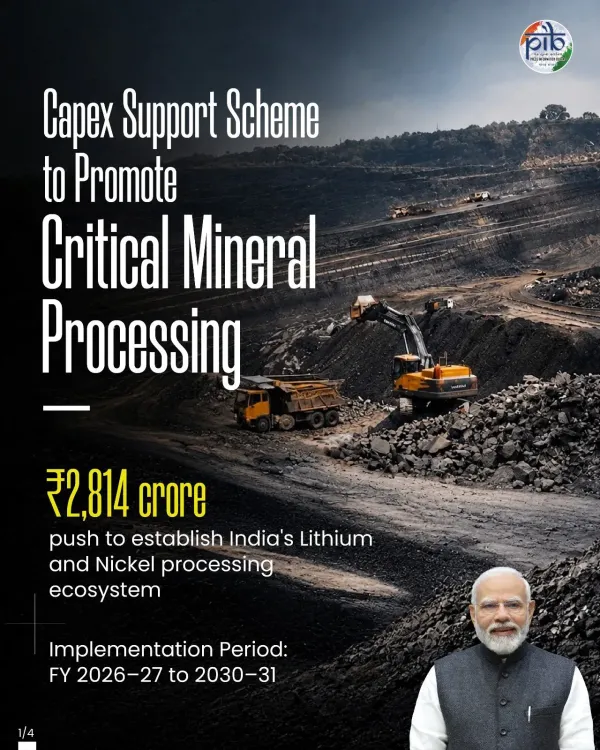
The Union Cabinet under PM Narendra Modi has approved a ₹2,814 crore Capex Support Scheme to accelerate critical mineral processing in India, running from FY 2026-27 to 2030-31. Union Minister Hardeep Singh Puri called it a major step toward self-reliance in critical minerals.
Key Takeaways
The Union Cabinet , chaired by PM Narendra Modi , approved a ₹2,814 crore Capex Support Scheme for critical mineral processing on 4 November 2026 .
The scheme runs from FY 2026-27 to FY 2030-31 , providing a five-year policy horizon for industry investment.
It aims to strengthen domestic processing, manufacturing and technological capabilities in critical minerals.
The move builds on India's 2023 notification of 30 critical minerals earmarked for domestic development.
Key beneficiaries include the mineral processing industry and downstream EV and electronics manufacturers .
Scheme guidelines, project selection criteria and first approvals are expected ahead of the FY 2026-27 rollout .
India's race to secure the building blocks of its clean-energy and electronics future just got a serious financial commitment. Union Petroleum Minister Hardeep Singh Puri on Wednesday, 4 November 2026 announced that the Union Cabinet, chaired by Prime Minister Narendra Modi, has approved a ₹2,814 crore Capex Support Scheme to accelerate domestic critical mineral processing — a sector India has long imported its way through.
Posting in Hindi, Minister Puri described the decision as 'a big step towards self-reliance in critical minerals' (महत्वपूर्ण खनिजों में आत्मनिर्भरता की दिशा में बड़ा कदम), adding that the scheme would strengthen processing capacity, domestic manufacturing and technological capabilities across the value chain. The scheme is slated to run from FY 2026-27 through FY 2030-31 — a full five-year deployment window designed to give investors and industry the policy certainty they need.Why critical minerals sit at the centre of India's industrial future
Critical minerals — think lithium, cobalt, graphite, rare earths — are the unglamorous raw materials that power everything from EV batteries to semiconductors to guided-missile systems. Historically, their processing has been almost entirely concentrated in a handful of nations, leaving supply-chain-dependent economies like India exposed.
New Delhi moved to address this in 2023, when the government notified a list of 30 critical minerals to target for domestic exploration, mining and reduced import dependence. That notification was largely a declaration of intent. The ₹2,814 crore Capex Support Scheme is now the money behind the message — channelling capital expenditure support to players who process these minerals on Indian soil rather than shipping raw ore abroad for value addition elsewhere.
The Atmanirbhar logic and what changes at the factory floor
The scheme sits squarely within the Atmanirbhar Bharat framework — Prime Minister Modi's self-reliance doctrine that has already spawned production-linked incentive schemes for semiconductors, solar panels and pharmaceuticals. Critical minerals are the next frontier: without domestic processing muscle, every EV factory and every defence electronics plant is ultimately dependent on a foreign chokepoint.
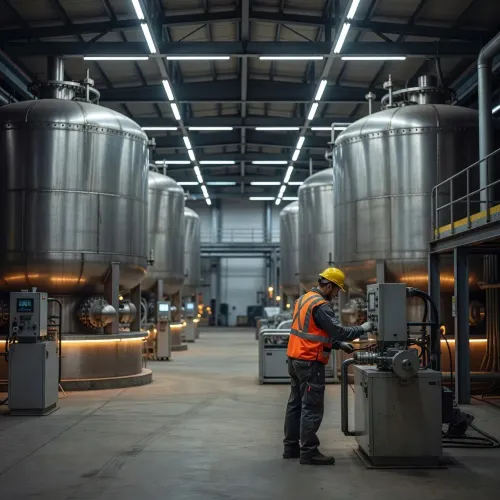
For the mineral processing industry and downstream EV and electronics manufacturers, the capex support changes the arithmetic of setting up local refining and processing operations — costs that have historically made it cheaper to simply import finished precursor materials. The five-year horizon through 2030-31 aligns with India's broader EV adoption targets and global clean-energy transition timelines.
Scheme rollout: what to watch before April 2027
The Cabinet approval is the starting gun, not the finish line. Scheme guidelines, project selection criteria and the first round of approvals are all expected to be fleshed out ahead of the FY 2026-27 rollout. How the government defines eligible processing activities, sets disbursement milestones and attracts private capital alongside the public capex support will determine whether the ₹2,814 crore commitment translates into functional refining capacity — or remains a headline figure.
India is not alone in this race: the United States, the European Union, Japan and Australia have each launched their own critical-mineral security programmes. The Cabinet decision signals that New Delhi intends to be a processor and manufacturer in this space, not merely a consumer reliant on rivals' supply chains.
The minerals that power tomorrow's economy are being claimed today — and India has just put ₹2,814 crore on the table to make sure it has a seat at that table.
Point of View
814 crore critical mineral capex scheme represents a meaningful escalation in India's industrial self-reliance strategy — moving from mapping minerals on paper to subsidising the processing plants that turn raw ore into economic leverage. It follows a recognisable BJP policy template: declare intent through a framework (the 2023 critical minerals list), then follow with a targeted financial instrument (PLI-style capex support). The five-year window is calibrated to India's EV and green-energy timelines, and the geopolitical subtext is hard to miss — global critical-mineral supply chains are being redrawn, and India is signalling it wants upstream industrial capacity, not just downstream dependence. Execution risk — specifically, whether capex support translates into operational processing facilities rather than stranded assets — will be the real test.
NationPress
4 Nov 2026
Frequently Asked Questions
What is the Cabinet-approved critical mineral processing scheme?
The Union Cabinet approved a ₹2,814 crore Capex Support Scheme on 4 November 2026 to promote domestic critical mineral processing, manufacturing and technology development in India from FY 2026-27 to 2030-31.
What are critical minerals and why does India need them?
Critical minerals such as lithium, cobalt, graphite and rare earths are essential for EV batteries, electronics and defence equipment. India currently relies heavily on imports for processed forms of these minerals, creating supply-chain vulnerabilities the new scheme aims to reduce.
How much money has the government allocated for critical minerals?
The Union Cabinet has approved ₹2,814 crore in capital expenditure support specifically for critical mineral processing activities over five financial years from 2026-27 to 2030-31.
Who will benefit from the critical mineral capex scheme?
The primary beneficiaries are companies in the mineral processing industry and downstream manufacturers in the EV and electronics sectors who set up or expand critical mineral processing operations within India.
When will the critical mineral processing scheme be implemented?
The scheme is set to be implemented from FY 2026-27, with detailed guidelines and project selection criteria expected to be announced before the rollout. It will run through FY 2030-31.