Cabinet Clears ₹62,500 Cr Mobile Phone Manufacturing Scheme
Synopsis
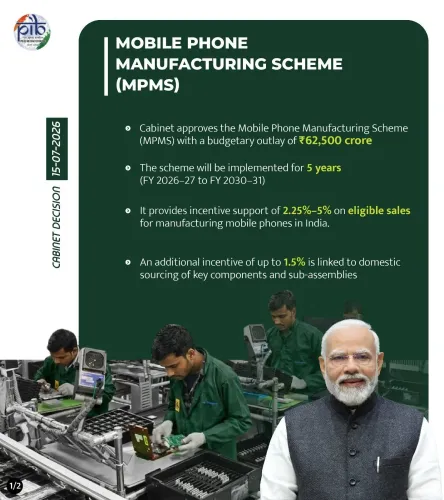
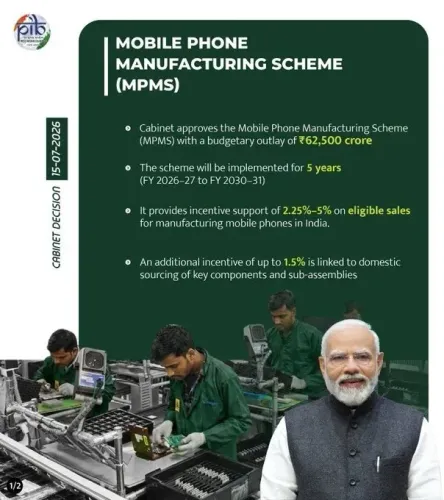
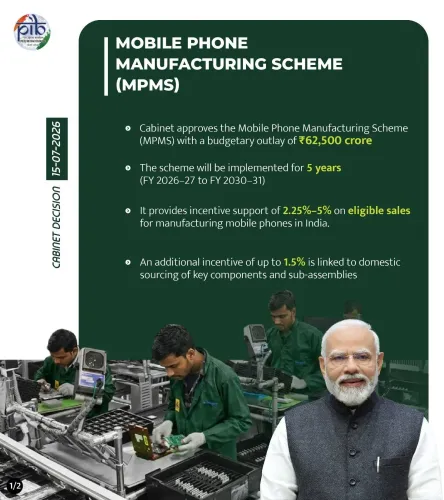
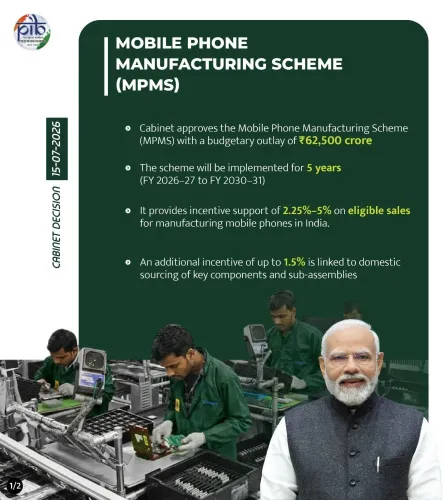
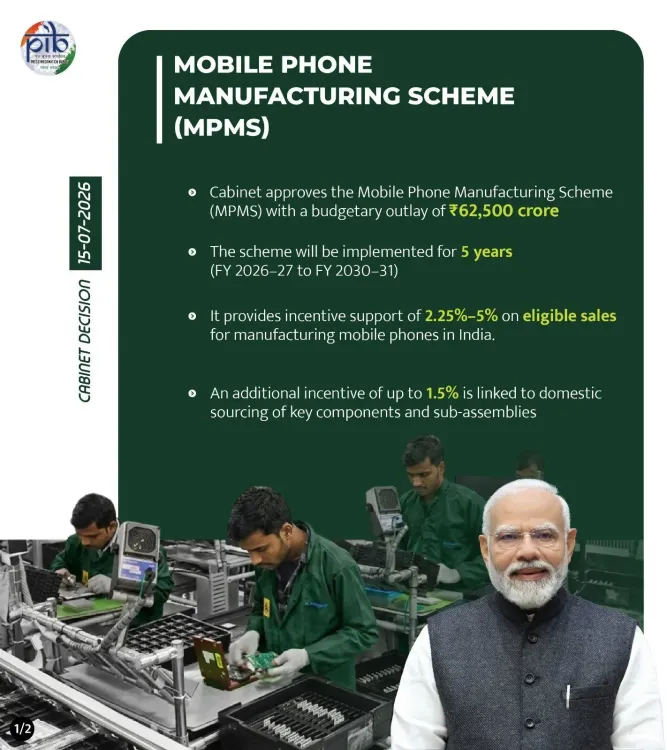
The Union Cabinet has approved the Mobile Phone Manufacturing Scheme with a ₹62,500 crore outlay for FY 2026–27 to 2030–31, offering performance-linked incentives of 2.25%–5% on eligible sales to deepen domestic value addition, build supply chain resilience, and promote Indian brands and technological sovereignty.
Key Takeaways
The Union Cabinet, chaired by PM Narendra Modi , approved the Mobile Phone Manufacturing Scheme (MPMS) on 15 July 2026 .
The scheme carries a budgetary outlay of ₹62,500 crore and runs from FY 2026–27 to FY 2030–31 — a five-year horizon.
Performance-linked incentives on eligible sales will range from 2.25% to 5% , tied to manufacturing output and domestic value addition.
The MPMS explicitly targets technological sovereignty , Indian brand development, and patent creation through indigenous design and R&D.
The scheme succeeds the 2020 PLI scheme for mobile manufacturing, which carried an outlay of approximately ₹41,000 crore , raising the financial commitment by over ₹21,000 crore.
Roll-out guidelines and beneficiary selection are expected to be finalised by MeitY ahead of the scheme's first year.
Union Road Transport and Highways Minister Nitin Gadkari announced on Wednesday, 15 July 2026 that the Union Cabinet, chaired by Prime Minister Narendra Modi, has approved the Mobile Phone Manufacturing Scheme (MPMS) with a budgetary outlay of ₹62,500 crore, to be implemented over five years from FY 2026–27 to FY 2030–31.
Context
Gadkari shared the cabinet decision on X, stating that the scheme aims 'to scale up mobile phone manufacturing, deepen domestic value addition, strengthen supply chain resilience, and enhance India's global competitiveness.' The scheme also targets fostering Indian brands, promoting technological sovereignty, and encouraging innovation through 'indigenous design, R&D, and patent creation.'
Performance-linked incentives on eligible sales will be offered at rates ranging from 2.25% to 5%, rewarding manufacturers based on output and domestic value addition benchmarks.
Policy Backdrop
The MPMS builds on India's earlier Production Linked Incentive (PLI) scheme for mobile manufacturing, approved in 2020 with an outlay of approximately ₹41,000 crore. That scheme attracted investment from global assembly units and helped India sharply increase mobile phone production volumes and exports under the Atmanirbhar Bharat framework.
The new scheme substantially raises the financial commitment — by over ₹21,000 crore — and shifts the emphasis beyond assembly toward deeper supply chain integration, indigenous design, and intellectual property creation. Where the 2020 PLI primarily targeted scale, the MPMS explicitly sets technological sovereignty as a policy goal.
India has rolled out sector-specific incentive schemes across electronics, pharmaceuticals, textiles, and other industries since 2020, seeking to reduce import dependence and position the country as a global manufacturing hub. The mobile phone sector has been a flagship of this effort, with production value rising significantly over the past five years.
Stakeholders and Impact
The scheme's primary beneficiaries will be mobile phone manufacturers and electronics component suppliers operating in India. By linking incentives to eligible sales, the MPMS is designed to reward firms that invest in domestic production capacity and move up the value chain from assembly to component and design-level manufacturing.
The push for Indian brands and indigenous R&D signals an intent to nurture homegrown champions alongside established global players. Patent creation is explicitly cited as an objective, suggesting the government wants India to move from a manufacturing destination to an innovation origin in the mobile technology space.
For consumers and the broader economy, a deeper domestic supply chain could reduce the country's dependence on imported components — particularly from China — and improve resilience against global supply disruptions of the kind seen during the COVID-19 pandemic.
What's Next
Implementation details, including roll-out guidelines and beneficiary selection criteria, are expected to be finalised by the Ministry of Electronics and Information Technology (MeitY), which oversees the electronics manufacturing policy portfolio. Annual reviews of value-addition and export targets are anticipated once the scheme's first year, FY 2026–27, gets under way.
The scheme's success will hinge on whether manufacturers deepen localisation beyond final assembly and whether Indian brands can gain meaningful market share — both domestically and in export markets — by FY 2030–31.
Point of View
R&D, and patent creation. The near-₹63,000 crore commitment signals that the government views mobile manufacturing as a strategic, not merely economic, priority in its Atmanirbhar Bharat arc. The inclusion of technological sovereignty as a stated goal is notable: it aligns the scheme with broader geopolitical currents around supply chain de-risking and reduced dependence on Chinese components. Whether the incentive structure is sufficient to catalyse genuine deep-tech investment — rather than incremental assembly expansion — will be the central question for analysts tracking the scheme's five-year trajectory.
NationPress
15 Jul 2026
Frequently Asked Questions
What is the Mobile Phone Manufacturing Scheme (MPMS)?
The MPMS is a Union Cabinet-approved scheme with a ₹62,500 crore outlay, running from FY 2026–27 to FY 2030–31, that offers performance-linked incentives of 2.25%–5% on eligible sales to boost mobile phone manufacturing, domestic value addition, and indigenous R&D in India.
How much money has the government allocated for the MPMS?
The government has allocated a budgetary outlay of ₹62,500 crore for the Mobile Phone Manufacturing Scheme, to be disbursed over five financial years from 2026–27 to 2030–31.
How is the MPMS different from the earlier PLI scheme for mobile phones?
The earlier PLI scheme approved in 2020 had an outlay of approximately ₹41,000 crore and focused primarily on scaling up mobile phone assembly. The MPMS raises the financial commitment by over ₹21,000 crore and additionally targets supply chain resilience, indigenous design, patent creation, and the development of Indian mobile brands.
Who will benefit from the Mobile Phone Manufacturing Scheme?
Mobile phone manufacturers and electronics component suppliers operating in India are the primary beneficiaries. The scheme also aims to nurture Indian brands and firms investing in indigenous R&D and design capabilities.
When will the MPMS be implemented and who oversees it?
The scheme runs from FY 2026–27 to FY 2030–31. The Ministry of Electronics and Information Technology (MeitY) is expected to finalise roll-out guidelines and beneficiary selection criteria, with annual reviews of value-addition and export targets planned throughout the period.