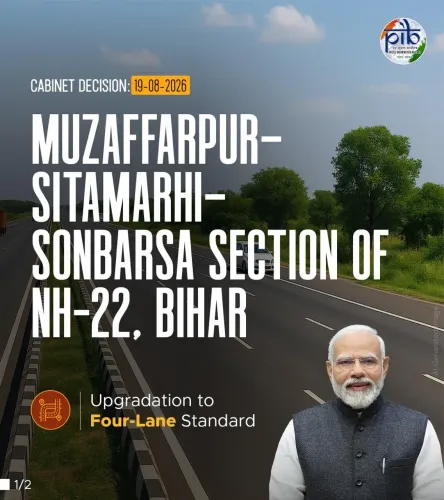
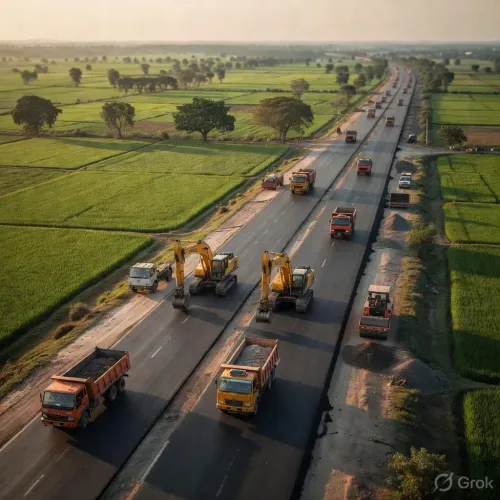
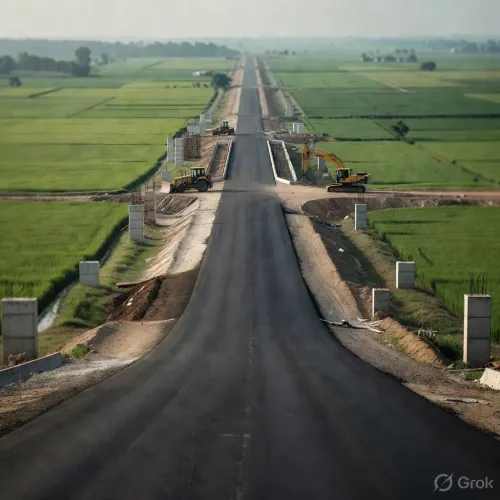
Bihar NH-22 four-laning: Cabinet clears ₹3,590 crore Muzaffarpur-Sitamarhi-Sonbarsa project
Synopsis
The Centre has cleared a ₹3,590.73 crore upgrade of 82.578 km of NH-22 in Bihar, four-laning the Muzaffarpur–Sitamarhi–Sonbarsa corridor that links the India–Nepal border to the East–West freight grid. The project targets congestion relief across seven towns and integrates five Gati-Shakti economic nodes — making it as much a trade corridor as a road project.
Key Takeaways
The CCEA , chaired by PM Narendra Modi , approved the project on 19 August at a cost of ₹3,590.73 crore .
The four-laning covers 82.578 km of NH-22 from Muzaffarpur to Sonbarsa on the India–Nepal border .
Seven towns — including Muzaffarpur , Runni Saidpur , and Dumra — will see significant congestion relief.
Infrastructure includes 7 major bridges , a 340-metre Bagmati River bridge , 3 ROBs , and 2 flyovers .
The corridor connects 5 PM Gati-Shakti Economic Nodes , 4 Social Nodes , and 2 Logistic Nodes .
Design speed is 100 kmph with an average operating speed of 80 kmph , with no at-grade median openings.
The Cabinet Committee on Economic Affairs (CCEA), chaired by Prime Minister Narendra Modi, on Wednesday, 19 August approved the four-laning of an 82.578 km stretch of the Muzaffarpur–Sitamarhi–Sonbarsa section of NH-22 in Bihar, at a total capital outlay of ₹3,590.73 crore. The project is designed to decongest key urban corridors and strengthen the state's freight and passenger connectivity with the India–Nepal border at Sonbarsa.
Strategic Importance of the Corridor
The upgraded highway will serve as a critical feeder route linking the India–Nepal border at Sonbarsa to Muzaffarpur on NH-27, part of the East–West Corridor. According to an official Cabinet communique, the stretch 'holds significant strategic and economic relevance, ensuring seamless linkage to the national freight grid.'
The corridor also bolsters cross-border trade and passenger movement through the Land Port at Bhithamore, and enhances access to industrial zones including Barauni and riverine logistics hubs in the region.
Congestion Relief for Key Towns
The project is expected to significantly ease traffic pressure in densely populated areas along the route — including Muzaffarpur, Muksudpur, Runni Saidpur, Thumma, Dumra, Bhutahi, and Sonbarsa. The four-lane design, with no at-grade median openings, has been planned for a top speed of 100 kmph and an average operating speed of 80 kmph.
Infrastructure and Engineering Features
The project includes seven major bridges — among them a 340-metre-long bridge over the Bagmati River — along with three Railway Over Bridges (ROBs) and two flyovers to ensure uninterrupted cross-traffic movement and safe high-speed travel.
Economic Nodes and Social Connectivity
Beyond freight, the upgraded corridor will improve access to five PM Gati-Shakti Economic Nodes, comprising four Industrial Estates and one Mega Food Park. It also connects four Social Nodes — Baba Garibnath Temple, Mata Janki Temple, Punaura Dham, and the aspirational districts of Muzaffarpur and Sitamarhi — along with two Logistic Nodes at Muzaffarpur and Sitamarhi Railway Stations.
The route also supports agricultural supply chains and provides better access to cultural destinations including the Buddhist Circuit and the historic Janaki Punaura Dham Temple in Sitamarhi. This approval is part of the Centre's broader push to integrate Bihar's highway network with national economic corridors ahead of the next infrastructure cycle.
Point of View
And this approval addresses a genuine bottleneck — the Muzaffarpur–Sonbarsa corridor is one of the busiest undivided stretches feeding the Nepal border trade. What makes this project more than routine highway spending is its explicit integration with Gati-Shakti nodes: linking industrial estates, food parks, and railway logistics hubs in a single corridor design is a structural upgrade over earlier standalone road projects. The real measure of success, however, will be execution speed — Bihar has historically seen cost overruns and land acquisition delays on highway projects of this scale. Whether the ₹3,590 crore outlay translates into on-time delivery will determine how much of the projected economic benefit actually materialises.
NationPress
5 Oct 2026
Frequently Asked Questions
What is the Bihar NH-22 four-laning project approved by the Cabinet?
It is a ₹3,590.73 crore project to upgrade 82.578 km of the Muzaffarpur–Sitamarhi–Sonbarsa section of NH-22 to a four-lane highway. Approved by the CCEA on 19 August, the project aims to ease congestion across seven towns and strengthen connectivity with the India–Nepal border at Sonbarsa.
How does the NH-22 project benefit trade with Nepal?
The upgraded corridor serves as a direct feeder route from the India–Nepal border at Sonbarsa to Muzaffarpur on NH-27, the East–West Corridor. It also strengthens cross-border cargo and passenger movement via the Land Port at Bhithamore, supporting bilateral trade flows.
Which towns will see congestion relief from the NH-22 upgrade?
According to the Cabinet, the project will significantly reduce congestion in Muzaffarpur, Muksudpur, Runni Saidpur, Thumma, Dumra, Bhutahi, and Sonbarsa — all densely populated areas along the existing undivided stretch.
What infrastructure is included in the NH-22 project?
The project includes seven major bridges — including a 340-metre bridge over the Bagmati River — three Railway Over Bridges, and two flyovers. The highway is designed for a top speed of 100 kmph with no at-grade median openings.
How does the project connect to PM Gati-Shakti nodes?
The upgraded NH-22 corridor links five PM Gati-Shakti Economic Nodes (four Industrial Estates and one Mega Food Park), four Social Nodes including religious sites in Muzaffarpur and Sitamarhi, and two Logistic Nodes at Muzaffarpur and Sitamarhi Railway Stations.