Cabinet Clears Rs 6,969 Cr Dwarka Expressway Tunnel for Delhi
Synopsis
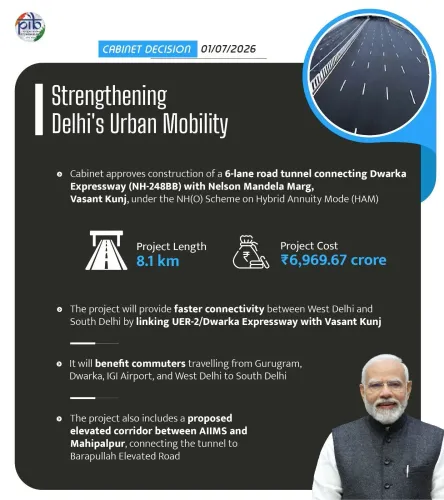
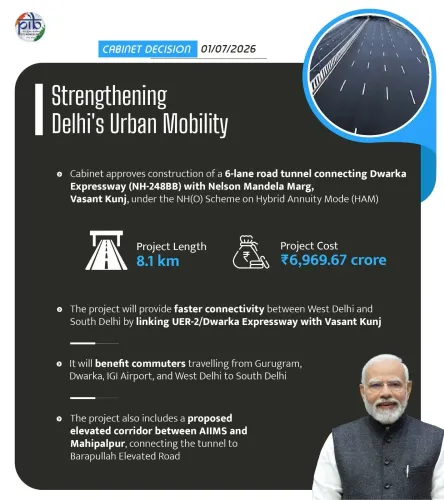
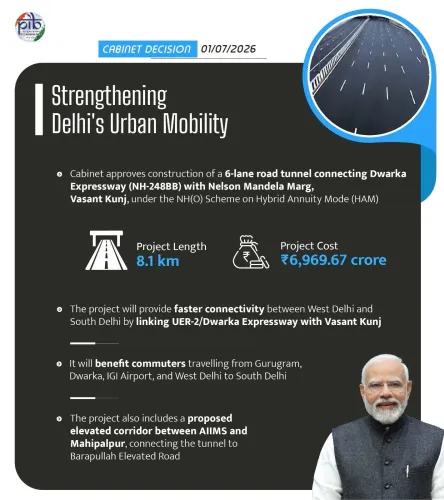
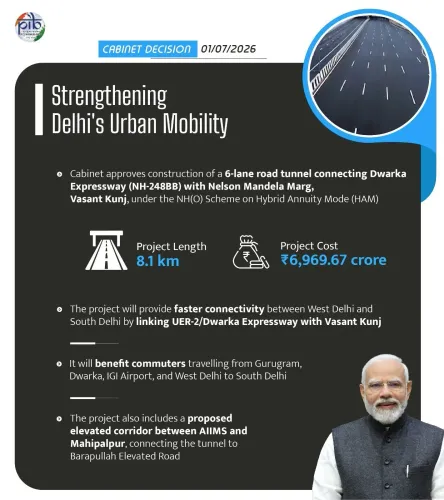
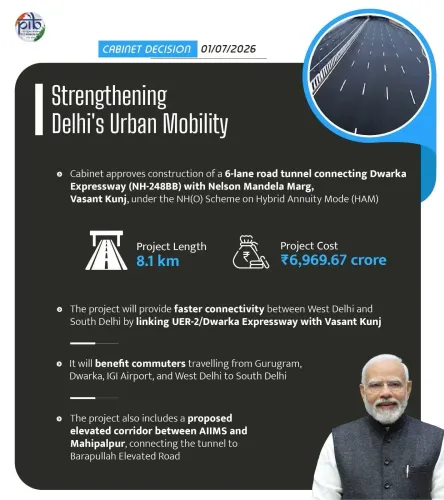
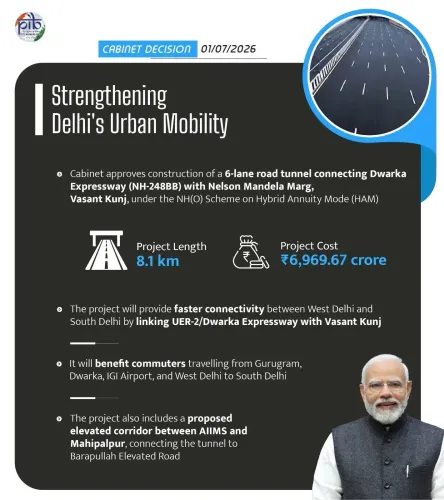
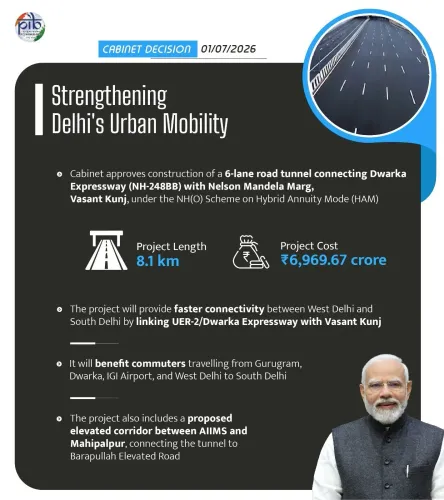
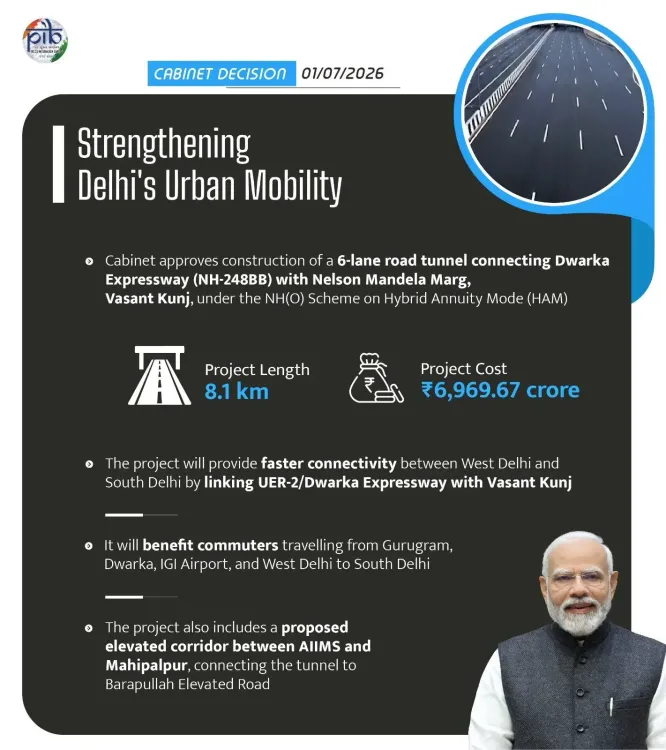
The Union Cabinet on 1 July 2026 approved an 8.1 km, 6-lane twin-tube tunnel linking Dwarka Expressway (NH-248BB) to Nelson Mandela Marg in Vasant Kunj at Rs 6,969.67 crore, aiming to ease travel between west and south Delhi while preserving the Southern Ridge forest.
Key Takeaways
The Union Cabinet approved a 6-lane, 8.1 km twin-tube underground tunnel connecting Dwarka Expressway (NH-248BB) to Nelson Mandela Marg, Vasant Kunj on 1 July 2026 .
The project carries an estimated cost of Rs 6,969.67 crore .
The tunnel will improve travel for commuters from Gurugram, Dwarka, IGI Airport and western Delhi to south Delhi.
The underground alignment is designed to protect Delhi's Southern Ridge forest zone from surface disruption.
A proposed AIIMS-to-Mahipalpur elevated corridor will link the tunnel to the existing Barapulla Elevated Road , completing a wider connectivity loop.
The project is expected to generate employment and advance the government's Viksit Bharat development agenda.
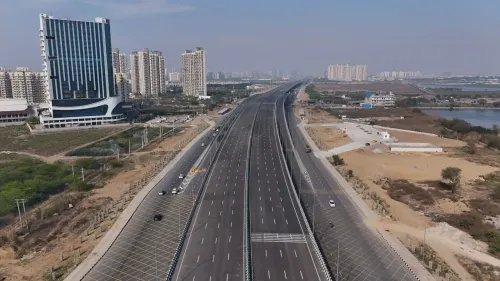
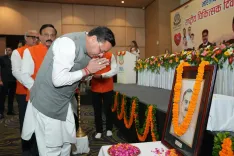
Union Agriculture Minister Shivraj Singh Chouhan announced on Wednesday, 1 July 2026 that the Union Cabinet, under the leadership of Prime Minister Narendra Modi, has approved a major underground road tunnel project linking Dwarka Expressway (NH-248BB) to Nelson Mandela Marg in Vasant Kunj, aimed at transforming east-west and north-south connectivity across Delhi-NCR.
Context
The approved project involves an 8.1 kilometre, 6-lane twin-tube underground tunnel at an estimated cost of Rs 6,969.67 crore. Chouhan stated that the tunnel will make travel between west and south Delhi faster, smoother and safer, with direct benefits for commuters from Gurugram, Dwarka, Indira Gandhi International (IGI) Airport and western Delhi heading to south Delhi. In his post on X, the minister described the project as 'aatyadhunik pariyojana' — an ultra-modern project — that will give new momentum to better connectivity, employment generation and the vision of a 'Viksit Bharat' (Developed India).
Policy Backdrop
The approval builds on the Bharatmala Pariyojana, launched in 2017, which has driven accelerated national highway and expressway development across the country, including multiple NCR corridors. Earlier cabinet approvals for phases of the Dwarka Expressway were granted between 2018 and 2021 as part of a broader urban decongestation strategy for the National Capital Region. The choice of a twin-tube underground alignment reflects a deliberate policy to reconcile highway expansion with the protection of Delhi's Southern Ridge, a notified forest zone that surface-level construction would have disturbed. Chouhan noted that the tunnel design preserves the Southern Ridge forest area, making it 'a powerful symbol of the balance between development and environment.'
Stakeholders and Impact
The project is expected to benefit millions of daily commuters across Delhi-NCR, including residents of Gurugram and Dwarka, frequent flyers using IGI Airport, and patients and staff at AIIMS. A proposed elevated corridor from AIIMS to Mahipalpur will connect the new tunnel to the existing Barapulla Elevated Road, further strengthening south Delhi's integration with the wider NCR network. The project is also expected to generate significant employment during both construction and operational phases, a point Chouhan highlighted explicitly in his announcement.
What's Next
Execution will be overseen by the National Highways Authority of India (NHAI), with construction timelines and land acquisition processes to be finalised in the coming months. The integration milestone to watch is the completion of the AIIMS-Mahipalpur elevated corridor, which is critical to realising the full connectivity loop between the new tunnel and the Barapulla network. Parliamentary updates and NHAI progress reports will indicate whether the project stays on schedule within its approved cost envelope of Rs 6,969.67 crore.
Point of View
The government sidesteps a politically and legally sensitive flashpoint while still delivering a headline connectivity win ahead of what are likely to be active electoral cycles in Delhi-NCR. The linkage to Barapulla and the AIIMS-Mahipalpur corridor signals an intent to create a continuous elevated-and-underground spine across south and west Delhi — an ambition whose real test will be execution speed and cost discipline on a project of this scale and complexity.
NationPress
1 Jul 2026
Frequently Asked Questions
What is the Dwarka Expressway tunnel project approved by the Cabinet?
The Union Cabinet approved an 8.1 km, 6-lane twin-tube underground tunnel connecting Dwarka Expressway (NH-248BB) to Nelson Mandela Marg in Vasant Kunj, south Delhi, at an estimated cost of Rs 6,969.67 crore.
How much will the Dwarka Expressway tunnel cost?
The approved project cost is Rs 6,969.67 crore, as announced following the Union Cabinet meeting on 1 July 2026.
How will the tunnel help commuters from Gurugram and IGI Airport?
The tunnel will provide a faster and smoother underground route from Dwarka Expressway — the main corridor for Gurugram and IGI Airport traffic — directly into south Delhi via Nelson Mandela Marg, cutting travel time significantly.
Will the tunnel affect Delhi's Southern Ridge forest?
No. The twin-tube underground design is specifically intended to pass beneath the Southern Ridge protected forest area without disturbing it, balancing infrastructure development with environmental conservation.
What is the AIIMS-Mahipalpur elevated corridor and how does it connect to this tunnel?
The proposed AIIMS-to-Mahipalpur elevated corridor is a planned road structure that will link the new Dwarka Expressway tunnel to the existing Barapulla Elevated Road, creating a continuous connectivity corridor across south and west Delhi-NCR.