CM Yogi backs Cabinet's 5-year FTSC extension for rape, POCSO trials

Synopsis
The Union Cabinet on 4 November 2026 extended the Fast Track Special Courts scheme — covering 1,023 courts including 389 exclusive POCSO courts — for five years to March 2031. UP Chief Minister Yogi Adityanath publicly welcomed the decision as a landmark step for women's and children's justice.
Key Takeaways
The Union Cabinet approved continuation of the Fast Track Special Courts (FTSCs) centrally sponsored scheme for five years , from 1 April 2026 to 31 March 2031 .
The scheme covers 1,023 Fast Track Special Courts including 389 exclusive POCSO courts , first sanctioned in 2019 under the Nirbhaya Fund framework.
Exclusive POCSO courts handle only cases under the Protection of Children from Sexual Offences Act, 2012 , ensuring child-friendly, time-bound trial procedures.
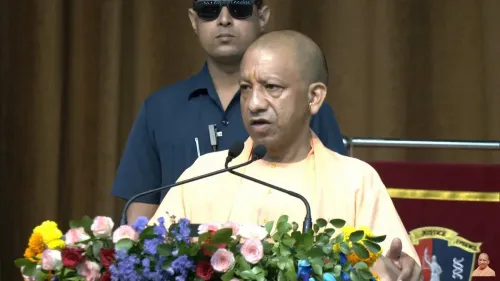
UP Chief Minister Yogi Adityanath publicly welcomed the Cabinet decision and thanked PM Narendra Modi for the step toward protecting women's and children's rights.
State governments, including Uttar Pradesh, will be responsible for operationalising courts and reporting case-disposal timelines to the Department of Justice from April 2026.
India's most backlogged court dockets carry a grim category: rape and child sexual abuse cases where survivors wait years, sometimes decades, for a verdict. On Wednesday, 4 November 2026, the Union Cabinet moved to cut that wait — approving a five-year extension of the Fast Track Special Courts scheme — and Uttar Pradesh Chief Minister Yogi Adityanath was quick to publicly welcome the decision.
Posting on X in Hindi, CM Yogi wrote that Prime Minister Narendra Modi's cabinet had approved continuation of the centrally sponsored Fast Track Special Courts (FTSCs) scheme — including exclusive POCSO courts — for the period 1 April 2026 to 31 March 2031. He called the decision 'abhinavdaniya' (commendable) and said it would play a crucial role in the swift disposal of rape and POCSO cases, making the judicial process more effective. 'I express heartfelt gratitude to the Prime Minister for this important decision in the direction of protecting women's and children's rights,' he wrote.
What the FTSC scheme does — and why it was born
The Fast Track Special Courts programme was originally carved out of the Nirbhaya Fund in 2019, following years of pressure on the government after the 2012 gang-rape case that shocked the country and triggered sweeping criminal law amendments. The initial Cabinet sanction established 1,023 Fast Track Special Courts, of which 389 were exclusive POCSO courts — dedicated entirely to offences under the Protection of Children from Sexual Offences Act, 2012.
The logic was simple and urgent: mainstream session courts, drowning in general pendency, were ill-equipped to deliver the time-bound trials that POCSO and amended rape laws now mandated. Dedicated courts, ring-fenced funding, and specialised staff were meant to break that bottleneck. The scheme ran on periodic Cabinet renewals after the initial three-year window; Wednesday's approval pushes the runway out by a full five years.
POCSO at the centre — protecting children in court
The POCSO Act was designed with one explicit promise to child survivors: child-friendly procedures, in-camera trials, and time-bound justice. Exclusive POCSO courts take that promise further — removing child sexual offence cases from the general docket entirely and placing them before judges who handle nothing else. The five-year extension signals that the Centre considers this dedicated-infrastructure model the long-term answer, not a stopgap.
For Uttar Pradesh — India's most populous state and one with significant case volumes in this category — the continuation carries direct administrative weight. State governments are expected to operationalise the courts, report case-disposal data to the Department of Justice, and draw down central funds against performance benchmarks. How quickly UP moves on that front, starting April 2026, will be a concrete test of the rhetoric.
A pattern of judicial infrastructure as a political signal
CM Yogi's post is part of a consistent pattern: BJP-governed states and their leaders publicly amplifying central decisions on women's safety as evidence of governance commitment. The move also arrives in the context of persistent criticism that conviction rates in POCSO and rape cases remain low despite dedicated courts — a challenge that infrastructure alone cannot solve but that the scheme's proponents argue is better addressed from a position of court availability than without it.
The five-year horizon — running to March 2031 — gives states a planning window long enough to hire, train, and embed specialised prosecutors and support staff. Whether that window translates into measurably faster justice for survivors is the question the scheme's next review cycle will have to answer.
Point of View
Public endorsement by CM Yogi serves a dual purpose: it reinforces the party's women's-safety narrative ahead of a long election cycle and creates a performance benchmark that the state will now be held to. The scheme's real test, however, lies not in its extension but in conviction rates and disposal timelines — metrics that infrastructure investments alone have historically struggled to move without parallel reforms in prosecution quality and survivor support services.
NationPress
5 Nov 2026
Frequently Asked Questions
What are Fast Track Special Courts for POCSO cases?
Fast Track Special Courts (FTSCs) are dedicated courts set up under a central government scheme to ensure time-bound trials in rape and POCSO (child sexual abuse) cases, removing them from overloaded general court dockets.
How long has the Fast Track Special Courts scheme been extended?
The Union Cabinet approved a five-year extension of the scheme, covering the period from 1 April 2026 to 31 March 2031 .
How many Fast Track Special Courts exist under this scheme?
The scheme originally sanctioned 1,023 Fast Track Special Courts , including 389 exclusive POCSO courts , when it was first approved in 2019 under the Nirbhaya Fund.
What is the POCSO Act?
The Protection of Children from Sexual Offences (POCSO) Act was enacted in 2012 to specifically address sexual offences against children, mandating child-friendly procedures, in-camera trials, and time-bound justice.
What did CM Yogi Adityanath say about the FTSC scheme extension?
CM Yogi called the Cabinet decision 'commendable' and said it would play a crucial role in the swift disposal of rape and POCSO cases, also expressing gratitude to PM Modi for the step toward protecting women's and children's rights.