Cabinet clears 4 railway projects worth ₹9,450 crore, adds 410 km by 2031
Synopsis
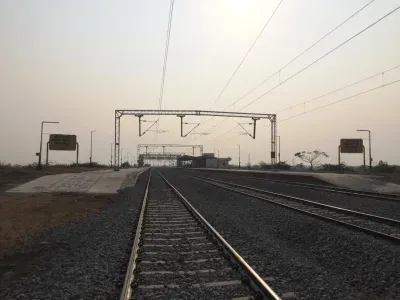
The CCEA has cleared four railway multi-tracking projects worth ₹9,450 crore that will add 410 km of new lines across four states by 2030-31. The corridors are set to unlock 76 MTPA of additional freight capacity and connect 6,448 villages — making this one of the larger single-batch rail capacity approvals of the year.
Key Takeaways
The CCEA , chaired by PM Modi , approved four multi-tracking railway projects worth ₹9,450 crore on 19 August .
The projects will add approximately 410 km of new lines across West Bengal , Odisha , Andhra Pradesh , and Tamil Nadu .
All four projects are targeted for completion by 2030-31 .
Additional freight capacity of 76 MTPA is projected, covering coal, iron ore, steel, and other commodities.
An estimated 60 lakh people across 6,448 villages and eight districts stand to benefit from improved connectivity.
The projects are expected to reduce oil imports by 13 crore litres and cut CO2 emissions by 65 crore kg .
The Cabinet Committee on Economic Affairs (CCEA), chaired by Prime Minister Narendra Modi, on Wednesday, 19 August approved four multi-tracking railway projects with a combined investment of ₹9,450 crore, targeting completion by 2030-31. The projects span 410 km across West Bengal, Odisha, Andhra Pradesh, and Tamil Nadu, and are expected to benefit an estimated 60 lakh people across approximately 6,448 villages.
The Four Projects at a Glance
The first project covers a 4th line on the Kharagpur–Bhadrak (Ranital) corridor stretching 173 km across West Bengal and Odisha. The second adds a 4th line on the Bhadrak–Haridaspur route, covering 75 km entirely within Odisha.
The third project lays a 3rd and 4th line on the Gummidipundi–Gudur stretch of 90 km, spanning Andhra Pradesh and Tamil Nadu. The fourth adds a 3rd and 4th line on the Cuttack–Paradeep (Badabandha) route, a 72 km corridor in Odisha. Together, the four corridors cover eight districts across the four states.
Capacity and Freight Impact
According to the Cabinet communiqué, the multi-tracking works are designed to alleviate congestion on some of India's busiest freight corridors. The capacity augmentation is projected to generate additional freight traffic of 76 MTPA (Million Tonnes Per Annum), handling commodities including coal, iron ore, cement, steel, containers, automobiles, and food grains.
The projects are aligned with the PM Gati Shakti National Master Plan, which emphasises integrated multi-modal connectivity and logistics efficiency. Officials said the enhanced capacity will cut logistics costs, reduce oil imports by approximately 13 crore litres, and lower CO2 emissions by around 65 crore kg — equivalent, according to the statement, to planting 2.60 crore trees.
Connectivity to Villages and Tourist Sites
Beyond freight, the projects are expected to improve passenger connectivity to several prominent destinations. The Cabinet statement listed tourist and religious sites including the Kuldiha Wildlife Sanctuary, Bhitarkanika National Park, Maa Bhadrakali Temple, Panchalingeswar Temple, Chandipur Beach, Pulicat Lake, Nelapattu Bird Sanctuary, Lord Veeraraghava Perumal Temple, and the Buddhist heritage site at Lalitgiri, among others.
This comes amid a broader push by the Centre to expand Indian Railways' network capacity ahead of projected freight and passenger demand growth through 2030. Multi-tracking projects have been a consistent feature of CCEA approvals over the past two years, as congestion on legacy single and double-track corridors has constrained throughput on key industrial routes.
Employment and Regional Development
The government said the projects are consistent with Prime Minister Modi's vision of making communities in the region 'Atmanirbhar' through infrastructure-led development. The statement cited enhanced employment opportunities during construction and increased economic activity post-commissioning as key social benefits across the eight districts covered.
With a 2030-31 completion target, the projects now move to detailed execution planning. Industry observers will watch whether disbursement timelines and contractor mobilisation keep pace with the stated deadline — a persistent challenge in large rail infrastructure programmes.
Point of View
450 crore approval is significant in scale but not unusual in pattern — the CCEA has been clearing multi-tracking batches at a steady clip, reflecting the Centre's recognition that single and double-track bottlenecks are throttling freight growth. The 76 MTPA freight projection is the number to watch: Indian Railways has a history of capacity additions that outpace actual traffic ramp-up, particularly where port and road connectivity at either end remains incomplete. The Cuttack–Paradeep corridor is the most commercially sensitive of the four, given Paradeep Port's rising bulk cargo volumes. Whether these projects actually compress logistics costs will depend as much on last-mile port integration as on the rail lines themselves.
NationPress
19 Aug 2026
Frequently Asked Questions
What are the four railway projects approved by the Cabinet?
The Cabinet approved a 4th line on the Kharagpur–Bhadrak (Ranital) corridor (173 km), a 4th line on Bhadrak–Haridaspur (75 km), a 3rd and 4th line on Gummidipundi–Gudur (90 km), and a 3rd and 4th line on Cuttack–Paradeep (72 km). Together they add approximately 410 km of new track across West Bengal, Odisha, Andhra Pradesh, and Tamil Nadu.
What is the total investment and completion timeline?
The four projects carry a combined investment of ₹9,450 crore and are targeted for completion by 2030-31, according to the Cabinet communiqué.
How many people will benefit from these railway projects?
According to the government statement, the projects will enhance rail connectivity for approximately 60 lakh people across around 6,448 villages in eight districts spanning the four states.
What is the freight impact of these multi-tracking projects?
The capacity augmentation is projected to generate additional freight traffic of 76 MTPA, covering commodities such as coal, iron ore, cement, steel, containers, automobiles, and food grains.
How do these projects align with PM Gati Shakti?
The four projects are planned under the PM Gati Shakti National Master Plan, which focuses on integrated multi-modal connectivity and logistics efficiency through coordinated planning across transport ministries and stakeholder consultations.