Cabinet Clears Railway Multitracking Across Karnataka, Andhra Pradesh
Synopsis
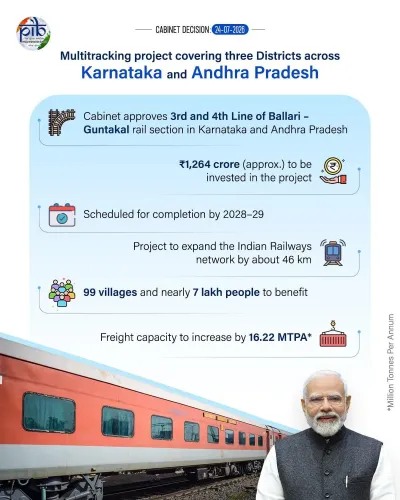
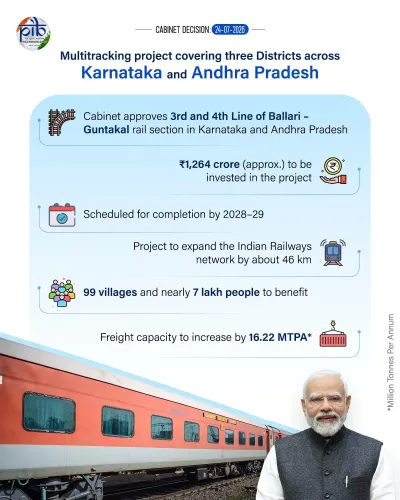
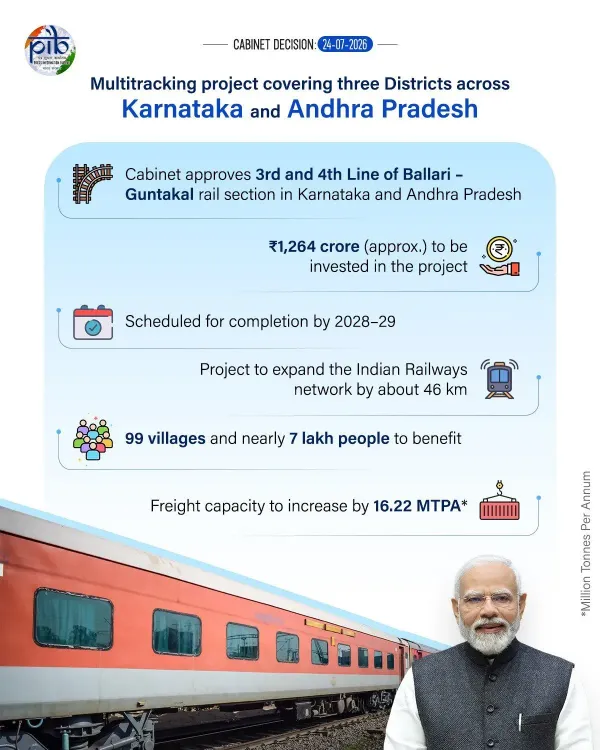
The Union Cabinet has approved a multitracking railway project spanning three districts across Karnataka and Andhra Pradesh, adding roughly 46 km to the Indian Railways network. The decision, announced by Minister Kiren Rijiju, continues the government's push to expand capacity on busy southern corridors.
Key Takeaways
The Union Cabinet, chaired by PM Narendra Modi , approved a railway multitracking project on 25 July 2026 .
The project covers three districts spread across Karnataka and Andhra Pradesh .
The approval adds approximately 46 kilometres to the existing Indian Railways network.
Multitracking allows more trains to operate simultaneously, reducing congestion on shared southern corridors.
The decision follows the government's National Infrastructure Pipeline framework launched in 2019 .
Detailed project sanction orders, land acquisition timelines, and cost estimates are expected in subsequent Railway Board communications.
Union Parliamentary Affairs Minister Kiren Rijiju announced on Friday, 25 July 2026 that the Union Cabinet, chaired by Prime Minister Narendra Modi, has approved a multitracking project spanning three districts across Karnataka and Andhra Pradesh, adding approximately 46 kilometres to the existing Indian Railways network.
Context
The Cabinet decision, communicated under the hashtag #CabinetDecisions, marks the latest in a series of railway capacity augmentation approvals targeting southern India. Multitracking projects add parallel lines to existing corridors, allowing more trains to run simultaneously and reducing bottlenecks on shared routes. The 46-km addition covers a cross-border alignment touching districts in both states, strengthening inter-state rail connectivity in the region.
Minister Rijiju, who routinely communicates Cabinet outcomes on behalf of the government, posted the announcement directly from his official account, citing the project as evidence of the Modi administration's continued infrastructure push.
Policy Backdrop
Track doubling and multitracking have been a cornerstone of Indian Railways capacity planning since the early 2010s, with momentum accelerating after the launch of the National Infrastructure Pipeline in 2019. The pipeline consolidated hundreds of rail, road, and port projects under a single investment framework, giving Cabinet-level visibility to incremental network expansion that might otherwise proceed through routine administrative approvals.
Southern rail corridors linking Karnataka and Andhra Pradesh carry significant freight — including coal, steel inputs, and agricultural produce — alongside dense passenger traffic between cities such as Bengaluru, Hyderabad, and Vijayawada. Adding track capacity on these routes directly affects freight transit times and passenger punctuality without requiring entirely new land alignments, making multitracking a cost-efficient expansion tool.
Stakeholders and Impact
Rail passengers and freight operators across the three affected districts stand to benefit most immediately from reduced congestion once the project is commissioned. State transport departments in both Karnataka and Andhra Pradesh are expected to coordinate on land acquisition, a step that has historically determined the pace of project delivery on cross-border alignments.
For the broader regional economy, improved rail capacity supports inter-state goods movement, potentially lowering logistics costs for manufacturers and agricultural exporters operating along the corridor. Local communities near the alignment may also see ancillary economic activity during the construction phase.
What's Next
Following a Cabinet approval, the standard sequence involves the Railway Board issuing a detailed project sanction order, after which land acquisition proceedings and tender processes begin. Parliamentary updates or ministry communications are expected to provide district-level specifics, revised cost estimates, and a commissioning timeline. Progress on land acquisition in particular will be a key indicator of how quickly the 46-km expansion moves from approval to ground-level execution.
The approval reinforces the government's broader pattern of using incremental multitracking to raise line capacity on high-density southern corridors, a strategy likely to continue as freight volumes on the peninsular network grow.
Point of View
Lower-cost route to raising network capacity. By targeting a corridor shared between Karnataka and Andhra Pradesh — two states with politically significant rail freight and passenger flows — the approval also carries inter-state goodwill value ahead of any state-level electoral considerations. The 46-km addition is modest in isolation, but it reflects a cumulative strategy in which dozens of such approvals collectively reshape the southern rail map. The real test, as with most multitracking projects, will be the speed of land acquisition and whether the Railway Board's project sanction translates into on-ground progress within the stated timelines.
NationPress
22 Oct 2026
Frequently Asked Questions
What did the Union Cabinet approve for Indian Railways on 25 July 2026?
The Union Cabinet approved a multitracking project spanning three districts across Karnataka and Andhra Pradesh, which will add approximately 46 kilometres to the existing Indian Railways network.
Which states are covered by the new railway multitracking project?
The project covers districts in both Karnataka and Andhra Pradesh, making it a cross-border rail infrastructure initiative in southern India.
What is railway multitracking and why does it matter?
Multitracking involves laying additional parallel rail lines alongside an existing track. It increases the number of trains that can use a corridor simultaneously, reducing delays and congestion without requiring an entirely new route.
Who announced the Cabinet decision on the railway project?
Union Parliamentary Affairs Minister Kiren Rijiju announced the approval on his official social media account, attributing the decision to the Cabinet led by Prime Minister Narendra Modi.
What happens after Cabinet approves a railway project in India?
After Cabinet approval, the Railway Board issues a detailed project sanction order. Land acquisition, tendering, and construction follow, with timelines dependent largely on how quickly land is acquired from the states involved.