Cabinet Clears BHAVYA Rasayan Scheme for Chemical Parks
Synopsis
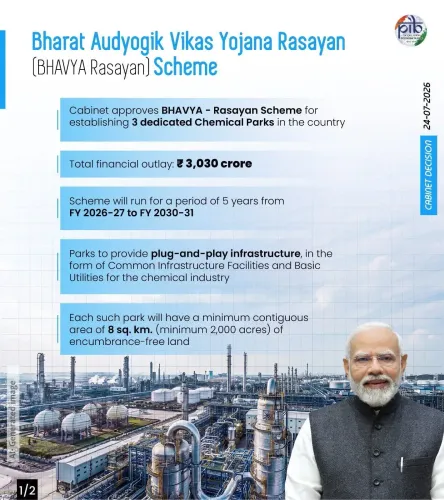
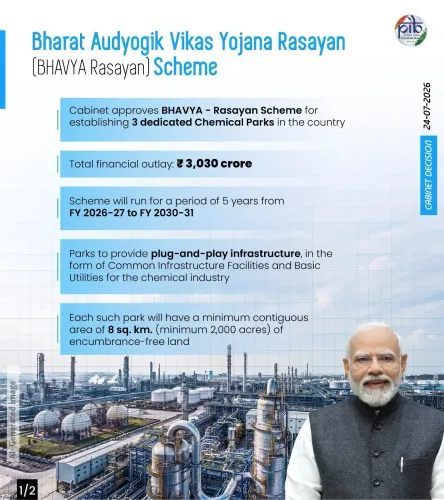
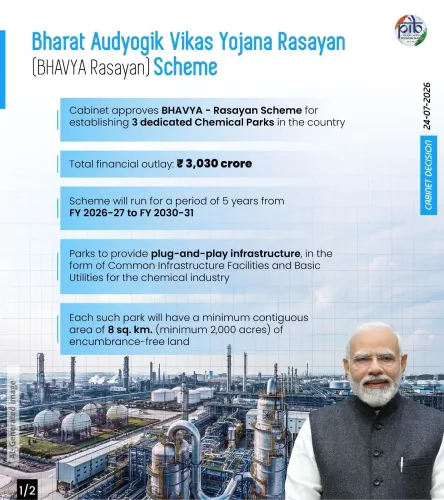
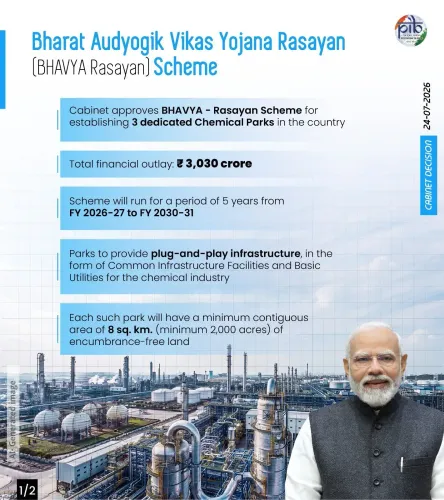
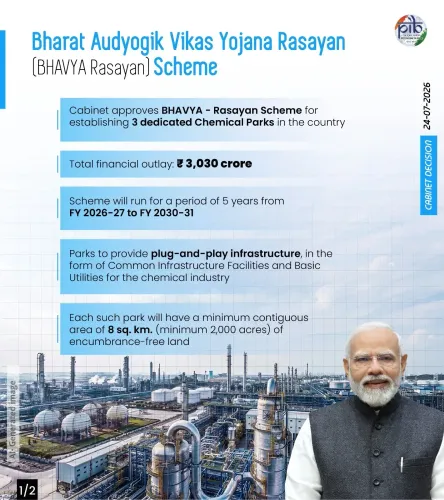
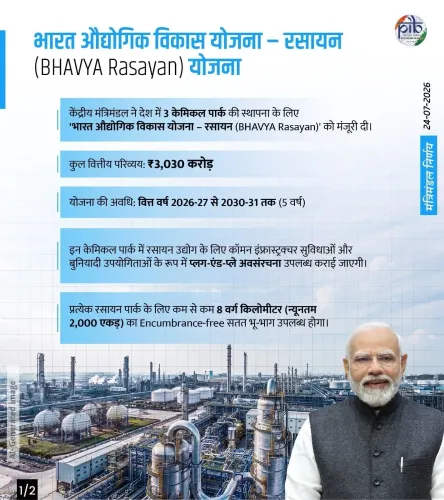
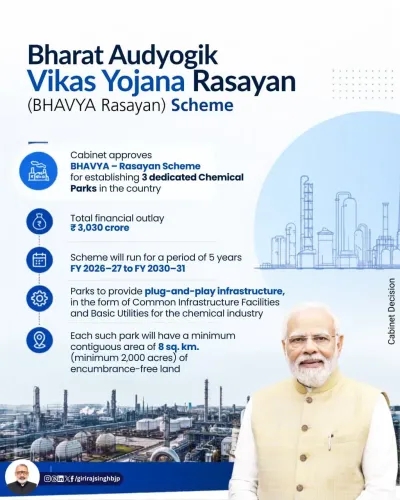
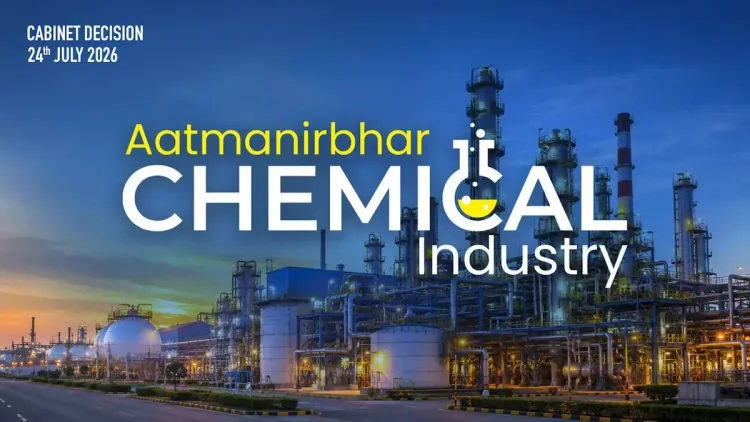
The Union Cabinet has approved the BHAVYA Rasayan Scheme to develop world-class chemical parks across India. Announced by Union Minister Ashwini Vaishnaw on 25 July 2026, the scheme aims to accelerate chemical manufacturing, reduce import dependence, and strengthen sunrise industries through dedicated industrial infrastructure.
Key Takeaways
The Union Cabinet approved the BHAVYA Rasayan Scheme on 25 July 2026 to establish world-class chemical parks across India .
The scheme targets acceleration of chemical manufacturing and strengthening of sunrise industries, including pharmaceuticals, agrochemicals, and textiles.
It builds on India's earlier PCPIR policy (2007) and complements PLI schemes for chemical segments introduced from 2020 .
Key beneficiaries include chemical manufacturers and MSME units that will gain from shared infrastructure and lower compliance costs.
Site selection criteria, budgetary outlays, and implementation details are yet to be notified through subsequent government communications.
Union Minister Ashwini Vaishnaw announced on Saturday, 25 July 2026 that the Union Cabinet has approved the BHAVYA Rasayan Scheme, a dedicated programme to establish world-class chemical parks aimed at accelerating chemical manufacturing and strengthening sunrise industries across India.
Context
The Cabinet's approval of the BHAVYA Rasayan Scheme marks the government's latest push to build integrated, large-scale chemical manufacturing infrastructure. Vaishnaw described the scheme as a vehicle to 'establish world-class Chemical Parks that will accelerate chemical manufacturing and strengthen sunrise industries across India.' The announcement signals a fresh policy commitment to the chemical sector at the highest executive level.
India's chemical industry occupies a strategic position in the economy, serving as a critical input supplier to pharmaceuticals, agrochemicals, textiles, and plastics. The sector has long been identified as a 'sunrise' industry due to its deep forward linkages and significant export potential.
Policy Backdrop
The BHAVYA Rasayan Scheme builds on a lineage of industrial cluster policies. The Petroleum, Chemicals and Petrochemicals Investment Regions (PCPIR) policy, notified in 2007, first established the framework for integrated chemical industry clusters with common infrastructure and environmental compliance facilities. Successive governments have returned to the cluster model, recognising that shared utilities, logistics, and regulatory compliance infrastructure lower costs for individual units.
From 2020 onwards, Production Linked Incentive (PLI) schemes were extended to select chemical segments, aiming to boost domestic value addition and exports. The BHAVYA Rasayan Scheme appears to complement this incentive architecture by addressing the physical infrastructure gap — providing the park-level backbone that PLI beneficiaries and other manufacturers need to scale up.
Reducing import dependence in specialty and bulk chemicals has been a persistent policy priority. China accounts for a large share of India's chemical imports, and dedicated parks with modern common infrastructure are seen as a structural solution to improve domestic competitiveness.
Stakeholders and Impact
The primary beneficiaries of the scheme are expected to be chemical manufacturers — both large corporates and MSME units — who stand to gain from shared infrastructure, reduced compliance costs, and improved logistics connectivity within designated parks. MSME chemical units, which often struggle with the capital expenditure required for individual effluent treatment and utilities, are likely to see the most direct operational benefit from common facility models.
Downstream industries — including pharmaceuticals, agrochemicals, dyes, and textiles — also stand to benefit indirectly through more reliable and competitively priced domestic chemical supply chains. For India, greater chemical self-sufficiency translates into reduced vulnerability to global supply chain disruptions of the kind witnessed during and after the COVID-19 pandemic.
What's Next
The Cabinet approval is the first formal step; the detailed implementation architecture — including site selection criteria, eligible investment categories, budgetary outlay, and nodal ministry responsibilities — is expected to be elaborated in subsequent government notifications and economic communications. Industry bodies and state governments with established chemical corridors are likely to engage early in the site-identification process.
The scheme's success will ultimately depend on how swiftly the government moves from approval to operationalisation, including environmental clearances, land acquisition frameworks, and connectivity linkages for proposed parks. Observers will watch whether the BHAVYA Rasayan Scheme translates the long-standing PCPIR vision into a faster, more execution-focused model suited to India's current industrial ambitions.
Point of View
If executed at scale, address a structural bottleneck that tax incentives alone cannot fix: the lack of plug-and-play industrial land with shared utilities and compliance infrastructure. The timing also reflects a strategic calculation around supply chain de-risking, as India seeks to reduce its dependence on imported bulk and specialty chemicals. Whether the scheme delivers will hinge on execution speed and the quality of centre-state coordination in land and environmental clearances.
NationPress
23 Oct 2026
Frequently Asked Questions
What is the BHAVYA Rasayan Scheme?
The BHAVYA Rasayan Scheme is a Cabinet-approved government programme to establish world-class chemical parks across India, aimed at accelerating chemical manufacturing and supporting sunrise industries such as pharmaceuticals, agrochemicals, and textiles.
Who announced the BHAVYA Rasayan Scheme?
Union Minister Ashwini Vaishnaw announced the Cabinet approval of the BHAVYA Rasayan Scheme on 25 July 2026 via a post on X (formerly Twitter).
How is BHAVYA Rasayan Scheme different from PCPIR?
The earlier PCPIR policy (2007) created a framework for integrated chemical investment regions, while the BHAVYA Rasayan Scheme is a newer initiative focused specifically on establishing world-class chemical parks with modern shared infrastructure to accelerate manufacturing at scale.
Who will benefit from the BHAVYA Rasayan Scheme?
Chemical manufacturers, including large industries and MSME units , are the primary beneficiaries. Downstream sectors such as pharmaceuticals, agrochemicals, dyes, and textiles will also benefit from a more reliable domestic chemical supply chain.
What happens after Cabinet approval of the BHAVYA Rasayan Scheme?
After Cabinet approval, the government is expected to notify detailed implementation guidelines covering site selection criteria, eligible investment categories, budgetary outlays, and nodal ministry responsibilities through subsequent official communications.