Cachar Pineapples Enter Dubai Market, Boosting Assam Agri-Exports
Synopsis
Pineapples from Assam's Cachar district have entered the Dubai market, the Chief Minister's Office announced on 4 July 2026. The development marks a significant step in Assam's push to diversify agri-exports beyond tea and oil, aligning with India's 2018 Agricultural Export Policy and APEDA's cluster-based framework.
Key Takeaways
Cachar district pineapples have gained export traction with Dubai as a key destination, announced on 4 July 2026 .
Dubai serves as a re-export hub connecting Indian produce to West Asia and Africa .
The move aligns with India's Agricultural Export Policy of 2018 , which targets cluster-based and signature crops for international markets.
APEDA is the central agency facilitating such export linkages for northeastern agricultural produce.
CM Himanta Biswa Sarma 's administration has prioritised horticultural exports as part of a broader economic diversification away from tea, oil, and coal.
Sustained export volumes and potential MoUs with UAE importers will be the key indicators to watch in the 2026-27 season .
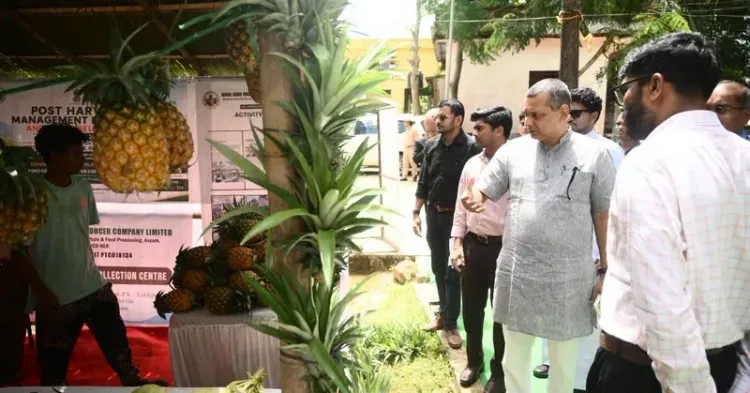
The Chief Minister's Office of Assam on Saturday, 4 July 2026 highlighted a significant milestone for the state's horticultural sector: pineapples from Cachar district have begun gaining export traction, with Dubai emerging as a key entry point into international markets.
Context
Cachar, a southern district of Assam, has long been recognised for its distinctive pineapple variety that commands strong demand within the region. The district's growers have historically sold their produce through domestic supply chains, with limited access to premium export corridors. The entry into the Dubai market marks a notable shift in that trajectory.
Dubai functions as a major re-export hub in the UAE, serving as a gateway for Indian agricultural produce into West Asia and Africa. Securing a foothold there effectively opens Cachar pineapples to a far wider consumer base than any single bilateral trade route would allow.
Policy Backdrop
India's Agricultural Export Policy of 2018 set an ambition to double agri-exports by focusing on geographically distinct and cluster-based produce, a category that Cachar's pineapples naturally fit. The policy specifically encouraged state governments to identify signature crops and link them to international buyers through infrastructure support and certification.
The Agricultural and Processed Food Products Export Development Authority (APEDA), the central agency overseeing such efforts, has been instrumental in facilitating export linkages for northeastern produce. Assam has increasingly aligned its horticultural push with APEDA's cluster-based export framework, seeking to replicate the success that states like Meghalaya and Tripura have had with their own signature crops.
Chief Minister Himanta Biswa Sarma, in office since May 2021, has championed a diversification agenda that moves Assam's economic identity beyond its traditional anchors of tea, oil, and coal. Horticultural exports from districts like Cachar represent a concrete expression of that strategy.
Stakeholders and Impact
The most direct beneficiaries are the pineapple growers of Cachar, who stand to receive better farmgate prices as export demand competes with domestic buyers. For smallholder farmers in particular, access to Gulf-market premiums can meaningfully raise household incomes during the harvest season.
Assam's exporter community also gains a replicable template: if Cachar pineapples can clear the logistics, phytosanitary, and cold-chain requirements for a Gulf destination, the pathway can be adapted for other horticultural produce from the Northeast. The development also reinforces India's broader push to deepen agricultural trade ties with Gulf Cooperation Council nations, a priority that has gained momentum in recent years.
What's Next
Attention will now turn to the volume of Cachar pineapples shipped during the 2026-27 season and whether the initial export traction translates into sustained commercial agreements with UAE importers. Any follow-up in the form of MoUs with Dubai-based distributors or APEDA-supported cold-chain infrastructure upgrades in Cachar would signal that this is a durable market entry rather than a one-off consignment.
For the Northeast as a whole, Cachar's Dubai entry adds to a growing body of evidence that the region's horticultural potential can compete on the global stage — provided logistics, certification, and market intelligence continue to improve in step with farmer ambition.
Point of View
This is also a political proof-of-concept — demonstrating that the Northeast can participate in India's agri-export ambitions on its own terms. The test will be whether this initial traction is institutionalised through infrastructure and buyer agreements, or remains a headline without follow-through.
NationPress
3 Oct 2026
Frequently Asked Questions
Which district of Assam is famous for pineapple cultivation?
Cachar district in southern Assam is widely recognised for its signature pineapple variety, which has now begun entering international export markets including Dubai .
Where are Cachar pineapples being exported?
Cachar pineapples have gained export traction with Dubai in the UAE as a key destination, which also serves as a re-export hub for West Asia and Africa .
What is APEDA's role in Assam's agricultural exports?
APEDA (Agricultural and Processed Food Products Export Development Authority) is the central government agency that promotes and regulates agri-exports from India, including facilitating cluster-based export linkages for northeastern produce like Cachar pineapples.
What is India's Agricultural Export Policy?
India's Agricultural Export Policy of 2018 aims to double agri-exports by focusing on geographically distinct and cluster-based produce, encouraging state governments to link signature crops to international buyers with infrastructure and certification support.
How is Assam diversifying its economy beyond tea?
Under Chief Minister Himanta Biswa Sarma , Assam has been actively promoting horticultural exports from districts like Cachar , moving beyond its traditional economic anchors of tea, oil, and coal to tap Gulf and international markets.