Health Minister Nadda: CCEA clears ₹4,288-cr Ennore terminal
Synopsis
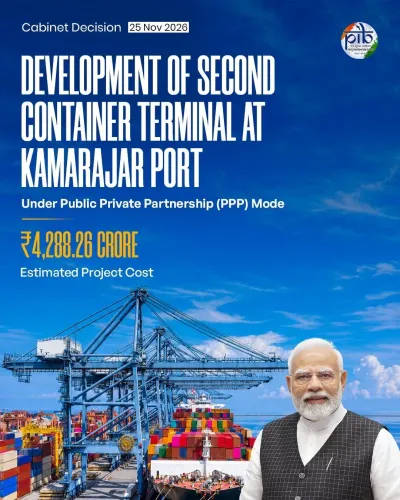
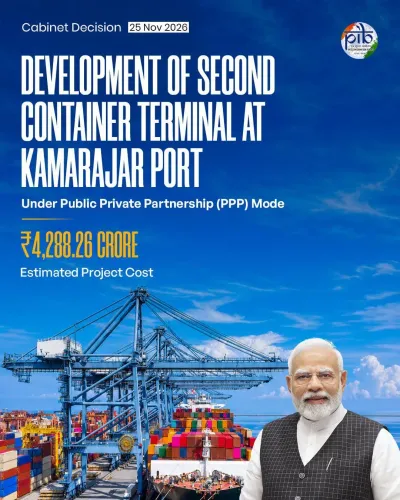
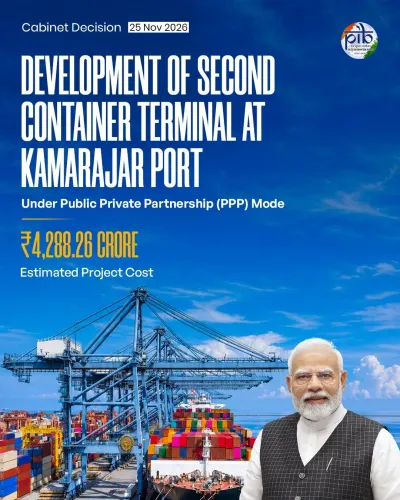
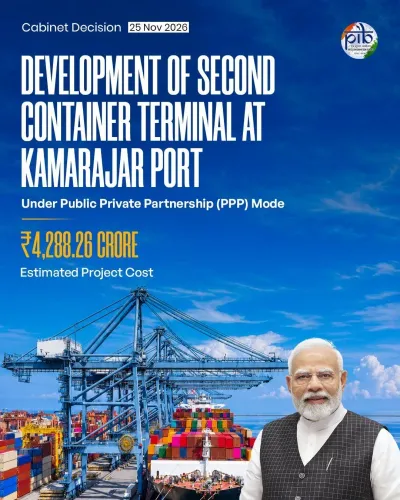
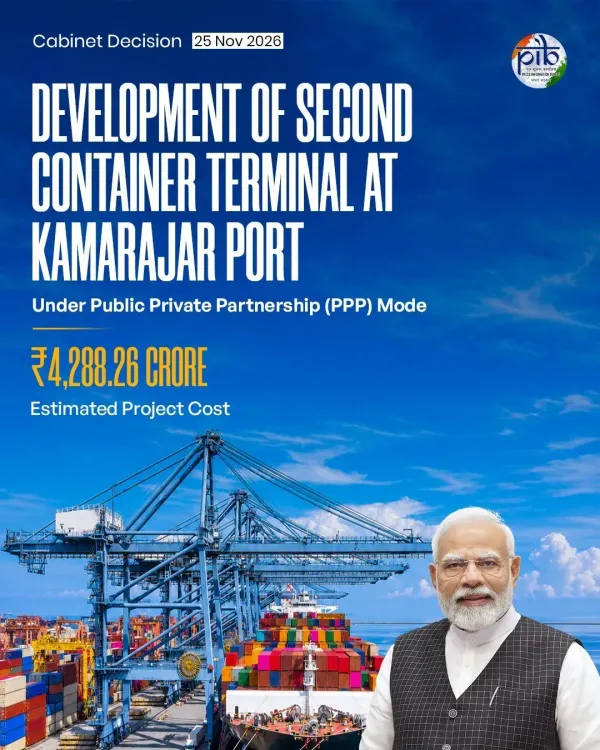
Union Health Minister J. P. Nadda said the CCEA, chaired by PM Narendra Modi, approved a ₹4,288.26 crore second container terminal at Kamarajar Port in Tamil Nadu. The 900-metre PPP facility is designed for 2 million TEUs a year to cut logistics costs and lift EXIM trade.
Key Takeaways
Union Health Minister J.
Nadda said the CCEA, chaired by PM Narendra Modi, approved a second container terminal at Kamarajar Port, Tamil Nadu.
He put the project cost at ₹4,288.26 crore, to be developed under the PPP mode.
The planned terminal is 900 metres long with an annual capacity of 2 million TEUs.
Nadda said it would lift port capacity, shipping connectivity, EXIM trade and jobs while cutting logistics costs.
He linked the nod to Atmanirbhar Bharat and Maritime India Vision 2030, which follows the Sagarmala programme of 2015.
Kamarajar Port is the major port at Ennore, north of Chennai, operated by Kamarajar Port Limited.
India's next container bet just got cabinet clearance. Union Health Minister J. P. Nadda on 25 November 2026 said the Cabinet Committee on Economic Affairs, chaired by Prime Minister Narendra Modi, has approved a second container terminal at Kamarajar Port in Tamil Nadu at a cost of ₹4,288.26 crore under the PPP mode.
Nadda said the 900-metre terminal will have an annual capacity of 2 million TEUs. In his words, it will enhance port capacity, strengthen international shipping connectivity, reduce logistics costs, boost EXIM trade and generate employment. He called the nod a major step towards strengthening India's maritime capabilities and advancing Atmanirbhar Bharat and Maritime India Vision 2030.
900 metres of quay, 2 million TEUs a year
Kamarajar Port, the major port at Ennore north of Chennai, will host the new berth. A 900-metre container face is a serious stretch of waterfront: long enough for large vessels and a high-volume yard behind it. The stated handling target — 2 million TEUs a year — is meant to add a dedicated second terminal rather than squeeze more boxes through the existing layout.
The build is structured as a public-private partnership. That is the template New Delhi has used to expand major-port capacity: public waterfront and regulatory cover, private capital and operations. Kamarajar Port Limited runs the Ennore harbour; the second terminal is designed to sit on that platform without the full bill landing on the Union budget.
The EXIM math behind Ennore's second berth
Nadda framed the project as a logistics intervention, not a ribbon-cutting. Extra container capacity on the Coromandel coast is supposed to ease berth pressure, deepen shipping connectivity and cut the cost of moving export-import cargo — still one of Indian manufacturing's stubborn drags.
Who feels it first? EXIM traders, liner companies and the Tamil Nadu workforce around the port. More vessel calls mean more work in yards, trucks, warehouses and allied services. Whether logistics costs actually fall will depend on hinterland roads, rail and how quickly the new quay is utilised once it is live.
Sagarmala's long shadow, MIV 2030's next berth
The decision sits on a known stack. Sagarmala, launched in 2015, made port-led development a national programme. Maritime India Vision 2030, released in 2021, then set a sharper brief: grow capacity, modernise terminals and use PPP models so logistics keep pace with trade. Successive cabinet notes have followed that pattern — private operators, public ports, both coasts in play.
Ennore is a logical eastern-coast pick. It already sits on Chennai's industrial hinterland and can absorb overflow as container volumes climb. Watch the next markers: tendering, construction milestones and how full the terminal runs once it opens. More MIV 2030 projects will likely return to the same cabinet table.
Cabinet paper is the easy part. The test is whether those 2 million TEUs show up on the quay — and whether the boxes move cheaper.
Point of View
Hinterland links and whether logistics costs actually fall once the 2 million TEUs come online.
NationPress
25 Nov 2026
Frequently Asked Questions
What did JP Nadda announce about Kamarajar Port?
Union Health Minister J. P. Nadda said the Cabinet Committee on Economic Affairs chaired by PM Narendra Modi approved a second container terminal at Kamarajar Port in Tamil Nadu. He put the project cost at ₹4,288.26 crore under the PPP mode, with 2 million TEUs of annual capacity.
Where is Kamarajar Port and what is being built there?
Kamarajar Port is the major port at Ennore in Tamil Nadu, north of Chennai. The approved project is a 900-metre-long second container terminal designed to handle 2 million TEUs a year.
What is Maritime India Vision 2030?
Maritime India Vision 2030 is a government roadmap released in 2021 to modernise ports, shipping and related infrastructure by 2030. It emphasises capacity expansion and public-private partnership models, building on the Sagarmala programme launched in 2015.
How will the Ennore terminal affect trade and jobs?
Nadda said the terminal would enhance port capacity, strengthen international shipping connectivity, reduce logistics costs, boost EXIM trade and generate employment. EXIM traders, logistics firms and the Tamil Nadu workforce around the port are the groups most directly in play.
What is the Cabinet Committee on Economic Affairs?
The Cabinet Committee on Economic Affairs is the apex Union cabinet body that approves major economic projects and investments. It is chaired by Prime Minister Narendra Modi.