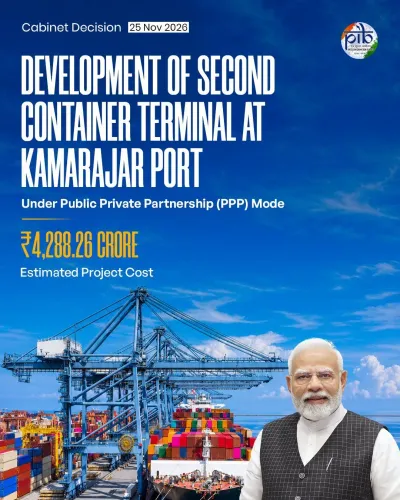
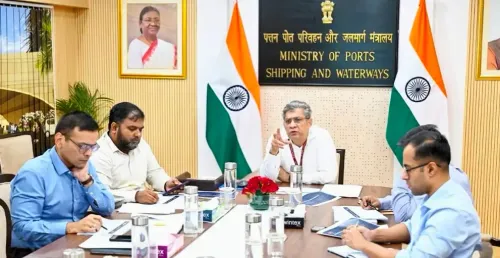
Cabinet okays ₹4,288 crore Kamarajar Port 2nd terminal
Synopsis
The Union Cabinet has cleared a ₹4,288.26 crore second container terminal at Kamarajar Port, adding 2 million TEUs as the existing berth sits at 88 per cent utilisation. The 40-year PPP-DBFOT project is designed for 24,000-TEU mainline ships and Chennai–Ennore EXIM cargo.
Key Takeaways
The Union Cabinet, chaired by PM Narendra Modi , approved a second container terminal at Kamarajar Port Limited on Wednesday .
Estimated PPP cost is ₹4,288.26 crore (GST included): ₹2,429.32 crore in Phase I and ₹1,858.94 crore in Phase II.
The 900-metre terminal will add 2.0 million TEUs a year ( 1.1 million in Phase I, 0.9 million in Phase II) and can take vessels of up to 24,346 TEUs .
KPL’s existing terminal ran at about 88 per cent utilisation in FY 2025–26 , handling about 0.7 million TEUs against 0.8 million TEUs capacity.
KPL will separately bear an estimated ₹450 crore dredging cost; the concession is 40 years including 48 months of construction.
The project is aligned with Maritime India Vision 2030 and Maritime Amrit Kaal Vision 2047 .
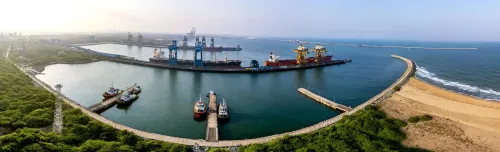
The Union Cabinet, chaired by Prime Minister Narendra Modi, on Wednesday approved a second container terminal at Kamarajar Port Limited under the public-private partnership (PPP) mode on a design, build, finance, operate and transfer (DBFOT) basis, at an estimated project cost of ₹4,288.26 crore. The 900-metre facility, with a design draft of 18 metres, will add 2.0 million TEUs of annual container-handling capacity in two phases. The project is intended to let the Ennore port take larger mainline vessels and meet rising containerised EXIM demand from the Chennai–Ennore industrial belt and the wider southern hinterland.
Project scale and vessel capability
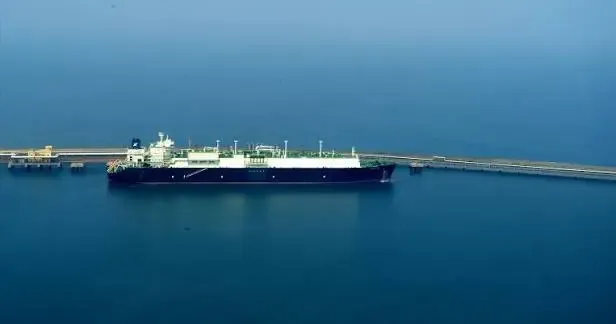
The terminal is planned with a berth width of 30 metres and is designed to handle large container ships, including vessels of up to 24,346 TEUs and 400 metres in length overall. According to an official statement, this will strengthen Kamarajar Port Limited (KPL) in taking larger mainline vessels and improve connectivity with international shipping routes.
Capacity will be built in two phases. Phase I will deliver 1.1 million TEUs, and Phase II will add 0.9 million TEUs, taking the new terminal to 2.0 million TEUs a year.
Cost, phases and who pays
The estimated cost of the PPP component is ₹4,288.26 crore, including GST, comprising ₹2,429.32 crore for Phase I and ₹1,858.94 crore for Phase II. The selected concessionaire is to arrange the investment under the DBFOT model. Separately, an estimated dredging cost of ₹450 crore is to be borne by KPL.
The concessionaire will recover its outlay through user charges in accordance with the Concession Agreement and the applicable tariff framework. The project is proposed to be implemented through a transparent, open global bidding process.
Why Kamarajar Port is adding capacity
KPL handled 49.08 million tonnes of cargo and 1,008 vessels during FY 2025–26, including more than 7 lakh TEUs of container traffic. The existing container terminal has an installed capacity of 0.8 million TEUs per annum and handled approximately 0.7 million TEUs in FY 2025–26, representing utilisation of about 88 per cent.
This comes amid sustained growth in boxed cargo. Container traffic in India has grown at a compound annual growth rate of about 7 per cent over the last five years, while KPL’s container traffic has grown at approximately 9.9 per cent over the same period. A feasibility study projects continued growth in the south-eastern region, supporting the case to augment capacity at KPL.
Key cargo-generating sectors in the catchment include automobiles and auto components, engineering goods, electronics, chemicals and other manufactured products. Notably, the second terminal is framed as a response to EXIM demand from the Chennai–Ennore industrial and economic region rather than as a standalone berth expansion.
Timeline, bidding and maritime vision
The project will be implemented on a DBFOT basis for a concession period of 40 years, including a construction period of 48 months. Phase I is scheduled for completion within 24 months from the Date of Award of Concession, with commercial operations commencing in the 25th month. Construction of Phase II will run from the 25th to the 48th month, with full commercial operations commencing in the 49th month.
The project is aligned with Maritime India Vision 2030 and Maritime Amrit Kaal Vision 2047. It is expected to strengthen KPL’s position as a container gateway on India’s East Coast, improve the efficiency of the maritime logistics chain and support the growth of EXIM trade. The next milestone is the global bid and award of concession, after which the 24-month clock on Phase I construction will start.
Point of View
288 crore headline: Kamarajar is already running hot, and a 9.9 per cent container CAGR — faster than the national 7 per cent — means delay would have turned a bottleneck into diverted cargo. A 40-year DBFOT concession, however, locks in a private operator for a generation; tariff discipline and berth productivity will matter more than the announcement. The ₹450 crore dredging bill on KPL’s books is a reminder that PPP does not mean the public side walks away from capital risk. East Coast containerisation has lagged the west for years; this terminal pays off only if hinterland rail-road links and Chennai–Ennore industrial cargo actually show up at the berth.
NationPress
25 Nov 2026
Frequently Asked Questions
What did the Union Cabinet approve at Kamarajar Port?
The Union Cabinet approved a second container terminal at Kamarajar Port Limited under the PPP-DBFOT model at an estimated cost of ₹4,288.26 crore. The 900-metre terminal is designed for 2.0 million TEUs a year and vessels of up to 24,346 TEUs.
How will the ₹4,288 crore Kamarajar Port terminal be funded?
The selected concessionaire will arrange the ₹4,288.26 crore PPP investment, including GST, under the DBFOT model and recover it through user charges. Phase I is estimated at ₹2,429.32 crore and Phase II at ₹1,858.94 crore, while KPL will separately bear about ₹450 crore in dredging costs.
When will the second Kamarajar Port container terminal become operational?
Phase I is scheduled for completion within 24 months from the Date of Award of Concession, with commercial operations from the 25th month. Phase II construction runs from the 25th to the 48th month, with full commercial operations from the 49th month, under a 40-year concession.
Why is a second container terminal needed at Kamarajar Port?
The existing terminal has 0.8 million TEUs of capacity and handled about 0.7 million TEUs in FY 2025–26, or roughly 88 per cent utilisation. KPL’s container traffic has grown at about 9.9 per cent over five years, faster than India’s roughly 7 per cent CAGR, and a feasibility study projects further growth in the south-eastern hinterland.
How does the project fit into India’s maritime plans?
The project is aligned with Maritime India Vision 2030 and Maritime Amrit Kaal Vision 2047. Officials expect it to strengthen KPL as an East Coast container gateway, improve maritime logistics efficiency and support EXIM trade from the Chennai–Ennore industrial region.