Nadda: CCEA clears ₹8,300 cr Odisha coastal highway
Synopsis
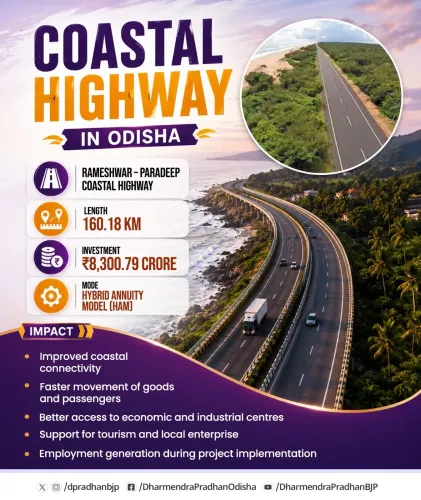
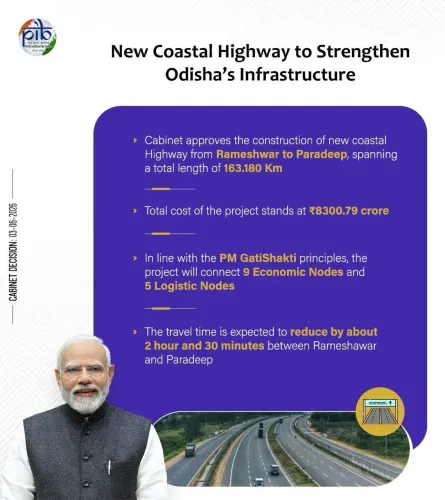
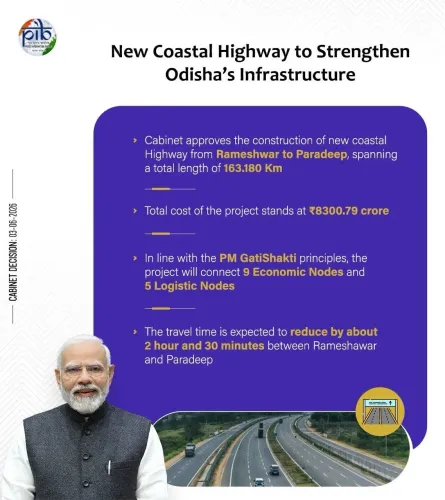
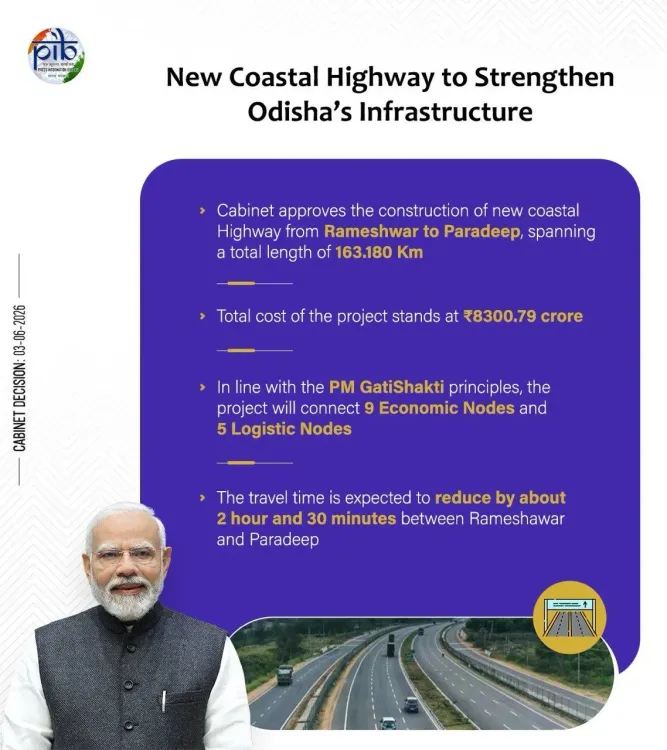
Union Health Minister J. P. Nadda announced CCEA approval for a 160.18-km coastal highway from Rameshwar to Paradip in Odisha at ₹8,300.79 crore under the Hybrid Annuity Model. The corridor will cross Khurda, Puri, Kendrapada and Jagatsinghpur, link 9 economic and 5 logistics nodes under PM GatiShakti, and cut travel time by 2 hours 30 minutes.
Key Takeaways
CCEA, chaired by PM Narendra Modi, approved a 160.18-km Rameshwar-Paradip coastal highway in Odisha.
The project is costed at ₹8,300.79 crore under the Hybrid Annuity Model (HAM).
It will pass through Khurda, Puri, Kendrapada and Jagatsinghpur districts.
The corridor connects 9 Economic Nodes and 5 Logistics Nodes under PM GatiShakti.
Travel time between Rameshwar and Paradip is expected to reduce by around 2 hours 30 minutes.
Announcement was made by Union Health Minister J.
Nadda on 3 June 2026.
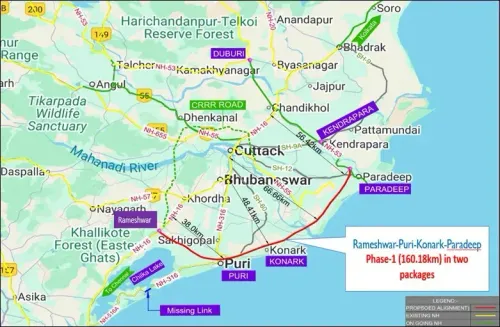
Union Health Minister J. P. Nadda on 3 June 2026 announced that the Cabinet Committee on Economic Affairs (CCEA), chaired by Prime Minister Narendra Modi, has approved construction of a 160.18-km coastal highway from Rameshwar to Paradip in Odisha at a cost of ₹8,300.79 crore under the Hybrid Annuity Model (HAM). The greenfield corridor will pass through Khurda, Puri, Kendrapada and Jagatsinghpur districts and is positioned as a key freight and tourism artery for the eastern coast.
Context
In his post, Nadda said the project 'will enhance regional connectivity, strengthen logistics infrastructure under PM GatiShakti, and connect 9 Economic Nodes and 5 Logistics Nodes.' He added that on completion, travel time between Rameshwar and Paradip will fall by 'around 2 hours and 30 minutes,' alongside gains in road safety, fuel efficiency and emissions reduction.
The announcement was tagged #CabinetDecisions, signalling it as part of the latest round of Union Cabinet clearances. Nadda, who is also BJP national president, frequently amplifies cabinet decisions on social media in addition to his portfolios in health and chemicals and fertilizers.
Policy backdrop
The corridor sits within the central government's wider push to expand the national highway network along India's eastern seaboard. PM GatiShakti, the National Master Plan launched in October 2021, is designed to synchronise road, rail and port planning, and the coastal highway has been explicitly placed under that framework.
The Hybrid Annuity Model, formalised in 2016, splits construction and revenue risk between the government and private developers. It has become the dominant procurement route for large national highway packages, particularly under the umbrella Bharatmala Pariyojana approved in 2015.
Odisha's coastline has also been a focus of the Sagarmala port-led development programme, cleared in 2015, which seeks tighter integration between ports such as Paradip and their hinterland industrial clusters.
Stakeholders and impact
The minister flagged that the alignment will connect 9 Economic Nodes and 5 Logistics Nodes, signalling integration with industrial estates, mineral and fertiliser cargo movement, and coastal tourism circuits across the four districts.
Paradip is one of India's largest bulk-cargo ports, handling significant volumes of coal, iron ore, petroleum and fertilisers. Improved last-mile road links are expected to ease evacuation pressure on existing corridors and offer an alternative to congested inland routes for traffic moving toward Khurda and the state capital region.
For residents of Puri, Kendrapada and Jagatsinghpur, the highway is likely to shorten intercity travel and improve access to health, education and emergency services. Logistics operators stand to gain from a more predictable freight corridor along the coast.
What's next
Attention will now shift to the detailed project report, tendering of HAM packages and the pace of land acquisition across the four coastal districts. Construction milestones, environmental clearances in eco-sensitive coastal stretches, and coordination with Paradip port capacity expansion plans will determine whether the promised 2 hour and 30 minute travel-time saving materialises on schedule.
If executed without significant slippage, the Rameshwar-Paradip corridor could become a template for further coastal connectivity packages along the eastern seaboard, deepening the link between port-led growth and inland economic nodes.
Point of View
Node-based planning. By routing a coastal corridor through four Odisha districts and tying it to Paradip port, the Centre is reinforcing an eastern-seaboard logistics arc that complements Sagarmala and Bharatmala. That a senior BJP figure with non-infrastructure portfolios is amplifying the decision underscores how cabinet wins are now communicated as collective political capital. Execution risk, particularly land acquisition along sensitive coastal stretches, will be the real test.
NationPress
18 Oct 2026
Frequently Asked Questions
What is the Rameshwar to Paradip coastal highway project?
It is a 160.18-km greenfield coastal highway in Odisha approved by the CCEA at a cost of ₹8,300.79 crore under the Hybrid Annuity Model. It will pass through Khurda, Puri, Kendrapada and Jagatsinghpur districts and link 9 economic and 5 logistics nodes.
How much will travel time reduce between Rameshwar and Paradip?
Travel time between Rameshwar and Paradip is expected to reduce by around 2 hours and 30 minutes once the new coastal highway is operational, according to the announcement by Union Health Minister J. P. Nadda.
What is the Hybrid Annuity Model used for this highway?
The Hybrid Annuity Model (HAM) is a public-private partnership framework formalised in 2016 for national highway projects. It splits construction and revenue risk between the government and private developers and is being used to fund the ₹8,300.79 crore Rameshwar-Paradip corridor.
How is the project linked to PM GatiShakti?
The coastal highway has been planned under PM GatiShakti, the National Master Plan launched in 2021 for integrated infrastructure planning. It connects 9 Economic Nodes and 5 Logistics Nodes, aligning road capacity with port and industrial infrastructure in Odisha.
Which districts will the Odisha coastal highway pass through?
The highway will pass through four coastal districts of Odisha: Khurda, Puri, Kendrapada and Jagatsinghpur. It is expected to improve regional connectivity, road safety and access to Paradip port.