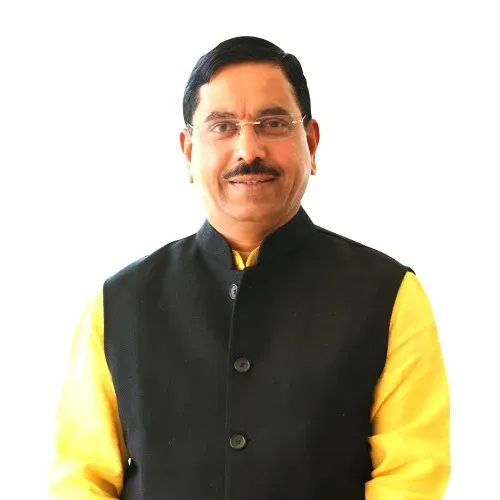
Pralhad Joshi: CCPA acts against 41 restaurants on service charge
Synopsis
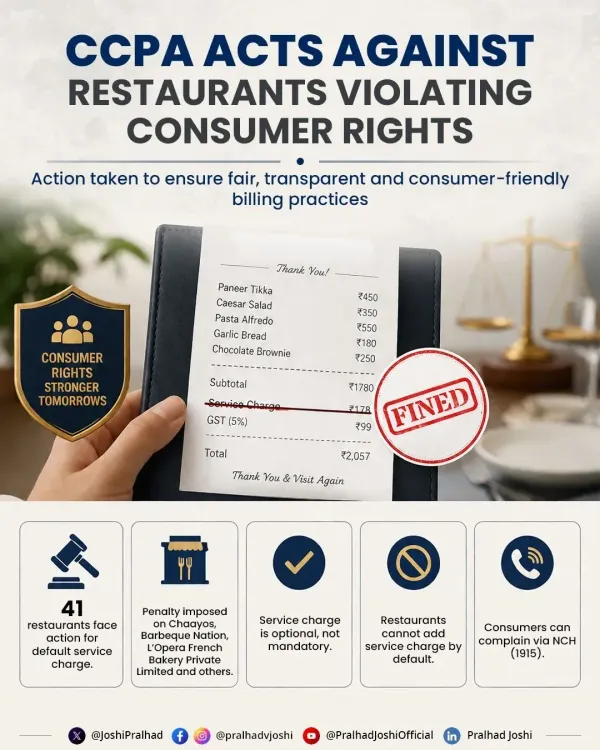
The CCPA has taken suo motu action against 41 restaurants for imposing service charge by default, penalising violators and ordering them to stop the practice. Union Minister Pralhad Joshi reaffirmed that service charge is voluntary and urged consumers to report violations on the National Consumer Helpline at 1915.
Key Takeaways
The CCPA has initiated suo motu action against 41 restaurants for levying service charge automatically without consumer consent.
Penalties have been imposed and restaurants have been directed to discontinue the automatic levy of service charge.
Action was triggered by complaints received through the National Consumer Helpline (1915) .
Service charge in restaurants is voluntary under Indian law; this position has been in place since 2017 Ministry guidelines .
The CCPA derives suo motu enforcement powers from the Consumer Protection Act, 2019 .
Consumers can report violations by calling the toll-free helpline 1915 .
Union Consumer Affairs Minister Pralhad Joshi announced on Sunday, 19 July 2026 that the Central Consumer Protection Authority (CCPA) has initiated suo motu action against 41 restaurants for levying service charge by default, imposing penalties and directing them to stop the automatic charge. The action follows complaints routed through the National Consumer Helpline (NCH), the government's toll-free grievance platform.
Context
In his post on X, Minister Joshi reaffirmed that 'service charge is voluntary and entirely at the consumer's discretion,' and that the CCPA has 'imposed penalties on violators, taken action against restaurants violating consumer protection law and directed them to discontinue the automatic levy of service charge.' He urged consumers to report such violations by calling 1915, the National Consumer Helpline number.
The CCPA is a statutory body constituted under the Consumer Protection Act, 2019, which replaced the older 1986 law. The 2019 legislation specifically empowered the Authority to take suo motu cognisance of complaints and unfair trade practices — a significant expansion of regulatory reach.
Policy Backdrop
The government's position on service charge has been consistent for nearly a decade. As far back as 2017, the Ministry of Consumer Affairs issued guidelines explicitly stating that service charge in hotels and restaurants is voluntary and cannot be levied by default. Those guidelines, however, lacked the enforcement teeth that the 2019 Act subsequently provided.
The CCPA has since periodically issued orders targeting unfair trade practices across the hospitality and retail sectors. The current round of action against 41 restaurants represents a continuation of that enforcement pattern, now backed by formal penalty powers and a technology-enabled complaint pipeline through the NCH.
Stakeholders and Impact
For ordinary diners, the enforcement directly addresses a long-standing grievance: restaurant bills routinely include a service charge of 5 to 10 per cent presented as non-negotiable, even though it is legally optional. Consumers who have paid such charges without being informed of their right to refuse are among those whose complaints triggered the NCH-based action.
For the restaurant industry, the CCPA's move signals that suo motu enforcement — rather than case-by-case consumer litigation — is now the government's preferred tool. Restaurants found in violation face penalties under the Consumer Protection Act, 2019 and must revise their billing practices. The action could prompt a wider review of menus and point-of-sale systems across the hospitality sector.
What's Next
The CCPA's orders against the 41 restaurants are unlikely to be the last. The Authority can continue to draw on the NCH complaint database to identify further violators, and state consumer commissions may initiate parallel proceedings. Parliamentary scrutiny of enforcement data — including penalty amounts and compliance rates — is also possible in coming sessions.
The broader implication is a shift toward proactive, data-driven consumer protection in India: rather than waiting for consumers to file individual cases, the CCPA is using aggregated helpline data to identify systemic violations and act at scale. Whether restaurants comply swiftly or contest the orders will shape the next phase of this enforcement drive.
Point of View
2019 — muscle that the older 1986 law simply did not have. By anchoring the action in NCH complaint data rather than individual litigation, the Ministry is signalling a shift to systemic, technology-driven enforcement that can scale. For Minister Joshi, the announcement reinforces the government's pro-consumer credentials ahead of a period when cost-of-living pressures remain politically salient. The key test will be whether penalties are large enough and compliance is monitored rigorously enough to change industry behaviour, or whether restaurants treat fines as a manageable cost of business.
NationPress
18 Oct 2026
Frequently Asked Questions
Is service charge mandatory in restaurants in India?
No. Service charge in Indian restaurants is voluntary and entirely at the consumer's discretion. The Ministry of Consumer Affairs has maintained this position since 2017 guidelines, and the Consumer Protection Act, 2019 empowers the CCPA to penalise restaurants that levy it by default.
What is the CCPA and what powers does it have?
The Central Consumer Protection Authority (CCPA) is a regulatory body set up under the Consumer Protection Act, 2019. It can take suo motu cognisance of consumer rights violations, investigate unfair trade practices, and impose penalties — powers not available under the earlier 1986 law.
How can I complain about a restaurant charging service charge by default?
Consumers can report such violations by calling the National Consumer Helpline at 1915, a toll-free government service. Complaints registered there can trigger CCPA action, as happened in the current case involving 41 restaurants.
What action has the CCPA taken against restaurants for service charge in 2026?
The CCPA has initiated suo motu action against 41 restaurants, imposed penalties on violators, and directed them to stop automatically levying service charge on customer bills, Union Minister Pralhad Joshi announced on 19 July 2026.
What is the National Consumer Helpline number in India?
The National Consumer Helpline number is 1915. It is a toll-free government service where consumers can register complaints about unfair trade practices, including restaurants that add service charge without informing customers of their right to refuse.