CCPA Fines Storia Foods, Mrs. Bectors for Misleading '100%' Claims
Synopsis
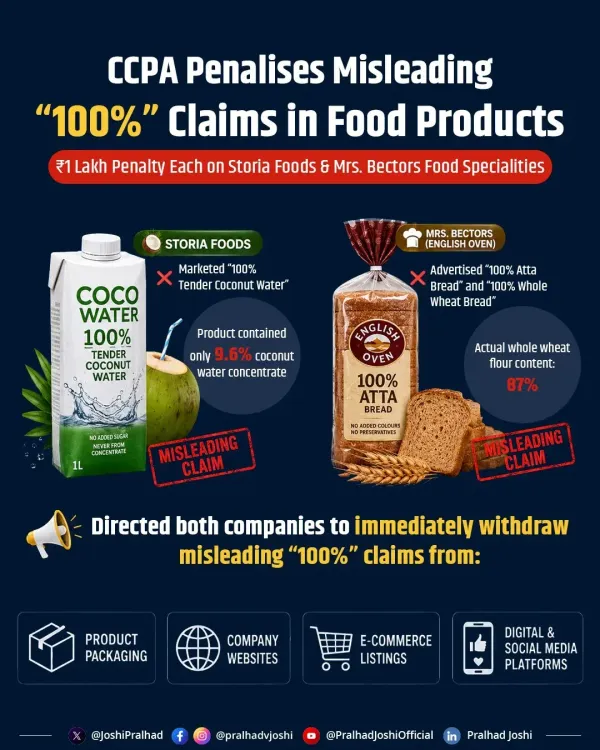
The CCPA has penalised Storia Foods & Beverages and Mrs. Bectors Food Specialities ₹1 lakh each for misleading '100%' claims on food products, directing both firms to immediately withdraw the claims from packaging, websites, and e-commerce platforms.
Key Takeaways
The CCPA imposed a penalty of ₹1 lakh each on Storia Foods & Beverages and Mrs.
Bectors Food Specialities Ltd. for misleading '100%' claims on food products.
Both companies have been directed to immediately discontinue such claims from product packaging, websites, e-commerce platforms, and digital media.
The CCPA reiterated that '100%' is an absolute claim and must accurately reflect the actual composition of a product.
The authority derives its powers from the Consumer Protection Act, 2019 and its 2022 Guidelines for Prevention of Misleading Advertisements .
The enforcement action is part of a broader CCPA pattern of cracking down on absolute percentage claims in the food and beverages sector , especially on digital platforms.
Union Consumer Affairs Minister Pralhad Joshi announced on Sunday, 21 June 2026 that the Central Consumer Protection Authority (CCPA) has imposed a penalty of ₹1 lakh each on Storia Foods & Beverages and Mrs. Bectors Food Specialities Ltd. for making misleading '100%' claims on their food products. The regulator has also directed both companies to immediately remove such claims from all product packaging, websites, e-commerce platforms, and digital media.
Context
The CCPA's action follows complaints about the use of the term '100%' on food product labels and digital listings by the two companies. The authority held that '100%' constitutes an absolute claim and must accurately reflect the actual composition of a product — any deviation makes the claim inherently misleading to consumers. Both companies now face a combined penalty of ₹2 lakh and a mandatory compliance directive.
Minister Joshi shared the development on his official X account, tagging @jagograhakjago — the government's consumer awareness initiative — and citing an official press release, signalling the ministry's intent to publicise enforcement actions widely.
Policy Backdrop
The CCPA was constituted in 2020 under the Consumer Protection Act, 2019, which replaced the older 1986 Act and significantly expanded the regulator's enforcement powers, including the authority to penalise misleading advertisements and unfair trade practices. In 2022, the CCPA issued dedicated Guidelines for Prevention of Misleading Advertisements and Endorsements, which specifically addressed the use of absolute claims such as '100%' and 'pure' in marketing communications.
These guidelines made clear that absolute percentage claims carry a higher evidentiary burden: a company asserting '100% fruit juice' or '100% whole grain', for instance, must be able to substantiate that every measurable component of the product meets that threshold. Regulators have flagged that such claims are particularly prone to misuse on e-commerce platforms, where product descriptions are often drafted without the same scrutiny applied to traditional print advertising.
Stakeholders and Impact
Storia Foods & Beverages is known for its range of flavoured milk and juice-based beverages, while Mrs. Bectors Food Specialities Ltd. markets biscuits, creams, and bakery products under well-known retail brands. Both companies operate across modern retail and major e-commerce channels, giving their product claims wide consumer reach.
For everyday consumers — particularly those making purchase decisions based on nutritional or ingredient purity claims — the CCPA's intervention reinforces the right to accurate product information. The directive to pull claims from digital and e-commerce platforms is notable, reflecting the regulator's recognition that online storefronts are now a primary point of consumer exposure to such assertions. FMCG manufacturers across the sector are likely to take note, as the CCPA has signalled a pattern of escalating enforcement against absolute claims.
What's Next
Both companies are required to comply immediately with the CCPA's directive to discontinue the flagged claims. Industry observers will watch for compliance filings submitted to the authority, as well as any appeal proceedings the companies may initiate. The CCPA is also expected to continue reviewing absolute claims in the packaged food and beverage sector, and may issue further sector-specific guidance to standardise how manufacturers substantiate such assertions. Repeated or wilful non-compliance under the Consumer Protection Act, 2019 can attract significantly steeper penalties, making swift corrective action the prudent course for both firms.
Point of View
The authority is extending its 2022 advertising guidelines into the digital commerce mainstream, where enforcement has historically lagged. For Minister Joshi's ministry, publicising such actions through official social media channels is a deliberate visibility strategy, reinforcing consumer-rights credentials ahead of what is a politically salient issue for middle-class urban voters. The broader arc points toward stricter, more frequent CCPA actions as the regulator builds a body of precedent on absolute claims — a trend that will compel FMCG legal and marketing teams to audit their product claims proactively.
NationPress
19 Sept 2026
Frequently Asked Questions
Why did CCPA fine Storia Foods and Mrs. Bectors?
The CCPA fined both companies ₹1 lakh each because they used misleading '100%' claims on their food products. The authority holds that '100%' is an absolute claim that must precisely reflect a product's actual composition, and found the companies' use of the term did not meet that standard.
What is the CCPA and what powers does it have?
The Central Consumer Protection Authority (CCPA) is a statutory regulator set up in 2020 under the Consumer Protection Act, 2019. It has the power to investigate violations of consumer rights, take action against unfair trade practices, and impose penalties for misleading advertisements.
What does '100% absolute claim' mean under Indian consumer law?
Under the CCPA's 2022 Guidelines for Prevention of Misleading Advertisements, an absolute claim like '100%' must be fully and accurately supported by the actual composition or nature of the product. Companies cannot use such claims loosely or aspirationally — the product must genuinely meet the 100% threshold in every measurable respect.
What must Storia Foods and Mrs. Bectors do now?
Both companies have been directed to immediately remove the flagged '100%' claims from all product packaging, their official websites, e-commerce platform listings, and digital media. Failure to comply could expose them to further and steeper penalties under the Consumer Protection Act, 2019.
Is CCPA taking action against other food companies for similar claims?
Yes. The CCPA has been steadily increasing enforcement against absolute percentage claims in the food and beverages sector, and has imposed similar penalties on other companies for '100%' or 'pure' assertions. The current action against Storia Foods and Mrs. Bectors is part of this broader enforcement pattern.