CCPA fines Storia, English Oven ₹1 lakh each over misleading '100%' food claims
Synopsis
India's consumer watchdog has penalised two prominent food brands for a deceptively simple offence: saying '100 per cent' when the product is not. Storia's coconut water used concentrate and a preservative; English Oven's 'whole wheat' bread was only 87% whole wheat. The CCPA's message is unambiguous — absolute claims demand absolute accuracy.
Key Takeaways
The CCPA has fined Storia Foods and English Oven (Mrs.
Bectors Food Specialities) ₹1 lakh each for misleading '100 per cent' food claims.
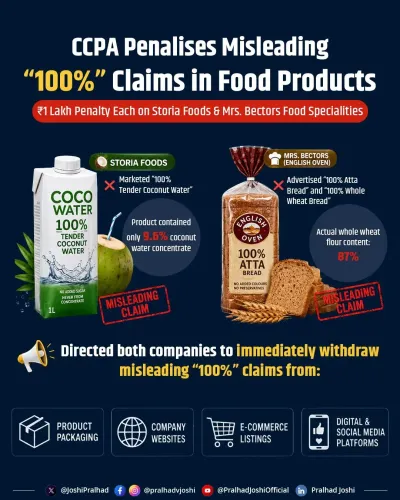
Storia's '100% Tender Coconut Water' was made from concentrate reconstituted with water and contained preservative INS 202 .
English Oven admitted during proceedings that its bread contained only 87 per cent whole wheat flour, not 100 per cent.
Both companies must immediately remove the disputed claims from all packaging, websites, and digital platforms .
Action was taken under the Consumer Protection Act, 2019 and the Misleading Advertisements Guidelines, 2022 .
The government warned all food brands that composition and health claims must be truthful, verifiable, and non-deceptive .
The Central Consumer Protection Authority (CCPA) has slapped penalties of ₹1 lakh each on Storia Foods and Beverages Pvt Ltd and Mrs. Bectors Food Specialities Limited, the maker of the English Oven bread brand, for running misleading advertisements that used '100 per cent' claims on food products. The orders, issued under the Consumer Protection Act, 2019, were disclosed in an official statement on 21 June by the Ministry of Consumer Affairs, Food and Public Distribution.
Both companies have been directed to immediately withdraw the disputed claims from all product packaging, websites, and digital platforms.
What the CCPA Found Against Storia Foods
The CCPA took suo motu cognisance of advertisements by Storia Foods promoting products labelled as '100 per cent Tender Coconut Water' and '100 per cent Juice' — covering variants such as pomegranate, mixed fruit, mango, and guava chilli — sold through the company's website, product packaging, and leading e-commerce platforms.
Investigators found that the '100 per cent Tender Coconut Water' product was, in fact, prepared from coconut water concentrate reconstituted with water, and the label itself disclosed the presence of preservative INS 202. The authority held that an ordinary consumer would reasonably interpret the claim to mean the product consisted entirely of natural tender coconut water — an impression the actual formulation could not support.
Similarly, the juice variants marketed as '100 per cent Juice' were found to contain water, fruit concentrates, and other added ingredients, rendering the absolute claim inaccurate and misleading.
English Oven's '100% Whole Wheat' Claim Under Scrutiny
In a separate proceeding, the CCPA examined advertisements by English Oven carrying claims such as '100 per cent Atta Bread' and '100 per cent Whole Wheat Bread' across print, digital, and social media platforms.
During the proceedings, the company itself admitted that its bread products contained 87 per cent whole wheat flour — not 100 per cent. The CCPA held that a product with 87 per cent whole wheat content cannot lawfully be advertised as '100 per cent Atta' or '100 per cent Whole Wheat'.
The authority also flagged the simultaneous use of '100 per cent Whole Wheat Bread' alongside 'Zero Maida' as compounding the misleading impression — suggesting to consumers that the bread contained no ingredients other than whole wheat flour.
English Oven's defence — that the claim referred only to wheat being the sole grain source, not the sole ingredient — was rejected. The CCPA ruled that advertisements must be assessed from the standpoint of a reasonable consumer, and that post-facto technical explanations cannot override the impression already created by marketing claims.
The Regulatory Standard on '100 Per Cent' Claims
The CCPA reiterated that the expression '100 per cent' is a precise and absolute numerical claim and cannot be deployed loosely, approximately, or merely as a marketing slogan. Any such claim must accurately reflect the actual composition of a product and must be interpreted in its plain, literal sense.
The action was taken under the Consumer Protection Act, 2019 and the Guidelines for Prevention of Misleading Advertisements and Endorsements, 2022.
Government's Broader Warning to Food Brands
The Ministry of Consumer Affairs reiterated that all claims relating to composition, quality, nutrition, or health benefits must be truthful, verifiable, and non-deceptive. Officials signalled that enforcement action against misleading food advertising will continue, underscoring consumers' right to make informed purchasing decisions.
This comes amid a broader regulatory push by the CCPA against deceptive labelling in the packaged food sector, with several brands having faced scrutiny over health and ingredient claims in recent months. The twin orders against Storia and English Oven are likely to prompt a wider review of '100 per cent' claims across the fast-moving consumer goods industry.
Point of View
Not financial. What the CCPA has done more effectively is establish a clear legal precedent: '100 per cent' is a binary claim, not a branding flourish, and post-facto technical defences will not hold. English Oven's admission that its bread was 87% whole wheat while being marketed as '100% Whole Wheat' is the kind of gap that erodes consumer trust across the entire packaged food category. The broader question is whether one-off penalties are sufficient, or whether the CCPA needs a graduated, revenue-linked penalty structure to change industry behaviour at scale.
NationPress
19 Sept 2026
Frequently Asked Questions
Why did the CCPA fine Storia Foods and English Oven?
The CCPA fined both companies ₹1 lakh each for using misleading '100 per cent' claims on their food products. Storia's coconut water was made from concentrate with a preservative, and English Oven's bread contained only 87 per cent whole wheat flour — both falling short of the absolute claims made in their advertising.
What specific products were found to have misleading labels?
Storia Foods' '100 per cent Tender Coconut Water' and '100 per cent Juice' variants (pomegranate, mixed fruit, mango, guava chilli) were found to contain concentrates, added water, and preservatives. English Oven's '100 per cent Atta Bread' and '100 per cent Whole Wheat Bread' were found to contain only 87 per cent whole wheat flour.
What action must the two companies take now?
Both Storia Foods and English Oven have been directed by the CCPA to immediately discontinue the disputed '100 per cent' claims across all product packaging, company websites, and digital and e-commerce platforms.
Under which laws was the CCPA action taken?
The penalties were imposed under the Consumer Protection Act, 2019, and the Guidelines for Prevention of Misleading Advertisements and Endorsements for Misleading Advertisements, 2022.
What is the CCPA's standard for using '100 per cent' on food labels?
The CCPA has clarified that '100 per cent' is a precise and absolute numerical claim that must accurately reflect the actual composition of a product. It cannot be used loosely as a marketing slogan, and must be interpreted in its plain, literal sense by an ordinary consumer.