How is the Centre Boosting the Textile Value Chain in the Northeast?
Synopsis
Union Textiles Minister Giriraj Singh announced the government's commitment to enhancing the textile value chain in Northeast India, from cocoon production to global market access. The newly inaugurated ITTC in Meghalaya aims to empower local artisans and elevate the region's textile heritage. Discover how these initiatives can transform the local economy and craft industry.
Key Takeaways
The ITTC aims to empower local artisans.
Government initiatives target boosting farmers' incomes.
Northeast contributes significantly to India's handloom industry.
Weavers' Service Centres will provide essential support.
Strengthening the textile sector aligns with national development goals.
Shillong, Dec 6 (NationPress) Union Textiles Minister Giriraj Singh stated on Saturday that under the guidance of Prime Minister Narendra Modi, the Union government is dedicated to enhancing every facet of the textile value chain in the Northeastern region, ranging from cocoon production to accessing global markets.
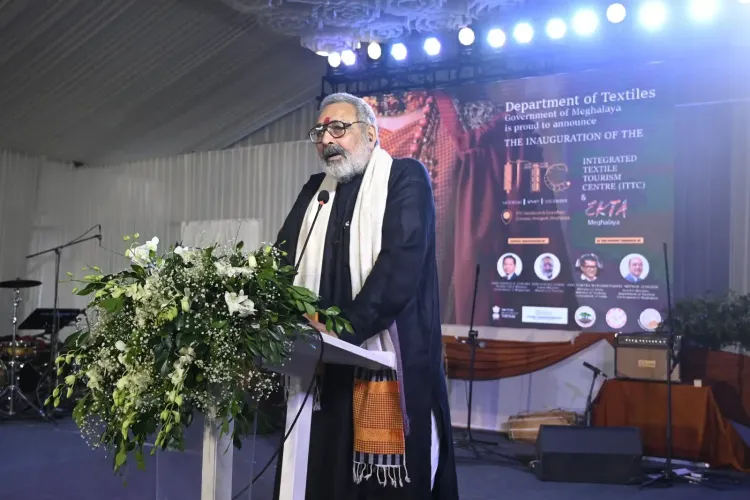
During the inauguration of the Integrated Textile and Tourism Centre (ITTC) at Nongpoh, in Meghalaya's Ri Bhoi district, Minister Singh remarked that the Northeast embodies the richness of India's textile heritage, being renowned for Muga, Eri, and traditional weaving mastery.
He emphasized that the ITTC will act as a comprehensive platform for training, design development, silk processing, product diversification, and tourism, thus enabling artisans in Meghalaya to tap into national and international markets.
Singh noted that the Union government is executing several schemes aimed at bolstering handloom clusters, enhancing raw material access, modernizing weaving technologies, and promoting natural fibers on a global scale.
He further mentioned new initiatives aimed at increasing farmers' income within the state, discussing the transition from two Muga crops to three to potentially double farmers' earnings.
"With best practices, one acre can yield four to five lakh rupees. The Central Silk Board and the State Sericulture Department will collaborate to realize this potential," he added.
Singh underscored the importance of cultivating an ecosystem that maximizes the region's capabilities, stating, "India is unique in producing a variety of silks – Muga, Tasar, Mulberry, and Eri. By scaling up Muga and Eri, Meghalaya and the Northeast can position India as a global leader, especially as other nations pivot towards synthetics," he remarked.
The Union Minister reiterated the government’s commitment to developing a robust textile and sericulture ecosystem in the Northeast.
Announcing the launch of a new Weavers' Service Centre in Meghalaya, Singh pointed out that the existing centre in Guwahati serves as a critical resource for technical and design assistance for weavers.
He stated, "Currently, we have only one such centre in the region. I plan to establish one in each state, starting with Meghalaya, once the state government allocates land."
Highlighting the region's competitive edge, Singh expressed confidence that the Northeast could emerge as a significant buyer-seller hub. "From Guwahati, it takes just an hour to reach the natural silk production sites. This is an exceptional advantage," he noted.
Emphasizing the Textile Ministry's income-centric initiative, he said, "My aim is to ensure every weaver achieves an income of Rs 50,000 monthly – this is our 'Pachlakhia Didi' model. We have devised the roadmap and will implement it in Meghalaya with state support."
He also engaged with master weavers and local producers, who expressed their appreciation for the new facility, acknowledging that the ITTC will facilitate training, raw material access, and improved market opportunities.
Union Minister of State (MoS) for Textiles, Pabitra Margherita, emphasized the notable presence of Northeast artisans on global platforms.
He recalled, "At BharatTex recently – one of the largest textile exhibitions globally, more than two lakh industry stakeholders and 6,000 international buyers attended. On that stage, a weaver from a distant village in Meghalaya showcased their fabric with great pride. This exemplifies the power of integration and India's growth narrative under Prime Minister Modi," the MoS remarked.
He highlighted that 52% of India's handlooms are situated in the Northeast, rendering the region one of the country's most potent textile clusters.
He also announced that all Textile Ministers from across India will gather in Guwahati next month to discuss a Northeast-centric textile development agenda.
Meghalaya Textiles Minister Metbah Lyngdoh expressed profound gratitude to the Ministry of Textiles for championing the state’s aspirations.
Describing the ITTC as a "historic and transformative project," he commented, "This centre symbolizes the fusion of tradition, skill, and vision for the cultural and economic future of Meghalaya. It will empower artisans, rejuvenate our rich silk legacy, and position Nongpoh as a distinctive destination for textile tourism."
He noted that the ITTC, established under the North East Regional Textile Promotion Scheme, is envisioned as a hub for artisan empowerment, a living museum for Ryndia, Eri, and Muga silk, a center for training, design development, and product innovation, and a textile-tourism spot, benefiting local communities directly.
P. Sivakumar, Central Silk Board Member Secretary, praised Meghalaya's traditional silk sector, stating, "Muga and Eri are not merely fibers; they represent the cultural and economic strengths of this region."
The ITTC will provide scientific, technical, and commercial support to enhance silk production, assure quality, and broaden market outreach, he mentioned.
Sivakumar reaffirmed the Central Silk Board's dedication to assisting Meghalaya in seed production, rearing capabilities, yarn quality enhancement, and cluster development.
Point of View
It is evident that the government's commitment to enhancing the textile sector in the Northeast is a strategic move, not only for economic upliftment but also for preserving and promoting the rich heritage of traditional weaving. This initiative has the potential to significantly benefit local artisans and the broader economy, aligning with national goals for sustainable development.
NationPress
11 Oct 2026
Frequently Asked Questions
What is the purpose of the Integrated Textile and Tourism Centre?
The ITTC aims to serve as a comprehensive platform for training, design development, silk processing, and tourism, enabling local artisans to access national and international markets.
How will this initiative impact local farmers?
The initiative is expected to boost farmers' incomes by introducing practices that allow for increased Muga crop production, potentially doubling their earnings through better agricultural practices.
What is the significance of the Northeast in India's textile industry?
The Northeast is home to 52% of India's handlooms, making it a critical region for textile production and innovation.
What support is being provided to weavers in the Northeast?
The government is establishing Weavers' Service Centres to offer technical and design support, along with various schemes to enhance raw material availability and promote natural fibers.
What role does the Central Silk Board play in this initiative?
The Central Silk Board will provide scientific, technical, and commercial support to enhance silk production and quality, aiding in the overall development of the sector.