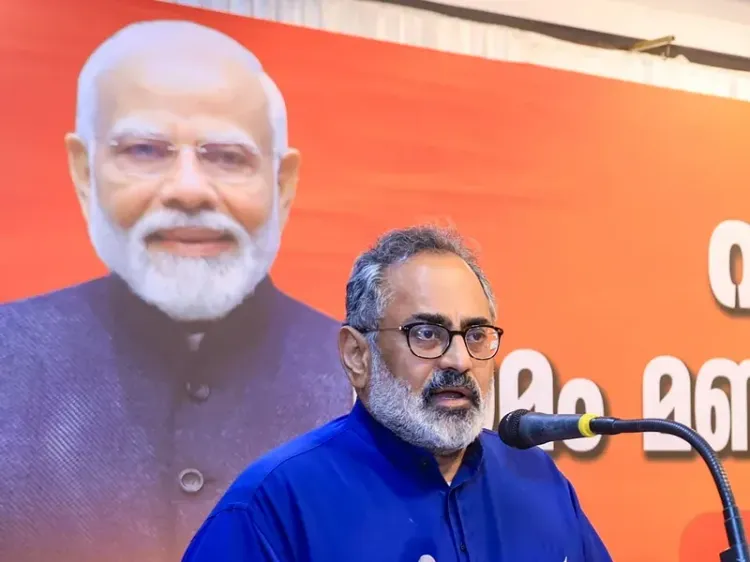
Rajeev Chandrasekhar hits back at Satheesan over VCs at RSS event
Synopsis
Three Kerala Vice-Chancellors attending an RSS centenary event addressed by Mohan Bhagwat has ignited a political firestorm. CM Satheesan demanded apologies; BJP chief Chandrasekhar fired back, questioning whether a government backed by IUML and Jamaat-e-Islami can credibly invoke secularism. The row cuts to a deeper question: who defines ideological neutrality in Kerala's public institutions?
Key Takeaways
Kerala BJP president Rajeev Chandrasekhar publicly countered CM V.D.
Satheesan on 14 June over the Vice-Chancellors controversy.
Three university Vice-Chancellors attended an RSS centenary programme in Kerala addressed by Mohan Bhagwat .
Satheesan called their attendance a Chandrasekhar alleged Satheesan has no moral authority on secularism given his government’s dependence on IUML and Jamaat-e-Islami .
The BJP leader accused both Congress and CPI-M of using anti-RSS rhetoric as a vote-bank strategy in Kerala.
The episode has triggered a broader debate on ideological neutrality in Kerala’s public universities.
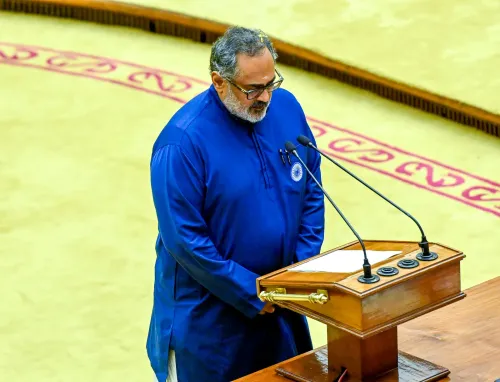
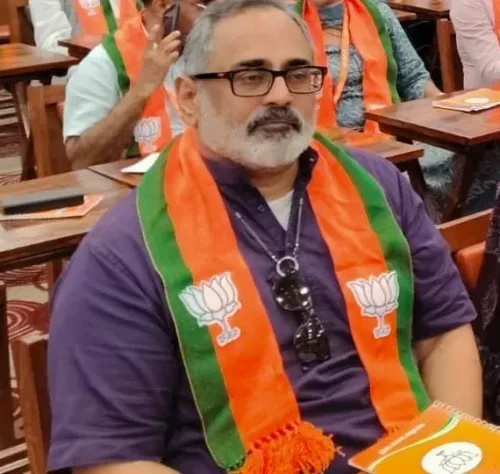
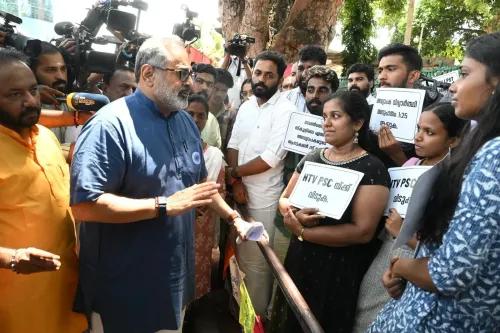
Kerala BJP president Rajeev Chandrasekhar on Sunday, 14 June launched a sharp counter-attack on Congress Chief Minister V.D. Satheesan, accusing him of hypocrisy on secularism after Satheesan publicly criticised three university Vice-Chancellors for attending an RSS centenary programme addressed by RSS Sarsanghchalak Mohan Bhagwat in Kerala. Chandrasekhar argued that a Chief Minister whose government depends on the support of the Indian Union Muslim League (IUML) and Jamaat-e-Islami has no moral standing to lecture others on constitutional values.
What Satheesan Said
Chief Minister Satheesan described the Vice-Chancellors' attendance at the RSS centenary-related event as a “serious lapse,” contending that the holders of such offices were expected to maintain dignity and ideological neutrality. He argued that attending a programme led by the head of an organisation he accused of promoting communal ideology was “unbecoming” of those carrying constitutional and academic responsibilities.
Satheesan went further, calling upon the three Vice-Chancellors to publicly apologise to the people of Kerala, and warned that any conduct encouraging communalism would not be tolerated by the government.
Chandrasekhar's Counter-Attack
Responding in a strongly worded social media post, Chandrasekhar alleged that Satheesan lacked the moral authority to invoke secularism while governing with the backing of the IUML and Jamaat-e-Islami. “Let us be very clear and honest with the people of Kerala. Someone who has normalised radical, anti-Constitution and anti-secular organisations like Jamaat-e-Islami, and who is in power only because of the support of the Muslim League and Jamaat-e-Islami, must not talk about supporting secularism or respecting the Constitution,” Chandrasekhar said.
He further termed it unacceptable that a Chief Minister who had sworn an oath to uphold the Constitution was, in his view, attempting to intimidate Vice-Chancellors for attending a lawful public programme featuring Mohan Bhagwat.
The Broader Political Charge
Chandrasekhar also alleged that both the Indian National Congress (Congress) and the Communist Party of India (Marxist) (CPI-M) had long deployed criticism of the RSS and the Bharatiya Janata Party (BJP) as a tool to consolidate minority votes in Kerala. He claimed that such tactics were losing their grip, arguing that more Malayalis were openly embracing nationalist sentiment.
“The days of treating the BJP and RSS as a tool for fear-mongering and vote-bank politics are over. Malayalis will fearlessly express their nationalism and stand proudly with leaders who put the nation first,” he said.
Why This Controversy Matters
The episode has surfaced a longstanding tension in Kerala's public life: the extent to which university administrators, who hold quasi-constitutional positions, can participate in events organised by ideologically affiliated organisations. This is not the first time Vice-Chancellors in the state have come under political scrutiny — Kerala's universities have periodically been flashpoints in disputes between the state government and the Governor over academic appointments and institutional autonomy.
The exchange has broadened into a wider debate on ideological neutrality in public institutions, the limits of political criticism in a democracy, and whether the charge of “communalism” is being applied selectively across party lines. How the three Vice-Chancellors respond — and whether the state government takes any formal action — will be closely watched in the days ahead.
Point of View
Point to the coalition math of the accuser. It is a tactic that has worked electorally in other states, but Kerala’s political culture has historically been resistant to it. The more substantive question — whether Vice-Chancellors, as quasi-constitutional officeholders, should attend events organised by ideologically aligned organisations — is getting lost in the noise. Satheesan’s demand for an apology, without specifying any formal disciplinary mechanism, suggests this is political signalling rather than institutional action. And Chandrasekhar’s framing of nationalist sentiment as a rising tide in Kerala will be tested at the ballot box, not in social media posts.
NationPress
14 Sept 2026
Frequently Asked Questions
Why did Kerala CM Satheesan criticise the three Vice-Chancellors?
Chief Minister V.D. Satheesan said the Vice-Chancellors’ attendance at an RSS centenary programme addressed by Mohan Bhagwat was a ‘serious lapse’ that was inconsistent with the dignity and neutrality expected of their offices. He called upon them to apologise to the people of Kerala.
What was Rajeev Chandrasekhar’s response to Satheesan?
Kerala BJP president Rajeev Chandrasekhar alleged that Satheesan had no moral authority to speak on secularism because his government depends on the support of the Indian Union Muslim League and Jamaat-e-Islami. He said attempting to intimidate Vice-Chancellors for attending a lawful public event was unacceptable.
Which RSS event did the Vice-Chancellors attend?
The three Vice-Chancellors attended an RSS centenary-related event in Kerala at which RSS Sarsanghchalak Mohan Bhagwat addressed a gathering. The event was part of programmes marking the RSS’s centenary.
What broader issue does this controversy raise?
The row has sparked a debate about whether university Vice-Chancellors, who hold quasi-constitutional positions, should participate in events organised by ideologically affiliated organisations. It also touches on whether political criticism of the RSS is being applied selectively across party lines in Kerala.
Has Chandrasekhar made similar political arguments before?
Chandrasekhar and the BJP have consistently argued that Congress and CPI-M deploy anti-RSS rhetoric primarily as a vote-bank tool in Kerala. His 14 June remarks follow an established BJP counter-narrative that frames such criticism as politically motivated rather than principled.