Giriraj Singh Hails ISRO's Chandrayaan-3 Winning 2026 AIAA Goddard Award
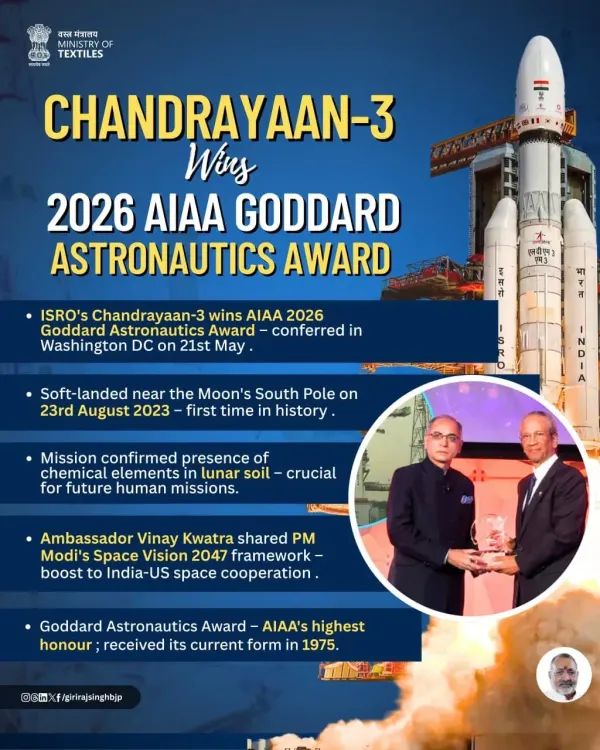
Synopsis
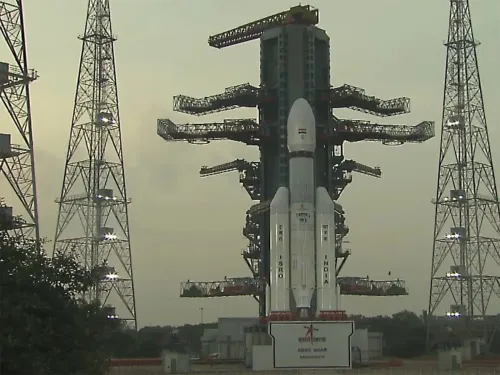
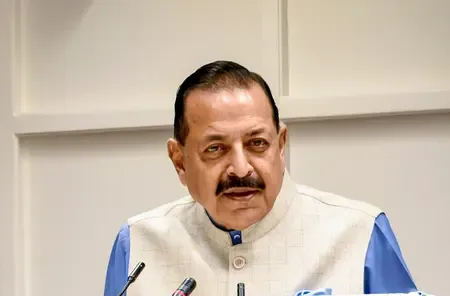
Union Textiles Minister Giriraj Singh has hailed ISRO's Chandrayaan-3 mission after it received the prestigious 2026 AIAA Goddard Astronautics Award in Washington DC, linking the honour to PM Modi's Space Vision 2047 and calling it a proud moment for every Indian.
Key Takeaways
Chandrayaan-3 has been awarded the 2026 AIAA Goddard Astronautics Award by the American Institute of Aeronautics and Astronautics in Washington DC .
Union Textiles Minister Giriraj Singh described the honour as the highest recognition and a source of national pride.
Singh linked the achievement to PM Narendra Modi's 'Space Vision 2047' framework for India's long-term space ambitions.
Chandrayaan-3 achieved the first-ever soft landing near the lunar south pole on 23 August 2023 .
India's space sector has expanded significantly since 2014 , with private participation enabled through the IN-SPACe framework.
The next major milestone for ISRO is the crewed spaceflight mission Gaganyaan .
Union Textiles Minister Giriraj Singh on Wednesday, 27 May 2026 congratulated ISRO after Chandrayaan-3 was honoured with the prestigious 2026 AIAA Goddard Astronautics Award in Washington DC, calling the recognition a matter of immense national pride. The award, conferred by the American Institute of Aeronautics and Astronautics (AIAA), is among the highest honours in the field of astronautics globally.
Context
Singh posted on X, stating: 'इसरो के चंद्रयान-3 को प्रतिष्ठित 2026 AIAA गॉडार्ड एस्ट्रोनॉटिक्स अवार्ड से सम्मानित किया गया है' ['ISRO's Chandrayaan-3 has been honoured with the prestigious 2026 AIAA Goddard Astronautics Award']. He described the honour received in Washington DC as the highest recognition and a source of pride for every Indian. Singh also linked the achievement to Prime Minister Narendra Modi's 'Space Vision 2047' framework, saying ISRO's journey is taking the country's space sector to new heights.
The AIAA Goddard Astronautics Award is presented annually by the American Institute of Aeronautics and Astronautics for outstanding contributions to the field of astronautics. Being conferred on an Indian mission underscores the global stature that Chandrayaan-3 has earned since its landmark success.
Policy Backdrop
Chandrayaan-3 made history on 23 August 2023 when its Vikram lander achieved the first-ever soft landing near the lunar south pole, a feat no other space agency had accomplished. The mission capped a three-generation lunar programme that began with Chandrayaan-1 in 2008 and continued with Chandrayaan-2 in 2019.
India's space ambitions have expanded significantly since 2014, with the government increasing public investment and simultaneously opening the sector to private players through the IN-SPACe regulatory framework. Missions such as Mangalyaan — launched in 2013-14 and completed on a comparatively modest budget — established India's credentials as a cost-effective, high-capability space power alongside the US, Russia, and China.
The government has framed successive space successes as proof of technological self-reliance, a narrative that aligns with the broader 'Atmanirbhar Bharat' push. Singh's invocation of 'Space Vision 2047' — described as a long-term roadmap for India's space sector under PM Modi — places Chandrayaan-3's international recognition within that strategic arc.
Stakeholders and Impact
ISRO scientists and engineers are the primary beneficiaries of the recognition, which validates years of indigenous research and development conducted on a fraction of the budget of comparable international missions. The award is also expected to boost morale within India's growing private space industry, which has been encouraged to collaborate with ISRO under the IN-SPACe framework.
For STEM students and young researchers across India, the international honour reinforces the appeal of careers in space science and engineering. Policymakers see such recognition as soft-power capital, strengthening India's hand in bilateral space cooperation discussions — including those at upcoming US-India diplomatic forums.
What's Next
Attention in India's space programme is increasingly turning toward Gaganyaan, the country's first crewed spaceflight mission, which represents the next major milestone in the national space roadmap. Progress on Gaganyaan, combined with the international credibility earned by Chandrayaan-3, is expected to feature prominently in any space-cooperation agenda at forthcoming US-India summits.
As India positions itself for a larger share of the global space economy, awards like the 2026 AIAA Goddard Astronautics Award serve as tangible markers of the country's rise — reinforcing the argument that Indian space technology has moved well beyond regional significance into the front rank of global achievement.
Point of View
And a senior BJP minister amplifying a US-conferred space award serves that story well on both the domestic and diplomatic fronts. By explicitly tying the honour to 'Space Vision 2047', the messaging seeks to project continuity between past mission success and future ambition, keeping the space programme politically salient ahead of Gaganyaan milestones. The choice of a Textiles Minister — rather than the Science or Space Minister — to lead this congratulatory communication reflects the BJP's broader strategy of deploying its entire senior leadership as a unified chorus on nationalist achievement narratives. Internationally, the award strengthens India's positioning in US-India space cooperation talks, where credibility and demonstrated capability are key bargaining assets.
NationPress
24 Sept 2026
Frequently Asked Questions
What is the AIAA Goddard Astronautics Award?
The AIAA Goddard Astronautics Award is one of the highest honours in the field of astronautics, presented annually by the American Institute of Aeronautics and Astronautics for outstanding contributions to the discipline. In 2026, it was conferred on India's Chandrayaan-3 lunar mission.
What did Chandrayaan-3 achieve?
Chandrayaan-3 achieved the first-ever successful soft landing near the lunar south pole on 23 August 2023 , a feat no other space agency had accomplished before. The mission comprised the Vikram lander and Pragyan rover.
What is India's Space Vision 2047?
Space Vision 2047 is a long-term roadmap for India's space sector championed by Prime Minister Narendra Modi , aimed at expanding the country's space capabilities and its share of the global space economy by the centenary of Indian independence.
Why did Giriraj Singh comment on the ISRO award?
As a senior BJP leader and Union Minister, Giriraj Singh posted on X to express national pride over Chandrayaan-3's international recognition, linking it to PM Modi's Space Vision 2047 as part of the government's broader narrative on technological self-reliance.
What is India's next major space mission after Chandrayaan-3?
India's next major milestone is Gaganyaan , the country's first crewed spaceflight mission being developed by ISRO, which is expected to mark another significant step in the national space programme.