CM Dhami Hails Chandrayaan-3's 2026 AIAA Goddard Award
Synopsis
Uttarakhand Chief Minister Pushkar Singh Dhami congratulated ISRO on 22 May 2026 after Chandrayaan-3 was honoured with the 2026 AIAA Goddard Astronautics Award, calling it a moment of pride for every Indian and crediting PM Modi's leadership for India's space achievements.
Key Takeaways
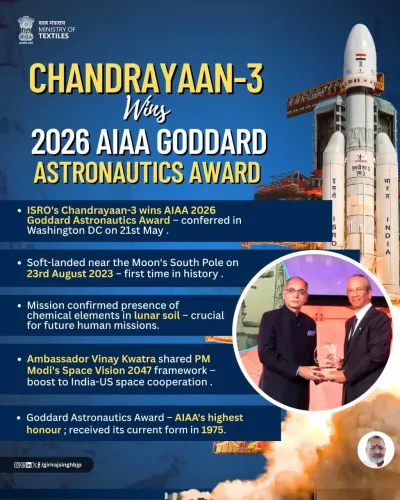
Uttarakhand CM Pushkar Singh Dhami congratulated ISRO on 22 May 2026 after Chandrayaan-3 was named the recipient of the 2026 AIAA Goddard Astronautics Award .
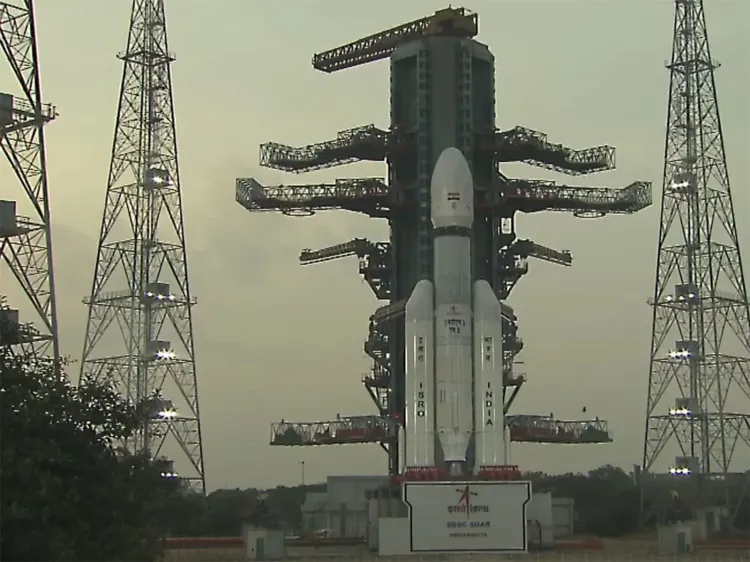
Chandrayaan-3 achieved the world's first soft landing near the Moon's south pole in August 2023 , making India the fourth nation to soft-land on the Moon.
The AIAA Goddard Astronautics Award is conferred by the American Institute of Aeronautics and Astronautics , one of the most respected professional aerospace bodies globally.
Dhami described the mission as a symbol of 'new India's confidence, resolve, and global leadership,' crediting PM Narendra Modi's visionary direction.
India's space programme has built successive lunar and planetary milestones since Chandrayaan-1 in 2008 , underpinned by a philosophy of frugal, self-reliant engineering.
The next major milestone being watched is the Gaganyaan human spaceflight mission, which aims to place Indian astronauts in orbit aboard an indigenous vehicle.
Uttarakhand Chief Minister Pushkar Singh Dhami on Friday, 22 May 2026 congratulated ISRO scientists and personnel after Chandrayaan-3 was announced as the recipient of the prestigious 2026 AIAA Goddard Astronautics Award, calling the recognition 'a moment of pride for every Indian.' Dhami posted his congratulations on X, crediting Prime Minister Narendra Modi's visionary leadership for India's rising stature in space research.
Context
In his post, Dhami wrote — 'चंद्रयान-3 मिशन को प्रतिष्ठित 2026 AIAA Goddard Astronautics Award से सम्मानित किया जाना प्रत्येक भारतीय के लिए गौरव का क्षण है' ['The conferment of the prestigious 2026 AIAA Goddard Astronautics Award on the Chandrayaan-3 mission is a moment of pride for every Indian']. He extended 'heartfelt congratulations and best wishes' to all scientists and dedicated personnel of ISRO for what he described as a historic achievement.
The AIAA Goddard Astronautics Award is conferred by the American Institute of Aeronautics and Astronautics, one of the world's foremost professional bodies in aerospace, and is among its highest honours recognising outstanding contributions to the science and engineering of astronautics.
Policy Backdrop
Chandrayaan-3 achieved a successful soft landing near the Moon's south pole in August 2023, making India the first country in the world to land a spacecraft in that region and the fourth nation overall to achieve a soft lunar landing. The mission built on decades of incremental capability — from Chandrayaan-1 in 2008, which confirmed the presence of water molecules on the Moon, to Chandrayaan-2 in 2019, which successfully placed an orbiter around the Moon despite a partial setback in its lander attempt.
India's space programme has operated under a philosophy of frugal, self-reliant engineering since ISRO's founding in 1969. The Mars Orbiter Mission of 2013 made India the first Asian country to reach Martian orbit on its maiden attempt, establishing a pattern of cost-effective deep-space exploration that the international scientific community has repeatedly acknowledged.
Stakeholders and Impact
The award recognition carries significance for ISRO's roughly 17,000-strong workforce of scientists, engineers, and technicians whose multi-year effort brought Chandrayaan-3 from design to successful touchdown. Dhami framed the mission not merely as a technological triumph but as 'a symbol of new India's confidence, resolve, and global leadership' — 'नए भारत के आत्मविश्वास, संकल्प और वैश्विक नेतृत्व का प्रतीक'.
The broader Indian scientific community, academic institutions, and the country's growing private space sector stand to benefit from the heightened global credibility that international honours of this stature bring to India's aerospace ecosystem.
What's Next
Attention in India's space programme is already turning to the Gaganyaan human spaceflight mission, which aims to send Indian astronauts to orbit aboard an indigenous vehicle. Follow-on lunar and planetary missions are also under discussion within ISRO's long-range planning. International recognition such as the AIAA Goddard Astronautics Award is likely to strengthen the case for sustained budgetary and policy support for these ambitious programmes in the years ahead.
Frequently Asked Questions
What is the AIAA Goddard Astronautics Award?
The AIAA Goddard Astronautics Award is one of the highest honours given by the American Institute of Aeronautics and Astronautics, recognising outstanding contributions to the science and engineering of astronautics. Chandrayaan-3 was named its 2026 recipient.
What did Chandrayaan-3 achieve?
Chandrayaan-3 achieved a successful soft landing near the Moon's south pole in August 2023, making India the first country to land a spacecraft in that region and only the fourth nation in history to achieve a soft lunar landing.
Why did CM Dhami congratulate ISRO?
Uttarakhand Chief Minister Pushkar Singh Dhami congratulated ISRO on 22 May 2026 following the announcement that Chandrayaan-3 had been selected for the prestigious 2026 AIAA Goddard Astronautics Award, calling it a moment of pride for every Indian.
What is India's next big space mission after Chandrayaan-3?
India's next major space milestone is the Gaganyaan human spaceflight mission, which aims to send Indian astronauts to orbit aboard an indigenous launch vehicle developed by ISRO.
How has India's space programme grown over the years?
India's space programme has grown steadily since ISRO's founding in 1969, progressing from Chandrayaan-1 in 2008 to the Mars Orbiter Mission in 2013 and Chandrayaan-3's historic south-pole landing in 2023, consistently emphasising frugal, self-reliant engineering.