CM Samrat Choudhary Hails Chandrayaan-3 AIAA Goddard Award
Synopsis
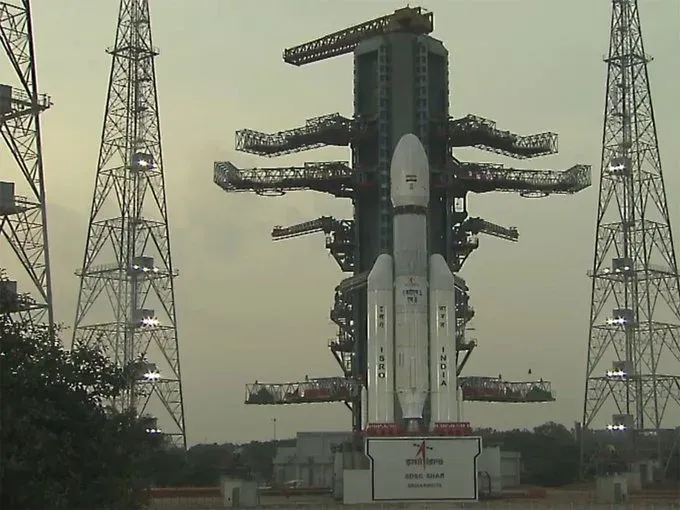
Bihar Chief Minister Samrat Choudhary has hailed the conferment of the 2026 AIAA Goddard Astronautics Award on Chandrayaan-3, calling it proof of India's scientific self-reliance and PM Modi's visionary leadership. The mission made history in August 2023 as the first to soft-land on the Moon's south pole.
Key Takeaways
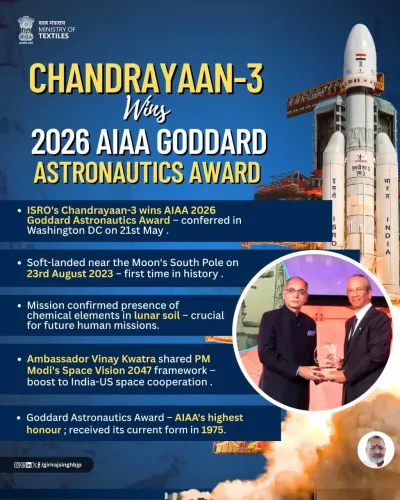
Bihar CM Samrat Choudhary publicly celebrated the 2026 AIAA Goddard Astronautics Award being conferred on Chandrayaan-3 on 22 May 2026 .
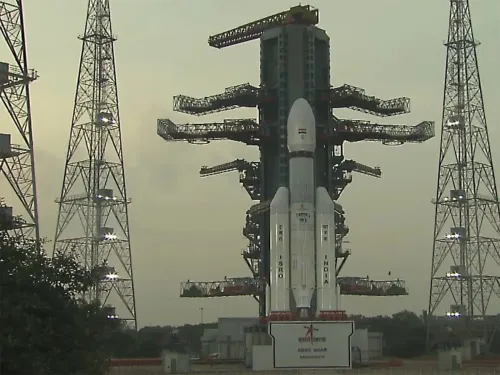
Chandrayaan-3 achieved the world's first successful soft landing on the Moon's south pole in August 2023 .
The AIAA Goddard Astronautics Award is given by the American Institute of Aeronautics and Astronautics for outstanding achievements in space flight.
The award was cited for the mission's successful soft landing and its unprecedented contribution to future lunar missions.
CM Choudhary credited the achievement to ISRO scientists, Atmanirbhar Bharat , and PM Narendra Modi 's leadership.
India's lunar programme has progressed from the Chandrayaan-1 orbiter in 2008 to a precision south-pole landing in 2023 .
Bihar Chief Minister Samrat Choudhary on Friday, 22 May 2026 celebrated the recognition of Chandrayaan-3 with the prestigious 2026 AIAA Goddard Astronautics Award, calling it a moment of pride for every Indian and a testament to the nation's growing scientific self-reliance.
Context
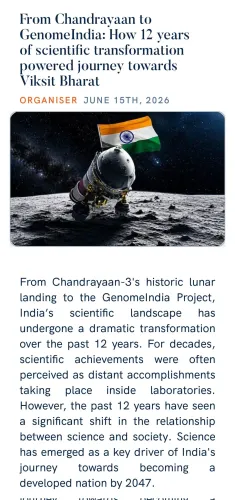
In his post, CM Choudhary wrote: 'वैश्विक सम्मान से गौरवान्वित हुआ भारत का चंद्र मिशन' ['India's lunar mission has been honoured with global recognition']. He noted that by planting the tricolour on the Moon's south pole, India had created history — and that this achievement has now been celebrated on a world stage.
The American Institute of Aeronautics and Astronautics (AIAA) Goddard Astronautics Award is among the most distinguished honours in the global space community, recognising outstanding contributions to space flight and astronautics. Chandrayaan-3 has been cited for its successful soft landing and its unprecedented contribution to future lunar missions.
Policy Backdrop
India's lunar exploration journey spans nearly two decades. Chandrayaan-1, launched in 2008, established the country's initial capability and returned evidence of water molecules on the lunar surface. Chandrayaan-2, launched in 2019, combined an orbiter, lander, and rover, but the Vikram lander did not achieve a soft landing.
The government approved and funded Chandrayaan-3 in 2020 as a focused lander-rover mission designed specifically to demonstrate a controlled soft landing. When ISRO successfully landed at the Moon's south pole in August 2023, India became the first country to achieve this feat — a region of intense scientific interest due to permanently shadowed craters that may contain water ice.
CM Choudhary credited the mission's success to the 'tireless hard work of India's scientists, the country's growing Atmanirbharta [self-reliance], and the visionary leadership of Prime Minister Narendra Modi.'
Stakeholders and Impact
The award reflects widening international acknowledgement of ISRO's cost-effective, indigenous approach to deep-space exploration. India's space programme has consistently demonstrated that complex missions can be executed at a fraction of comparable international costs, drawing attention from space agencies and research institutions worldwide.
For India's scientific community — the engineers, researchers, and mission controllers who built and operated Chandrayaan-3 — the AIAA Goddard Astronautics Award represents external validation of a methodology developed over decades. The recognition also strengthens India's standing in multilateral discussions around lunar resources and long-duration exploration, alongside programmes run by NASA, CNSA, and Roscosmos.
Politically, the award provides BJP leaders, including CM Choudhary, a platform to connect the government's Atmanirbhar Bharat policy framework to a tangible, globally acclaimed scientific outcome.
What's Next
ISRO is working on follow-on lunar concepts including sample-return missions and potential collaboration under the Artemis Accords framework. Budget allocations and parliamentary oversight of India's human spaceflight programme — Gaganyaan — and broader planetary exploration roadmap will determine the pace of these ambitions.
As global interest in the Moon's south pole intensifies among spacefaring nations, India's demonstrated soft-landing capability and the international recognition it has now earned position ISRO as a credible partner and competitor in the next era of lunar exploration.
Point of View
And BJP leaders are keen to anchor that narrative to the Atmanirbhar Bharat policy platform. CM Samrat Choudhary's public celebration of the award, while ceremonial in tone, is also a deliberate political signal — connecting Bihar's ruling establishment to a national achievement that carries broad popular appeal. The post's explicit invocation of PM Modi's 'visionary leadership' fits a well-established pattern of state-level BJP leaders reinforcing the Centre's science-and-technology brand. More substantively, international recognition from a body like the AIAA lends weight to India's ambitions for deeper collaboration on future lunar and planetary missions.
NationPress
20 Sept 2026
Frequently Asked Questions
What is the AIAA Goddard Astronautics Award?
The AIAA Goddard Astronautics Award is an annual honour given by the American Institute of Aeronautics and Astronautics to recognise outstanding contributions to space flight and astronautics. Chandrayaan-3 has been named for the 2026 award.
Why did Chandrayaan-3 win the AIAA Goddard Astronautics Award?
Chandrayaan-3 was recognised for its successful soft landing on the Moon's south pole and its unprecedented contribution to future lunar missions, according to Bihar CM Samrat Choudhary's post citing the award.
What was historic about Chandrayaan-3's landing?
Chandrayaan-3 achieved the world's first successful soft landing on the Moon's south pole in August 2023, a region of scientific interest because its permanently shadowed craters may contain water ice.
Who built and operated Chandrayaan-3?
Chandrayaan-3 was designed, built, and operated by ISRO — the Indian Space Research Organisation — with government funding approved in 2020 following the Chandrayaan-2 lander's unsuccessful landing attempt in 2019.
What did Bihar CM Samrat Choudhary say about the award?
CM Choudhary called the award a moment of pride and inspiration for every Indian, crediting it to ISRO scientists' tireless hard work, India's growing self-reliance, and PM Narendra Modi's visionary leadership.