Gujarat CMO Highlights 12 Years of India's Science Leap
Synopsis
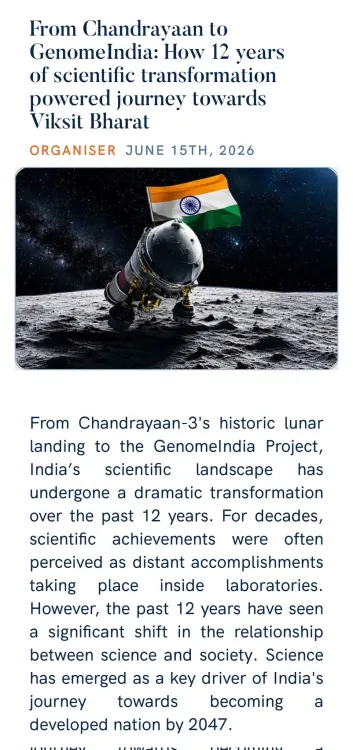
The Chief Minister's Office of Gujarat amplified a feature tracing India's 12-year scientific journey — from ISRO's Chandrayaan lunar landings to the GenomeIndia genomics project — as evidence of progress toward the Viksit Bharat 2047 development goal.
Key Takeaways
The Gujarat CMO shared an article on June 15, 2026 via the NaMo App highlighting 12 years of India's scientific transformation.
Chandrayaan-3 achieved a successful soft landing near the Moon's south pole in August 2023 , a landmark for ISRO .
The GenomeIndia project, launched in 2020 , aims to sequence 10,000 Indian genomes to advance precision medicine.
Both programmes are anchored in the Atmanirbhar Bharat framework announced in 2020 and the Viksit Bharat vision targeting 2047 .
The next major space milestone is the Gaganyaan human spaceflight mission by ISRO .
The Chief Minister's Office of Gujarat on Monday, June 15, 2026 shared an article tracing how 12 years of scientific transformation — from the Chandrayaan lunar missions to the GenomeIndia genomics project — have advanced India's journey toward becoming a developed nation under the Viksit Bharat vision.
Context
The post, shared via the NaMo App, links to a feature piece examining how India's indigenous science and technology programmes have evolved over the past decade-plus. The Gujarat CMO's amplification of this narrative signals the state's alignment with the broader national development agenda framed around scientific self-reliance.
At the heart of the article's argument are two landmark programmes: Chandrayaan-3, which achieved a successful soft landing on the Moon's south pole in August 2023, and the GenomeIndia project, a national initiative to sequence 10,000 Indian genomes to build a reference database for precision medicine research.
Policy Backdrop
The Indian Space Research Organisation (ISRO) executed the Chandrayaan series as part of India's planetary exploration programme. Chandrayaan-3's lunar landing was widely regarded as a milestone in indigenous space capability, placing India among a small group of nations to have achieved a controlled landing near the lunar south pole.
The GenomeIndia project was formally launched in 2020 by the Department of Biotechnology to map the genetic diversity of the Indian population. The data is intended to power precision medicine and disease-risk research tailored to Indian genetic profiles. Both programmes sit within the wider Atmanirbhar Bharat framework, announced in 2020, which emphasised indigenous development across strategic sectors including space and life sciences.
Since 2014, successive central government budgets have increased allocations for ISRO and the Department of Biotechnology, with achievements in both domains presented as evidence of progress toward strategic autonomy in science and technology.
Stakeholders and Impact
ISRO scientists and engineers, biotechnology researchers, and academic institutions across India are the primary stakeholders in the programmes cited. The Viksit Bharat vision — which targets transforming India into a fully developed economy by 2047 — positions science and technology as core pillars of national growth.
For ordinary citizens, the GenomeIndia database holds the potential to improve clinical outcomes through population-specific medical research, while advances in space technology carry implications for satellite-based services, agriculture monitoring, and national security applications.
What's Next
Attention in India's space programme is now focused on the Gaganyaan human spaceflight mission, which aims to send Indian astronauts to orbit and represents the next major milestone for ISRO. On the genomics front, researchers and policymakers are watching the expansion of the GenomeIndia database for clinical applications and its integration into public health planning.
The Gujarat CMO's decision to amplify this narrative on June 15, 2026 suggests that the state intends to position itself as a participant in — and beneficiary of — India's technology-led development story as the country moves closer to its 2047 centenary goal.
Point of View
Reinforcing the ruling dispensation's claim that science and technology achievements are products of a coherent 12-year policy agenda. By routing the share through the NaMo App, the post ties state-level communication infrastructure directly to the Prime Minister's personal digital ecosystem, blurring the line between government outreach and political branding. This pattern — state governments echoing central government science milestones — reflects a coordinated strategy to build a cumulative narrative of national achievement ahead of India's 2047 centenary target. The framing of space and genomics as twin pillars of development is also notable, as it broadens the 'Viksit Bharat' pitch beyond economic metrics to include scientific prestige.
NationPress
14 Sept 2026
Frequently Asked Questions
What is the Viksit Bharat vision?
Viksit Bharat is the Indian government's goal to transform India into a fully developed nation by 2047, the centenary of independence, with science and technology cited as key drivers.
What did Chandrayaan-3 achieve?
Chandrayaan-3, executed by ISRO, achieved a successful soft landing near the lunar south pole in August 2023, making India one of a handful of nations to accomplish this feat.
What is the GenomeIndia project?
GenomeIndia is a national project launched in 2020 by the Department of Biotechnology to sequence 10,000 Indian genomes and build a reference database for precision medicine research.
Why did the Gujarat CMO share this science article?
The Gujarat CMO shared the article to align the state with the central government's narrative of 12 years of scientific progress under the Viksit Bharat and Atmanirbhar Bharat frameworks.
What is India's next big space mission after Chandrayaan?
India's next major space milestone is the Gaganyaan mission, which aims to send Indian astronauts to orbit and is being developed by ISRO.