Chennai wins Best NMT City award; CM Vijay receives it
Synopsis
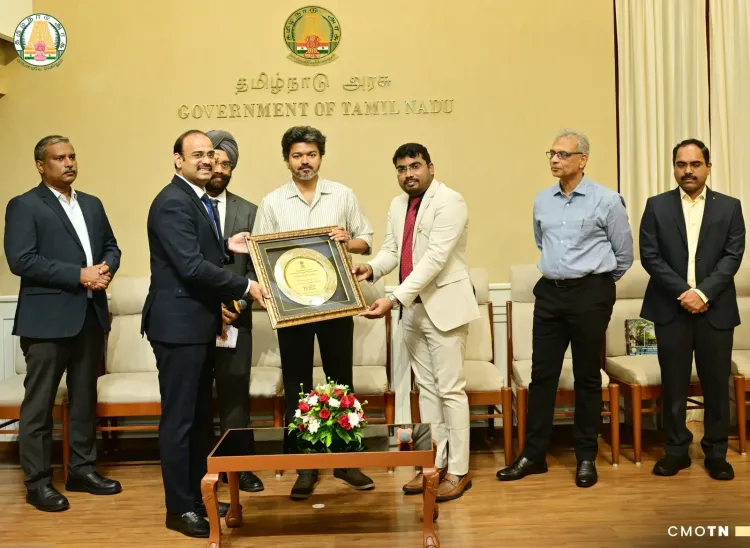
The Greater Chennai Corporation has won the Union Ministry of Housing and Urban Affairs' 'City with the Best Non-Motorized Transport System' award for pedestrian and road-safety infrastructure on Khader Nawaz Khan Road. Senior GCC officials presented the honour to CM C. Joseph Vijay at the Secretariat on 18 November 2026.
Key Takeaways
The Greater Chennai Corporation has been awarded the 'City with the Best Non-Motorized Transport System' title by the Union Ministry of Housing and Urban Affairs .
The award recognises dedicated pedestrian footpaths and road-safety works on Khader Nawaz Khan Road in the Teynampet Zone .
Senior IAS officers — Gagandeep Singh Bedi , Dr.
Saravanan — presented the award to Chief Minister C.
Joseph Vijay at the Secretariat on 18 November 2026 .
The recognition aligns with Central schemes including AMRUT and the Smart Cities Mission , both launched in 2015 , which mandate and fund non-motorized transport infrastructure.
Tamil Nadu urban local bodies have drawn multiple Central recognitions for pedestrian and cycling infrastructure in recent years, reflecting consistent execution on NMT policy.
The Teynampet model is a potential template for scaling similar upgrades across remaining GCC zones.
A pedestrian-first stretch along Khader Nawaz Khan Road in Chennai's Teynampet Zone has earned the city a national honour. The Union Ministry of Housing and Urban Affairs has conferred the 'City with the Best Non-Motorized Transport System' award on the Greater Chennai Corporation (GCC) — and on 18 November 2026, senior civic officials carried the award to the Chief Minister's Secretariat to present it to Chief Minister C. Joseph Vijay.
What Chennai built on Khader Nawaz Khan Road
The award recognises a package of infrastructure upgrades on Khader Nawaz Khan Road — dedicated pedestrian footpaths, road-safety furniture, and allied facilities designed to give walkers a safe, continuous corridor through one of central Chennai's busiest commercial belts. The Teynampet Zone, which covers central commercial and residential localities, was the site of these works. The upgrade is part of a broader push by the GCC to separate pedestrian movement from motorised traffic on high-footfall streets.
Who presented the award to CM Vijay
The award was shown to the Chief Minister at the Secretariat by three senior IAS officers: Gagandeep Singh Bedi, Additional Chief Secretary, Municipal Administration and Water Supply Department; Dr. G.S. Sameeran, Commissioner of Greater Chennai Corporation; and S. Saravanan, Joint Commissioner (Works), GCC. All three received the Chief Minister's congratulations in return.
AMRUT, Smart Cities, and the NMT recognition circuit
The Ministry of Housing and Urban Affairs periodically benchmarks and rewards cities for progress on sustainable mobility under two landmark Central frameworks — the AMRUT mission, launched in 2015, which funds non-motorized transport (NMT) infrastructure such as footpaths and cycle tracks, and the Smart Cities Mission, also from 2015, whose guidelines require participating cities to prepare dedicated NMT plans. Chennai's win places it among a select group of Indian cities that have translated policy mandates into measurable, on-the-ground infrastructure.
Tamil Nadu urban local bodies have drawn Central recognition for pedestrian and cycling infrastructure repeatedly in recent years — a pattern that signals both consistent state-level execution and an increasingly competitive national awards ecosystem that pushes cities to deliver visible results.
What comes next for Chennai's streets
The immediate question is replication. The GCC administers multiple zones across the city, and the Teynampet model — dedicated footpaths, safety markings, integrated road furniture — is a template ready to be rolled out on other high-pedestrian corridors. The Tamil Nadu Urban Development Fund remains a potential financing lever for scaling similar NMT works citywide. One national award on one road is a proof of concept; turning it into a city-wide standard is the real test.
Point of View
And Chennai's win suggests Tamil Nadu has learned how to play that game effectively. For CM Vijay, the optics of receiving a Union government honour at his own Secretariat carries quiet political value — it frames the state-Centre relationship as cooperative at a time when such optics matter. The harder question is whether a single-road showcase translates into systemic, zone-by-zone pedestrian infrastructure across a city of Chennai's density. Recognition is the easy part; replication at scale is where urban ambition is truly tested.
NationPress
18 Nov 2026
Frequently Asked Questions
What award did Greater Chennai Corporation win in 2026?
Greater Chennai Corporation won the 'City with the Best Non-Motorized Transport System' award from the Union Ministry of Housing and Urban Affairs, recognising pedestrian and road-safety infrastructure on Khader Nawaz Khan Road in the Teynampet Zone.
What work was done on Khader Nawaz Khan Road in Chennai?
The GCC undertook comprehensive infrastructure works including dedicated pedestrian footpaths and road-safety facilities along Khader Nawaz Khan Road in the Teynampet Zone, earning national recognition for non-motorized transport planning.
What is the AMRUT mission and how does it relate to this award?
AMRUT (Atal Mission for Rejuvenation and Urban Transformation), launched in 2015, funds non-motorized transport infrastructure such as footpaths and cycle tracks in Indian cities. Chennai's award-winning pedestrian infrastructure aligns with AMRUT's mandate.
Who presented the NMT award to Tamil Nadu CM Joseph Vijay?
Additional Chief Secretary Gagandeep Singh Bedi, GCC Commissioner Dr. G.S. Sameeran, and Joint Commissioner S. Saravanan presented the award to Chief Minister C. Joseph Vijay at the Secretariat on 18 November 2026.
Will Chennai expand pedestrian infrastructure to other zones after this award?
The Teynampet Zone model on Khader Nawaz Khan Road is considered a replicable template. Rollout of similar NMT works across remaining GCC zones and possible state-level scaling through the Tamil Nadu Urban Development Fund are being watched.