Chhattisgarh Cabinet Approves 3-Year Grant for Narayanpur Tribal College
Synopsis
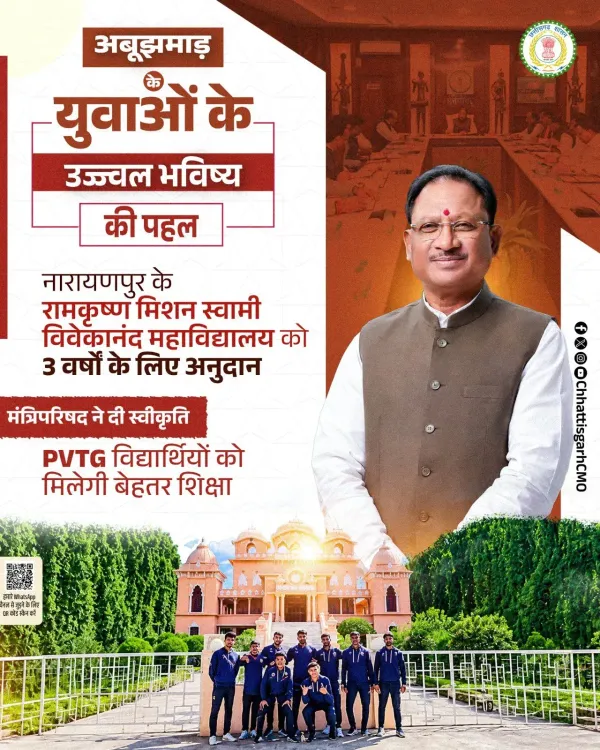
The Chhattisgarh cabinet has approved a three-year grant for Ramakrishna Mission Swami Vivekananda Mahavidyalaya in Narayanpur, aiming to improve higher education access for PVTG tribal students from the remote Abujhmad region.
Key Takeaways
The Chhattisgarh Council of Ministers approved a three-year grant for Ramakrishna Mission Swami Vivekananda Mahavidyalaya, Narayanpur on 18 November 2026 .
The grant targets improved higher education access for tribal students from Abujhmad , one of India's most remote forested regions.
Beneficiaries belong to Particularly Vulnerable Tribal Groups (PVTGs) , a central government classification for the most marginalised tribal communities.
The college is operated by the Ramakrishna Mission , which has an established presence in tribal education across India.
The multi-year nature of the grant provides planning certainty for faculty hiring and programme delivery across full academic cycles.
The decision aligns with the state's stated #JanjatiyaKalyan (tribal welfare) and #ViksitChhattisgarh policy agenda.
Deep inside Abujhmad — one of India's most remote and forested tribal belts — higher education has long been a distant dream for Particularly Vulnerable Tribal Group (PVTG) youth. That distance just got a little shorter. The Chief Minister's Office of Chhattisgarh announced on Wednesday, 18 November 2026 that the state cabinet has approved a three-year grant for the Ramakrishna Mission Swami Vivekananda Mahavidyalaya in Narayanpur, clearing a fresh path to higher education for tribal students in the region.
The cabinet decision, shared by the CMO, states: 'अबूझमाड़ के जनजातीय विद्यार्थियों को मिलेगी उच्च शिक्षा की बेहतर सुविधा' — 'Tribal students of Abujhmad will get better access to higher education.' The grant was cleared in a meeting of the Mantriparishad (Council of Ministers), signalling the state government's formal institutional commitment to the college's continued operation.
Ramakrishna Mission's foothold in Abujhmad's tribal heartland
The Ramakrishna Mission Swami Vivekananda Mahavidyalaya in Narayanpur is not a new arrival. Run by the Ramakrishna Mission — a century-old socio-religious organisation with a nationwide track record in tribal education — the college has functioned as one of the few higher-education institutions accessible to communities living in the dense, security-sensitive forests of Abujhmad. For PVTG youth, whose villages are often hours from the nearest town, proximity to a college is not a convenience. It is the difference between continuing education and dropping out entirely.
Chhattisgarh's tribal belt has historically seen limited access to formal college infrastructure, with Abujhmad — spread across Narayanpur district in the state's north — representing one of the most acute gaps. The state government's strategy of routing grants through established non-governmental institutions already embedded in these communities reflects a pragmatic approach: build on what exists rather than start from scratch in areas where state capacity is stretched.
PVTG welfare and the three-year commitment
The PVTG designation — a central government classification for the most marginalised tribal communities — triggers targeted welfare interventions in education, health, and livelihoods. Chhattisgarh is home to several PVTG groups, and Abujhmad is among the regions where their presence is concentrated. A cabinet-approved, multi-year grant rather than a one-off allocation signals that the state intends to give the institution planning certainty — the kind that lets a college hire faculty, retain students, and run programmes across a full academic cycle.
The CMO's post carried hashtags #JanjatiyaKalyan (tribal welfare), #ViksitChhattisgarh (developed Chhattisgarh), and #SushasanSarkar (good governance government) — framing the decision as part of a broader tribal-uplift and governance narrative the state administration is building ahead of its policy calendar.
Three years from now, the real verdict will come from enrolment numbers — how many PVTG students walk through those college gates who would not have otherwise.
Point of View
Anchoring tribal welfare spending in Abujhmad — historically associated with Maoist conflict and state absence — doubles as a security-linked development argument. The PVTG framing also positions this as convergent with central government priorities, potentially unlocking additional Union funding. Whether enrolment numbers actually rise will determine if this is landmark policy or well-branded routine spending.
NationPress
18 Nov 2026
Frequently Asked Questions
What is the Ramakrishna Mission Swami Vivekananda Mahavidyalaya in Narayanpur?
It is a higher-education college in Narayanpur district, Chhattisgarh, run by the Ramakrishna Mission and focused on providing college-level education to tribal youth in and around the Abujhmad region.
Who are PVTGs and why do they need special education support?
Particularly Vulnerable Tribal Groups (PVTGs) are communities identified by the Government of India as the most marginalised among scheduled tribes, often living in remote areas with very low literacy rates and limited access to schools and colleges.
What did the Chhattisgarh cabinet decide regarding Narayanpur college?
The Chhattisgarh Council of Ministers approved a three-year grant for the Ramakrishna Mission Swami Vivekananda Mahavidyalaya in Narayanpur to support higher education for tribal students from Abujhmad.
Where is Abujhmad and why is education access difficult there?
Abujhmad is a remote, densely forested tribal area in Narayanpur district of Chhattisgarh. Its geographic isolation, sparse infrastructure, and historically limited state presence have made access to colleges extremely difficult for local PVTG communities.
What is the significance of a three-year grant versus a one-year grant?
A multi-year grant gives the college financial predictability, allowing it to plan faculty appointments, run full academic programmes, and retain students — benefits a year-to-year allocation cannot guarantee.