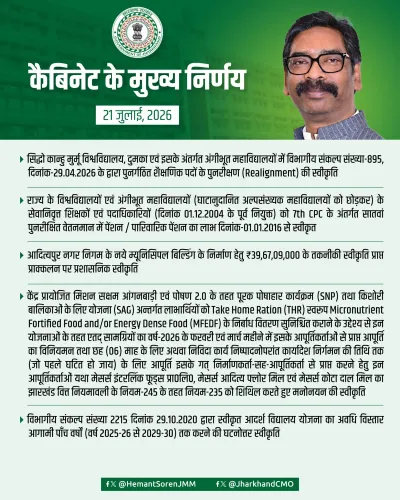
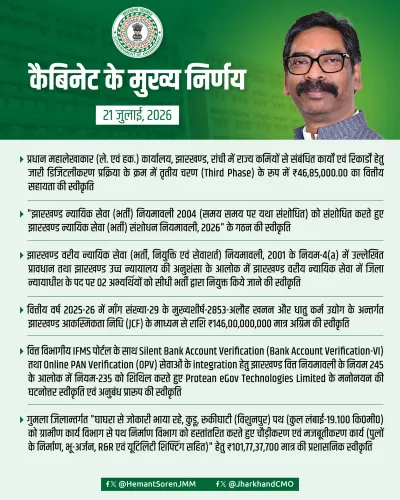
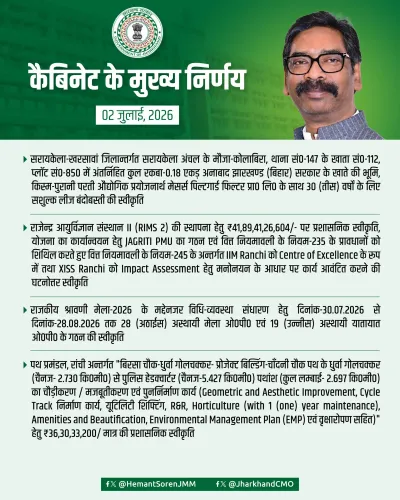
CM Hemant Soren Chairs Key Cabinet Meet on May 27
Synopsis
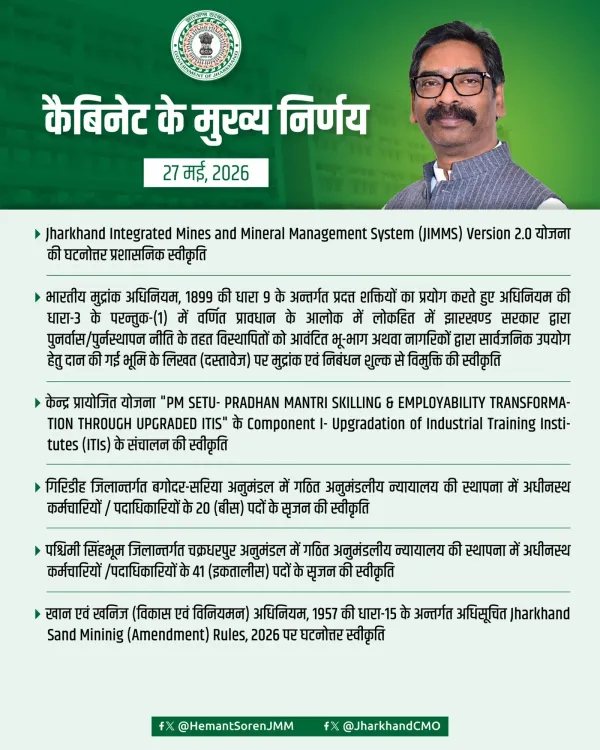
The Chief Minister's Office of Jharkhand announced key decisions from a Council of Ministers meeting held on 27 May 2026 under CM Hemant Soren's chairmanship, covering multiple governance and policy domains affecting the state's residents.
Key Takeaways
The Jharkhand Council of Ministers met on 27 May 2026 under CM Hemant Soren 's chairmanship.
The Chief Minister's Office disclosed the decisions in two parts via its official social media handle.
The meeting is part of Jharkhand 's regular cabinet cycle, a practice maintained since the state's formation in 2000 .
Hemant Soren leads the Jharkhand Mukti Morcha -headed government with a focus on tribal welfare and resource governance.
Detailed departmental orders and implementation timelines are expected to follow the cabinet approvals.
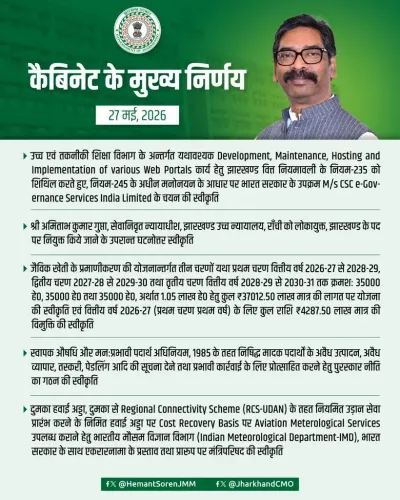
The Chief Minister's Office of Jharkhand announced on Wednesday, 27 May 2026 that the state's Council of Ministers, chaired by Chief Minister Hemant Soren, held a cabinet meeting and took several significant decisions. The official post, shared in two parts, described the outcomes as 'mahatvapurn nirnay' (important decisions) adopted at the session.
Context
The cabinet meeting was convened under Chief Minister Hemant Soren's chairmanship at Ranchi on 27 May 2026. The Chief Minister's Office shared the decisions publicly via its official social media handle, indicating a two-part disclosure of the outcomes — this being the second installment.
Jharkhand's Council of Ministers is the principal executive body of the state government, empowered to approve policies, schemes, and administrative orders that shape governance across the state's 24 districts.
Policy Backdrop
Since Jharkhand's formation as a separate state in 2000, successive governments have held periodic cabinet meetings to translate electoral mandates into executive action. These sessions typically cover a wide range: welfare scheme approvals, land and revenue decisions, infrastructure project clearances, and personnel appointments.
Hemant Soren of the Jharkhand Mukti Morcha leads the current government with a stated focus on tribal welfare, natural resource governance, and social security programmes. Cabinet meetings under his chairmanship have in the past addressed flagship initiatives targeting Scheduled Tribe communities, women's empowerment, and rural employment.
Stakeholders and Impact
The decisions taken at any Jharkhand cabinet meeting directly affect the state's approximately 3.8 crore residents, including a significant tribal population that constitutes roughly 26 percent of the state's demographic. State officials, district administrations, and beneficiaries of welfare schemes are the immediate stakeholders in the implementation chain.
Because the Chief Minister's Office released details in two parts, the full scope of decisions adopted on 27 May 2026 spans multiple policy domains — the breadth of which will become clearer as departmental follow-up orders are issued.
What's Next
The next steps involve individual departments translating cabinet approvals into government orders, budget allocations, and ground-level implementation. Legislative follow-up, if any decisions require amendments to existing laws, would be tabled in the Jharkhand Legislative Assembly in due course.
Political observers will watch for the detailed minutes or official press notes from the Jharkhand government, which typically accompany such announcements and provide item-by-item breakdowns of what was approved. The pace of implementation will be a measure of the administration's governance delivery ahead of future electoral cycles.
Point of View
Lending transparency to executive action. For Hemant Soren, regular cabinet cycles also serve as a visible signal of administrative momentum, particularly important for a government that has staked its identity on tribal welfare and social equity. The breadth of decisions across multiple domains suggests an active legislative agenda, and the pace of follow-through will be closely watched by both political opponents and civil society in the state. In a state where resource rights and welfare delivery remain contested terrain, each cabinet meeting carries outsized political weight.
NationPress
10 Oct 2026
Frequently Asked Questions
What decisions were taken in the Jharkhand cabinet meeting on 27 May 2026?
The Chief Minister's Office of Jharkhand announced that several important decisions were taken at the Council of Ministers meeting on 27 May 2026, though the full itemised list will be detailed in official departmental orders expected to follow.
Who chaired the Jharkhand cabinet meeting on 27 May 2026?
Chief Minister Hemant Soren of the Jharkhand Mukti Morcha chaired the Council of Ministers meeting held on 27 May 2026 .
How often does the Jharkhand Council of Ministers meet?
The Jharkhand Council of Ministers meets periodically as required by governance needs, typically to approve policies, scheme launches, administrative appointments, and budget reallocations.
What is the Jharkhand Council of Ministers?
The Jharkhand Council of Ministers is the principal executive body of the state government, comprising the Chief Minister and cabinet ministers, empowered to take binding decisions on state policy and administration.
What is Hemant Soren's focus as Jharkhand Chief Minister?
Hemant Soren has led the Jharkhand government with a stated emphasis on tribal welfare, natural resource governance, women's empowerment, and rural social security programmes.