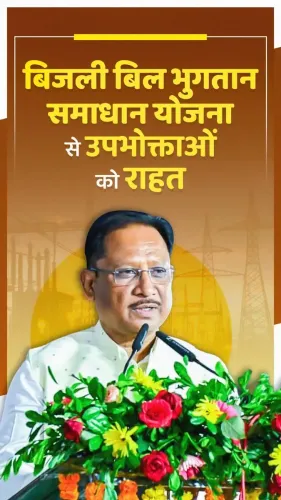
Chhattisgarh Cabinet Clears Direct Debit Mandate for Power Payments
Synopsis
The Chhattisgarh cabinet has approved a Direct Debit Mandate to replace the legacy tripartite payment agreement for electricity purchases from central PSUs including NTPC, aligning with RBI guidelines and ensuring supply continuity without additional burden on the state government.
Key Takeaways
The Chhattisgarh Council of Ministers approved replacing the tripartite power payment agreement with a Direct Debit Mandate (DDM) on 8 July 2026 .
The DDM will govern payments by Chhattisgarh State Power Distribution Company (CSPDCL) to central public sector undertakings including NTPC .
The new mechanism aligns payment security with current Reserve Bank of India (RBI) guidelines.
The state government has confirmed no additional financial burden on the exchequer; the discom's payment obligations remain unchanged.
An existing Letter of Credit (LC) arrangement will remain operative as a fallback where necessary.
The decision is expected to ensure uninterrupted electricity supply continuity from central generators to Chhattisgarh.
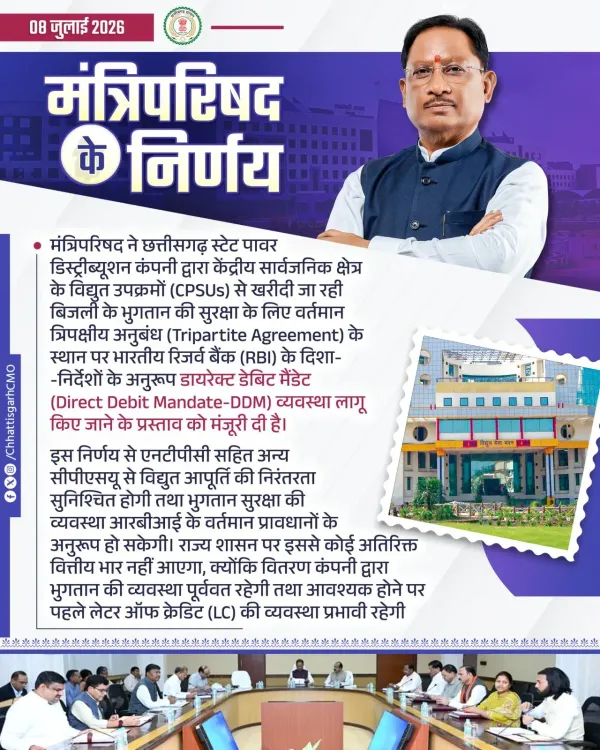
The Chief Minister's Office of Chhattisgarh announced on Wednesday, 8 July 2026 that the state cabinet has approved replacing the existing tripartite agreement with a Direct Debit Mandate (DDM) system for securing electricity payments made by the Chhattisgarh State Power Distribution Company (CSPDCL) to central public sector power undertakings (CPSUs).
The cabinet's post stated: 'मंत्रिपरिषद ने... डायरेक्ट डेबिट मैंडेट (Direct Debit Mandate-DDM) व्यवस्था लागू किए जाने के प्रस्ताव को मंजूरी दी है' — ('The Council of Ministers has approved the proposal to implement the Direct Debit Mandate system'). The new mechanism will align payment security with current Reserve Bank of India (RBI) guidelines, replacing a legacy tripartite contractual arrangement.
Context
The tripartite agreement has long served as the standard payment security instrument between state discoms, central generators, and state governments. Under this model, the state government stood as guarantor, enabling central generators to recover dues directly from state accounts in case of default. The DDM replaces this with an RBI-compliant automated debit instruction, a shift that several states have been undertaking to modernise payment infrastructure.
The CMO's post explicitly noted that the decision will ensure continuity of electricity supply from NTPC and other CPSUs, while bringing payment security arrangements in line with current RBI provisions.
Policy Backdrop
The move is consistent with the financial discipline framework promoted under the Ujwal DISCOM Assurance Yojana (UDAY), launched in 2015, which restructured state discom debt and pushed for stronger payment security mechanisms toward central generators. Rising electricity demand across India has made supply continuity a pressing concern, increasing pressure on discoms to maintain credible payment commitments.
The RBI's evolving guidelines on direct debit mandates — used widely in recurring payment contexts — have prompted multiple states to update legacy power sector instruments to reduce default risks and administrative friction. Chhattisgarh's cabinet decision is part of this broader national pattern of centre-state coordination on discom financial discipline.
Stakeholders and Impact
The Chhattisgarh State Power Distribution Company is the primary operational entity affected, as it will now execute payments to CPSUs through the DDM mechanism rather than the tripartite route. Central generators, including NTPC, gain a more standardised and RBI-aligned payment assurance, potentially reducing the risk of supply disruptions arising from payment disputes.
Crucially, the CMO's announcement specified that no additional financial burden will fall on the state government. The distribution company's payment obligations remain unchanged, and the existing Letter of Credit (LC) arrangement will remain available as a fallback where required. Consumers and industrial users in Chhattisgarh stand to benefit indirectly through more reliable power supply continuity.
What's Next
The approval sets the stage for CSPDCL to operationalise the DDM framework in coordination with its banking partners and the relevant CPSUs. The phased rollout of the mandate will be a key administrative milestone to watch. Should Chhattisgarh's transition proceed smoothly, it could serve as a reference model for other states still operating under older tripartite agreements. The broader implication is a gradual standardisation of power payment security instruments across India, reducing systemic risk in the electricity supply chain.
Point of View
Where the Centre has consistently nudged states to institutionalise payment discipline rather than rely on ad hoc sovereign backstops. The fact that the Letter of Credit safety net is being retained indicates a cautious, phased approach rather than an abrupt structural break. If the rollout is smooth, Chhattisgarh could accelerate a broader national migration away from legacy tripartite arrangements that have long been criticised for their administrative rigidity.
NationPress
8 Jul 2026
Frequently Asked Questions
What is the Direct Debit Mandate approved by the Chhattisgarh cabinet?
The Direct Debit Mandate (DDM) is an RBI-compliant automated payment instruction that allows the Chhattisgarh State Power Distribution Company to make recurring electricity payments to central public sector generators like NTPC directly, replacing the older tripartite agreement that required state government guarantees.
Why is Chhattisgarh replacing the tripartite power payment agreement?
The state is replacing the tripartite agreement because it is no longer aligned with current RBI guidelines. The DDM mechanism is more standardised, reduces administrative friction, and lowers the risk of payment defaults that could disrupt electricity supply.
Will Chhattisgarh consumers face any impact from this cabinet decision?
Consumers are not expected to face any direct impact. The decision is designed to ensure continuity of electricity supply from central generators, and the state government has confirmed that no additional financial burden will be placed on the exchequer or passed on through tariffs.
What happens to the Letter of Credit arrangement after the DDM is implemented?
The existing Letter of Credit (LC) arrangement will not be scrapped. The cabinet's decision specifies that the LC mechanism will remain available and operative as a fallback where necessary, providing an additional layer of payment security.
Which power companies are covered under this Chhattisgarh DDM decision?
The decision covers all central public sector power undertakings (CPSUs) from which the Chhattisgarh State Power Distribution Company purchases electricity, with NTPC specifically named as the most significant supplier among them.