Chhattisgarh CM Sai Unlocks Rs 6,855 Cr Rural Jobs Push
Synopsis
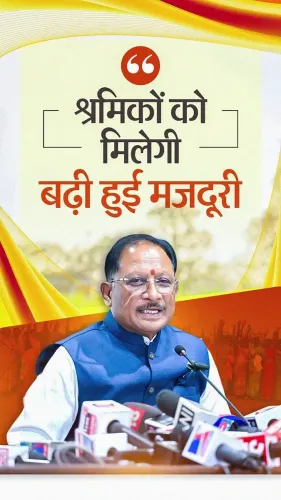
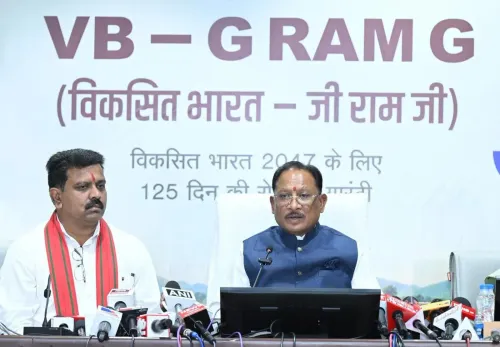
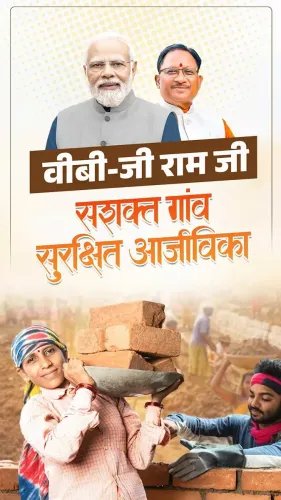
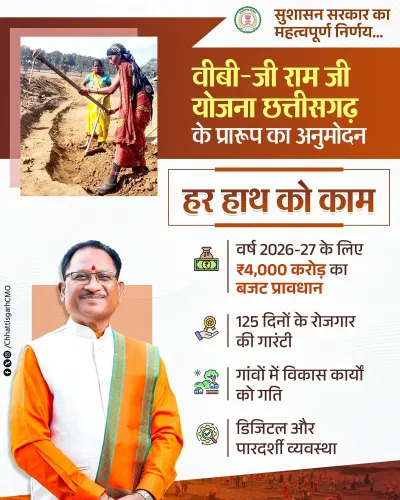
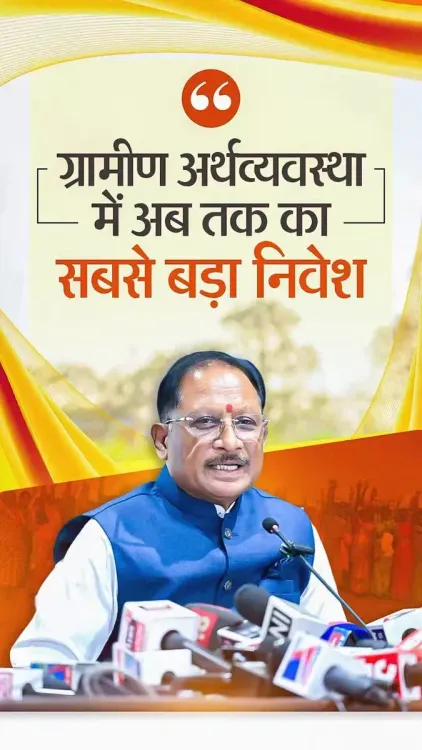
Chhattisgarh CM Vishnu Dev Sai has announced 125 days of on-demand employment for all registered rural workers, backed by a record Rs 6,855 crore combined allocation under MGNREGA and the state's VB-G Ram Ji Yojana for FY 2026-27.
Key Takeaways
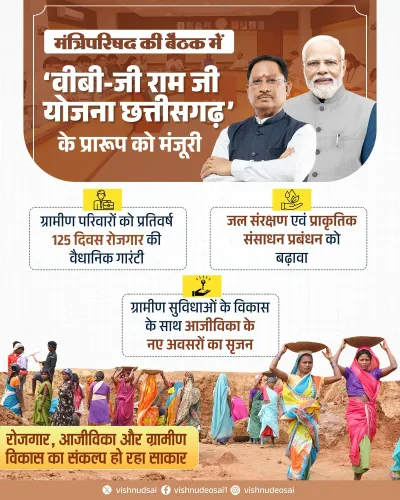
Every registered rural worker in Chhattisgarh is guaranteed 125 days of employment per year on demand .
The combined MGNREGA and VB-G Ram Ji Yojana allocation for FY 2026-27 totals Rs 6,855 crore — the largest rural employment investment in the state's history.
The central government has provisioned Rs 5,591 crore including the state's share under MGNREGA for the year.
The 125-day guarantee exceeds MGNREGA's statutory 100-day floor by 25 days , with the gap covered by the state's VB-G Ram Ji Yojana .
Chief Minister Vishnu Dev Sai has framed the initiative under the Viksit Chhattisgarh development vision.
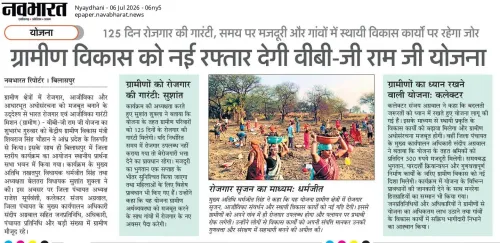
For millions of registered rural workers in Chhattisgarh, the promise of work just got bigger — and better funded. The Chief Minister's Office of Chhattisgarh announced on 6 August 2026 that every registered labourer in the state will be guaranteed 125 days of employment per year on demand, backed by the largest rural employment investment the state has ever seen.
Rs 6,855 Crore: The Number That Changes the Calculus
The combined allocation for financial year 2026-27 stands at Rs 6,855 crore — drawn from two streams: the central MGNREGA framework and the state's own VB-G Ram Ji Yojana. Of this, the central government has provisioned Rs 5,591 crore including the state's share for the year. The Chief Minister's Office described this as 'the largest investment ever in rural employment and development' in the state's history.
The post, attributed to Chief Minister Vishnu Dev Sai, makes the guarantee explicit: demand-based work, 125 days, no exceptions for registered workers. That is 25 days more than the 100-day floor mandated under the Mahatma Gandhi National Rural Employment Guarantee Act of 2005.
MGNREGA Plus: How the Two Schemes Stack Up
MGNREGA, enacted by Parliament in 2005, created a legal right to 100 days of wage employment for rural households. It remains one of the world's largest public works programmes. But in labour-surplus states like Chhattisgarh — where agriculture is seasonal and migration pressure is high — 100 days has long been considered a floor, not a ceiling.
The VB-G Ram Ji Yojana is Chhattisgarh's answer to that gap: a state-funded supplementary scheme designed to extend the guarantee beyond what the central programme covers. By merging the two into a single 125-day commitment, the Sai government is effectively fusing central and state resources into one unified rural employment floor — a model several states have experimented with since the 2010s, but rarely at this funding scale.
What This Means for Chhattisgarh's Villages
Chhattisgarh has a large rural workforce, much of it dependent on rain-fed agriculture and vulnerable to seasonal unemployment. Gram panchayats are the primary implementation units under MGNREGA, responsible for identifying works, registering job-card holders, and disbursing wages. A higher guaranteed-day ceiling, if matched by actual fund releases, directly reduces the incentive to migrate to cities during lean agricultural months.
The real test, as always, will be in execution: whether the Rs 6,855 crore translates into reported person-days on the ground in FY 2026-27, and whether gram panchayats have the administrative capacity to absorb and deploy funds at this scale.
Chief Minister Vishnu Dev Sai, who took office in December 2023 heading the BJP government in the state, has framed the announcement under the 'Viksit Chhattisgarh' (Developed Chhattisgarh) vision — positioning rural employment not as a welfare stopgap but as a development investment.
If the funds flow and the days are worked, Chhattisgarh's villages won't just have a safety net — they'll have the most generously funded one in the state's history.
Point of View
Using the MGNREGA architecture as a base and layering state funds on top — a pattern that has gained traction across BJP-governed states seeking to neutralise opposition narratives on rural distress. At Rs 6,855 crore, the scale is significant enough to be a credible development claim, not just an announcement. The critical variable is implementation: MGNREGA's history is littered with large allocations that generated fewer person-days than promised due to panchayat capacity constraints and delayed fund releases. How Chhattisgarh converts this headline number into actual workdays will determine whether this becomes a governance success story or a cautionary footnote.
NationPress
6 Aug 2026
Frequently Asked Questions
What is the VB-G Ram Ji Yojana in Chhattisgarh?
The VB-G Ram Ji Yojana is a Chhattisgarh state government rural employment scheme that supplements MGNREGA by providing additional days of work beyond the central scheme's 100-day guarantee, helping address seasonal unemployment in the state's villages.
How many days of employment will Chhattisgarh workers get under the new announcement?
Registered rural workers in Chhattisgarh will be guaranteed 125 days of employment per year on demand , combining MGNREGA's 100-day central guarantee with additional days funded through the state's VB-G Ram Ji Yojana.
How much money has been allocated for rural employment in Chhattisgarh in 2026-27?
A total of Rs 6,855 crore has been allocated for rural employment in Chhattisgarh for FY 2026-27, combining MGNREGA funds (including a state share of Rs 5,591 crore) and the VB-G Ram Ji Yojana — the largest such allocation in the state's history.
What is MGNREGA and how does it work?
MGNREGA — the Mahatma Gandhi National Rural Employment Guarantee Act — is a central government scheme enacted in 2005 that provides a legal guarantee of 100 days of wage employment per year to rural households on demand, implemented through gram panchayats.
Who is the Chief Minister of Chhattisgarh?
Vishnu Dev Sai is the Chief Minister of Chhattisgarh, heading the BJP government since December 2023 .