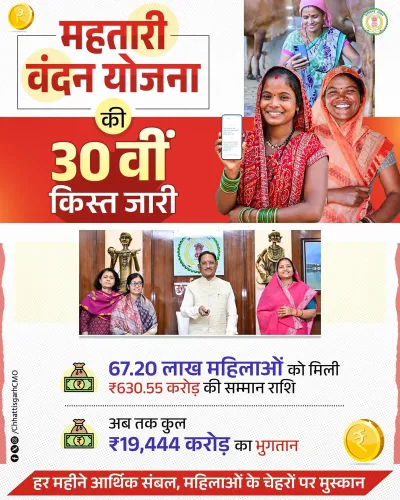
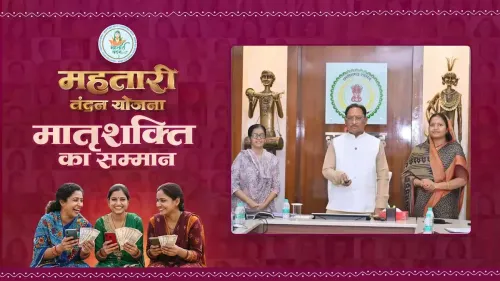
Chhattisgarh CMO marks 30th Mahatari Vandan installment
Synopsis
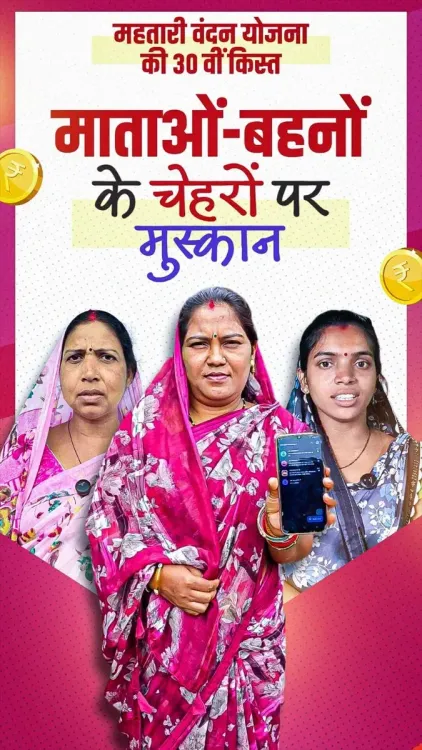
The Chief Minister's Office of Chhattisgarh marked the 30th installment of the Mahatari Vandan Yojana on 8 August 2026, calling the smiles of women beneficiaries thanking CM Vishnu Deo Sai the truest measure of the government's welfare resolve.
Key Takeaways
The Mahatari Vandan Yojana completed its 30th consecutive installment on 8 August 2026 , marking sustained delivery of the scheme.
The scheme provides periodic direct financial transfers to eligible mothers and women across Chhattisgarh for economic support and dignity.
Chief Minister Vishnu Deo Sai , popularly called 'Vishnu Bhaiya', has been the face of the scheme since taking office in December 2023 .
The BJP government launched the scheme after winning the 2023 Chhattisgarh assembly elections , as part of a broader women-empowerment agenda.
Chhattisgarh's model mirrors a national pattern of state-run Nari Shakti cash transfer programs aimed at women's financial autonomy.
Future installments and state budget allocations will determine the scheme's long-term expansion and coverage.
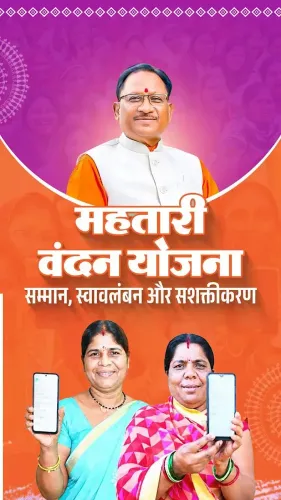
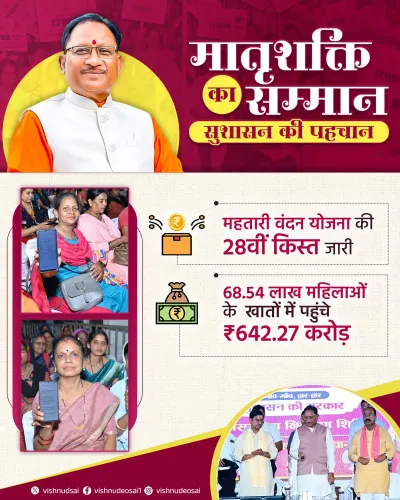
A smile of prosperity — that is how the Chief Minister's Office of Chhattisgarh described the faces of women across the state as the Mahatari Vandan Yojana completed its 30th installment on Saturday, 8 August 2026. The CMO's post framed the moment not as a bureaucratic milestone but as living proof of a government's promise kept to its mothers and sisters.
The post, shared in Hindi, read: 'महतारी वंदन योजना की 30वीं किस्त के साथ प्रदेश की माताओं-बहनों के जीवन में सम्मान, आत्मविश्वास और आर्थिक संबल की जुड़ी नई ऊर्जा' — ('With the 30th installment of Mahatari Vandan Yojana, new energy of dignity, self-confidence, and economic support has entered the lives of the state's mothers and sisters'). The women thanking Chief Minister Vishnu Deo Sai — affectionately called 'Vishnu Bhaiya' — and the smiles on their faces, the CMO said, are what give real shape to the government's resolve for public welfare.
What Mahatari Vandan Yojana does — and why 30 installments matter
Mahatari Vandan Yojana is a direct benefit transfer scheme launched by the BJP government in Chhattisgarh after it returned to power following the 2023 state assembly elections. The scheme channels periodic cash payments directly to eligible women — mothers and sisters across the state — as a tool for financial autonomy and dignity. Thirty consecutive installments signal sustained execution, not a one-time announcement.
That consistency matters in Indian welfare politics. State-level cash transfer schemes have a history of stalling after early fanfare, swallowed by budget pressures or administrative gaps. Reaching installment 30 is the government's loudest counter-argument to that pattern.
Sai's 'Vishnu Bhaiya' connect and the politics of proximity
Vishnu Deo Sai, who took charge as Chief Minister in December 2023, has built his public identity around grassroots accessibility — the 'Bhaiya' (elder brother) framing is deliberate. It signals a relationship, not just a transaction, between the government and women beneficiaries. The CMO's post leaned into that image hard, placing the CM's name inside the gratitude women express, tying personal trust to institutional delivery.
Chhattisgarh sits within a broader national pattern: several Indian states — from Madhya Pradesh to Maharashtra to Tamil Nadu — have anchored electoral and governance strategies on recurring women-focused cash transfers under the Nari Shakti framework. Chhattisgarh's version is now 30 chapters deep.
What the next installments will reveal
The scheme's long-term credibility will be tested by what comes next — expansion of beneficiary coverage, budget allocations in upcoming state assembly sessions, and whether the transfer amounts keep pace with cost-of-living realities. For now, the 30th installment stands as a data point the government is loudly proud of. The smiles, the CMO insists, are the metric that counts.
Point of View
A technique that has worked for ruling parties in Madhya Pradesh and Maharashtra with similar schemes. The real test, however, lies in whether the scheme's coverage and amounts expand in line with the state's fiscal capacity — or plateau into a symbolic milestone. Thirty installments in, the government has execution credibility; what it builds on that foundation will define the scheme's legacy.
NationPress
8 Aug 2026
Frequently Asked Questions
What is Mahatari Vandan Yojana in Chhattisgarh?
Mahatari Vandan Yojana is a Chhattisgarh government scheme that provides periodic direct cash transfers to eligible mothers and women in the state to support their financial independence and dignity. It was launched by the BJP government after the 2023 assembly elections.
How many installments of Mahatari Vandan Yojana have been released?
As of 8 August 2026, the Chhattisgarh government has released the 30th installment of the Mahatari Vandan Yojana, marking 30 consecutive periodic payments to women beneficiaries across the state.
Who is Vishnu Deo Sai and what is his role in Mahatari Vandan Yojana?
Vishnu Deo Sai is the BJP Chief Minister of Chhattisgarh, in office since December 2023. He is the political face of the Mahatari Vandan Yojana and is referred to affectionately as 'Vishnu Bhaiya' by women beneficiaries of the scheme.
Who benefits from Mahatari Vandan Yojana?
Eligible mothers and women residing in Chhattisgarh are the primary beneficiaries of the Mahatari Vandan Yojana, which aims to provide economic support and strengthen women's financial autonomy through direct bank transfers.
Is Mahatari Vandan Yojana similar to other state women welfare schemes in India?
Yes, Mahatari Vandan Yojana follows a broader national pattern of state-run direct benefit transfer schemes for women, similar to programs in Madhya Pradesh, Maharashtra, and Tamil Nadu, all operating under the Nari Shakti framework of women's empowerment.