Chhattisgarh CMO Signals Crackdown on Mineral Mafia
Synopsis
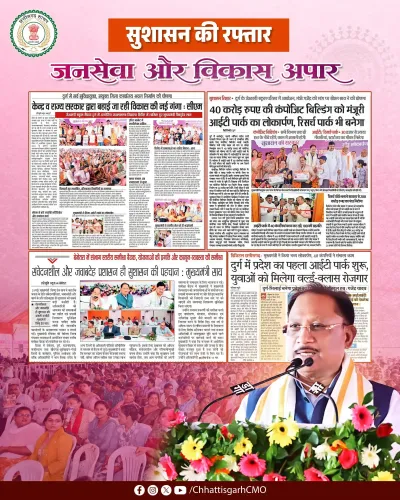
The Chief Minister's Office of Chhattisgarh used a Media Samvad post on 26 June 2026 to assert a firm good-governance stance against the mineral mafia, invoking the state's mineral wealth, tribal stakes, and the BJP's broader 'Sushasan' enforcement narrative.
Key Takeaways
The Chhattisgarh CMO posted on 26 June 2026 declaring a 'strict good-governance government against the mineral mafia.' The message was shared under the #MediaSamvad hashtag, a CMO format for direct media outreach.
Chhattisgarh holds major reserves of coal, iron ore, and bauxite, making illegal mining a significant revenue and law-and-order concern.
Central amendments to the MMDR Act in 2015 and 2021 introduced auction-based leases and stricter penalties for illegal extraction.
Key stakeholders include tribal communities , legal leaseholders, and the state's mining and excise departments.
Concrete accountability will hinge on royalty realisation data, FIR records, and new lease auction notifications from the state.
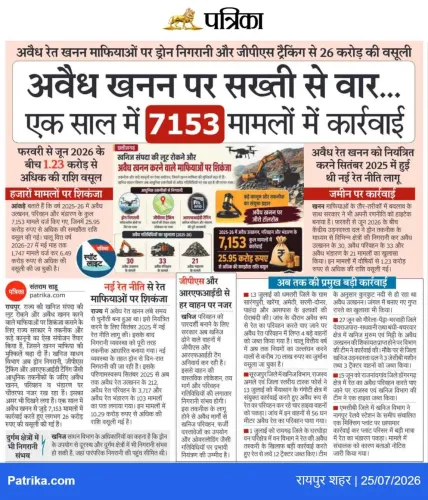
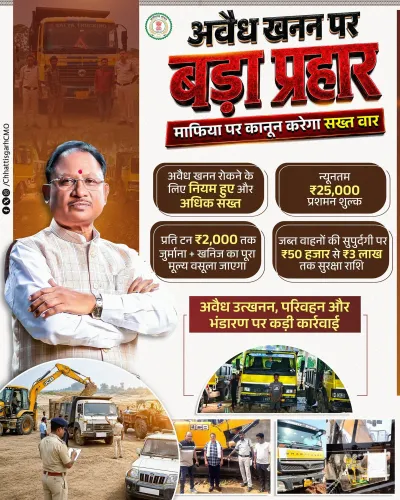
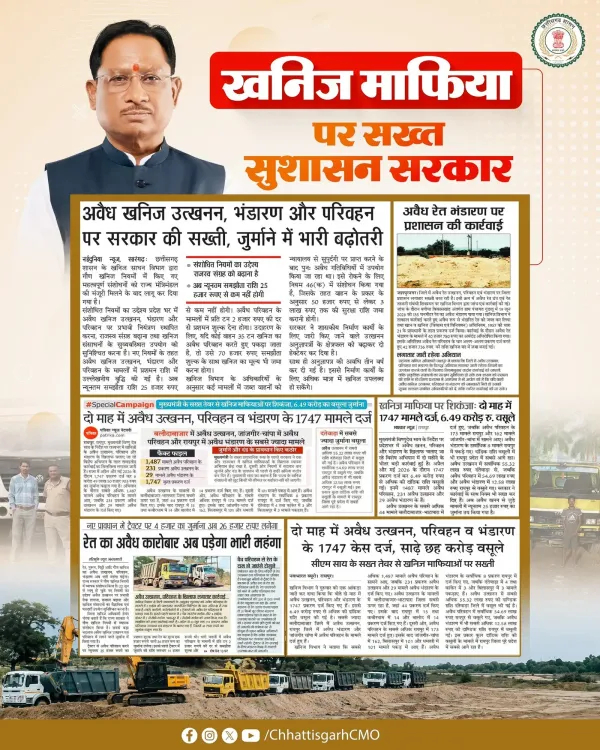
The Chief Minister's Office of Chhattisgarh on Friday, 26 June 2026 signalled a firm stance against illegal mineral extraction in the state, posting a sharp message on X under the hashtags #खनिज_माफिया (mineral mafia) and #SushasanSarkar (good governance government), reinforcing the ruling dispensation's governance narrative around mining enforcement.
Context
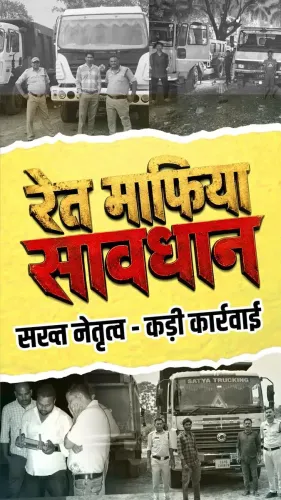
The post — 'खनिज माफिया पर सख्त सुशासन सरकार' ('A strict good-governance government against the mineral mafia') — was shared during a Media Samvad (#MediaSamvad) outreach, a format the CMO uses to communicate policy priorities directly to journalists and the public. The brevity of the message is deliberate: it frames the administration's identity around enforcement rather than announcing a specific operational measure.
Chhattisgarh is one of India's most mineral-rich states, holding significant reserves of coal, iron ore, and bauxite. The state's mining belt has long been associated with illegal extraction, revenue leakage, and, in several pockets, security challenges linked to Naxal-affected terrain and disputed tribal land rights.
Policy Backdrop
The Centre's amendments to the Mines and Minerals (Development and Regulation) Act — passed in 2015 and again in 2021 — introduced auction-based allocation of mining leases and significantly stiffened penalties for illegal extraction. These changes were intended to formalise the sector, reduce discretionary allotments, and increase royalty flows to state exchequers.
Across BJP-governed states, 'Sushasan' campaigns targeting sand and mineral mafias have become a recurring political and administrative motif since 2014. The framing connects law-and-order enforcement with fiscal prudence — illegal mining deprives state governments of royalties that fund public expenditure — and with environmental and tribal-rights concerns in ecologically sensitive zones.
For Chhattisgarh, where legal mining leaseholders, tribal communities, and the state's mining and excise departments are all key stakeholders, crackdowns on illegal operators carry both revenue and political significance.
Stakeholders and Impact
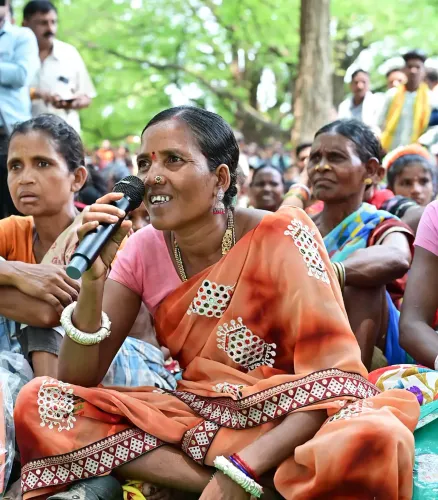
Tribal communities in mining-adjacent areas are among the most directly affected groups: illegal extraction often bypasses the consent and compensation mechanisms mandated under forest and tribal land laws, while also degrading local water sources and agricultural land. Formalising enforcement can, in principle, restore both ecological and economic protections to these communities.
Legal mining leaseholders stand to benefit from a level playing field if illegal operators are genuinely curtailed, while the state mining department stands to recover royalties that currently leak through unregulated extraction. Civil society groups and environmental watchdogs have consistently called for transparent enforcement data to verify that drives against the mineral mafia translate into sustained action rather than episodic crackdowns.
What's Next
The signal from the CMO's office will be tested against concrete administrative follow-through: enforcement notifications, FIR data from mining districts, and changes in royalty realisation figures in upcoming state budget documents or mining department reports will indicate whether the messaging reflects an ongoing operational drive.
Observers will also watch for new lease auction announcements, which serve as a structural check on illegal extraction by bringing more territory under regulated frameworks. The #MediaSamvad branding suggests the government intends to keep this narrative visible in the public domain, making accountability metrics harder to sidestep in subsequent press interactions.
Point of View
Hashtag-driven post is as much a political positioning statement as an administrative signal — the 'Sushasan' framing has been a consistent BJP governance brand since 2014, and invoking it against the mineral mafia in a media-outreach format keeps the narrative alive between concrete enforcement announcements. For a mineral-rich state like Chhattisgarh, where illegal extraction intersects with tribal rights and Naxal-affected geographies, the stakes of credible follow-through are unusually high. If royalty data and enforcement records do not improve, the messaging risks being read as performative rather than substantive. The choice of Media Samvad as the vehicle suggests the government is aware it needs press visibility on this issue — which itself creates a degree of accountability pressure.
NationPress
25 Sept 2026
Frequently Asked Questions
What did the Chhattisgarh CMO post about mineral mafia on 26 June 2026?
The Chief Minister's Office of Chhattisgarh posted on X stating 'A strict good-governance government against the mineral mafia,' using the hashtags #SushasanSarkar and #MediaSamvad to signal an enforcement stance against illegal mining in the state.
What is the mineral mafia problem in Chhattisgarh?
Chhattisgarh is rich in coal, iron ore, and bauxite, and illegal extraction by operators outside the formal leasing system has historically caused revenue leakage for the state, environmental damage, and harm to tribal communities whose land rights are bypassed.
What is Sushasan Sarkar in the context of Chhattisgarh?
'Sushasan Sarkar' translates to 'good governance government' and is a political and administrative label used by BJP-led administrations to brand law-and-order and anti-corruption drives, including crackdowns on sand and mineral mafias.
How does the MMDR Act address illegal mining in India?
Amendments to the Mines and Minerals (Development and Regulation) Act in 2015 and 2021 introduced auction-based allocation of mining leases and significantly increased penalties for illegal extraction, aiming to formalise the sector and reduce discretionary allotments.
Who are the main stakeholders affected by illegal mining in Chhattisgarh?
The primary stakeholders are tribal communities living near mining zones whose land and water resources are affected, legal mining leaseholders who face unfair competition, and the state's mining and excise departments that lose royalty revenue to illegal operators.