CM Vishnu Deo Sai: Chhattisgarh PMAY practice wins national honour
Synopsis
Chhattisgarh's mechanism of reserving land in private colonies for EWS-LIG housing under PMAY-Urban — securing plots for 25,413 homes without public expenditure — has been awarded a national Best Practice citation by the Government of India, CM Vishnu Deo Sai announced on 5 October 2026.
Key Takeaways
Chhattisgarh has received a Government of India 'Best Practice' citation under Pradhan Mantri Awas Yojana (Urban) .
The recognised mechanism mandates land reservation inside private residential colonies for EWS and LIG category beneficiaries.
The model has secured land for 25,413 homes with zero government expenditure on land acquisition.
CM Vishnu Deo Sai credited the achievement to PM Narendra Modi 's 'housing for all' vision.
The state government has pledged that no eligible family in Chhattisgarh will remain without a pucca home.
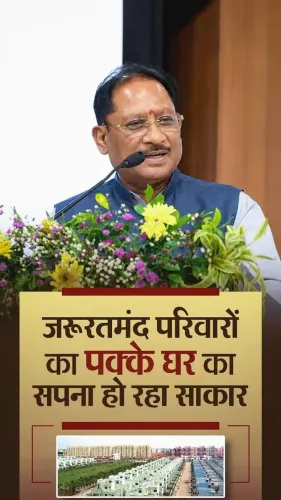
A state government's housing push just earned a national stamp of approval — and the numbers behind it are striking. Chhattisgarh Chief Minister Vishnu Deo Sai announced on Monday, 5 October 2026 that the state's land-reservation model for affordable housing under the Pradhan Mantri Awas Yojana (Urban) has been recognised by the Government of India as a 'Best Practice' — a rare federal citation for a state-level implementation mechanism.
Land without government spending: the 25,413-home model
At the heart of the recognition is a deceptively simple but politically significant mechanism: mandating land reservation inside private residential colonies for the Economically Weaker Section (EWS) and Low Income Group (LIG) categories. The result, according to CM Sai, is that land for 25,413 homes has been secured without a single rupee of government expenditure on land acquisition.
That figure matters. Land cost is typically the single largest barrier to affordable urban housing — not construction, not financing. By embedding the obligation within private-sector development approvals, Chhattisgarh has effectively transferred that cost to the colony developers rather than the public exchequer. It is a lever-based approach, and New Delhi has now held it up as a model worth replicating.
What the 'Best Practice' tag means in federal housing policy
PMAY-Urban, launched in 2015, operates across four verticals — in-situ slum redevelopment, credit-linked subsidy, affordable housing in partnership, and beneficiary-led construction. States are evaluated on targets met, fund utilisation, and innovation in delivery. A 'Best Practice' citation from the Centre signals that a particular state approach is being flagged to other state governments as a scalable template — it carries institutional prestige and can influence how future guidelines are drafted.
For Chhattisgarh, which has been a PMAY-Urban performer in recent years under the BJP government led by Sai since December 2023, the citation reinforces the state's positioning as a model administration within the party's governance narrative. CM Sai framed it explicitly as an expression of Prime Minister Narendra Modi's 'housing for all' vision being translated at the state level.
The political calculus behind 'no eligible family left out'
The Chief Minister's post closed with a pointed pledge: 'प्रदेश का कोई भी पात्र परिवार पक्के आवास से वंचित न रहे' — 'no eligible family in the state shall be deprived of a pucca home.' That is not merely aspirational language. It is a measurable commitment, and one that will be tested as urban migration pressures mount across Chhattisgarh's secondary cities.
The land-reservation model addresses supply on paper, but construction pace, beneficiary identification, and allotment transparency will determine whether those 25,413 plots convert into occupied homes. The national recognition raises the stakes — and the scrutiny — for what comes next.
Chhattisgarh has staked a specific, auditable claim: homes secured at zero land cost, a federal best-practice badge to show for it, and a promise that the work is not finished. The next audit of those 25,413 units will be the real verdict.
Point of View
The recognition lands at a useful moment: it ties his administration's performance to the BJP's flagship urban-housing mission ahead of future electoral cycles. The harder question is whether the 25,413-plot figure represents pipeline or delivery — in Indian affordable housing, the gap between land secured and keys handed over has historically been wide. How quickly Chhattisgarh converts this recognised model into occupied homes will determine whether the citation endures as a governance benchmark or fades as a political talking point.
NationPress
5 Oct 2026
Frequently Asked Questions
What is the PMAY Urban Best Practice award won by Chhattisgarh?
The Government of India recognised Chhattisgarh's land-reservation mechanism in private colonies for EWS-LIG housing under Pradhan Mantri Awas Yojana (Urban) as a 'Best Practice', a citation that flags the model to other states as a scalable approach.
How did Chhattisgarh secure land for 25,413 homes without government spending?
By mandating that private residential colony developers reserve a portion of their land for Economically Weaker Section and Low Income Group housing, the state secured plots for 25,413 homes without spending public funds on land acquisition.
What is Pradhan Mantri Awas Yojana Urban and how do states qualify for recognition?
PMAY-Urban, launched in 2015, aims to provide affordable housing to all eligible urban families. States are evaluated on target achievement, fund utilisation, and innovative delivery methods; standout mechanisms can be designated national Best Practices.
Who is Vishnu Deo Sai and when did he become Chhattisgarh Chief Minister?
Vishnu Deo Sai is a BJP leader who became Chief Minister of Chhattisgarh in December 2023 after the party won the state assembly elections.
What does EWS-LIG mean in housing policy?
EWS stands for Economically Weaker Section and LIG stands for Low Income Group — the two lowest income categories targeted by government affordable-housing schemes like PMAY, defined by annual household income thresholds set by the Centre.