Chirag Paswan Backs Fast-Track Courts for Paper Leak Cases
Synopsis
Union Minister Chirag Paswan on 23 July 2026 welcomed the Modi government's move to establish fast-track courts for paper leak cases, saying the step will deter wrongdoers and ensure swift justice for students whose futures have been put at risk.
Key Takeaways
Chirag Paswan and the Lok Janshakti Party (Ram Vilas) formally welcomed the central government's decision to constitute fast-track courts for paper leak cases on 23 July 2026 .
The minister addressed Prime Minister Narendra Modi directly on X, calling the move essential to punishing the guilty 'at the earliest'.
Paswan stated that youth and student interests are 'paramount' and that tampering with their futures 'cannot be accepted at any cost'.
The announcement follows the Public Examinations (Prevention of Unfair Means) Act enacted after the 2024 NEET paper leak protests.
Rollout details — geographic spread, case categories, and timelines — for the fast-track courts are yet to be officially notified.
Union Food Processing Minister Chirag Paswan on Thursday, 23 July 2026, welcomed the central government's decision to set up fast-track courts to expedite trial in examination paper leak cases, calling the move essential to delivering swift justice to students across India.
Context
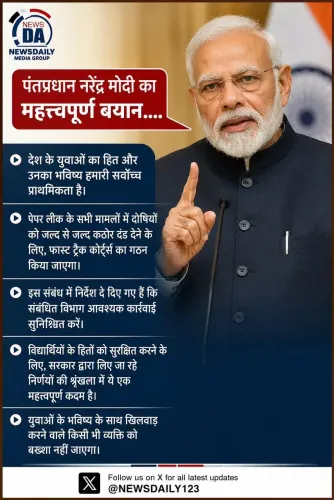
Posting on X in Hindi, Chirag Paswan addressed Prime Minister Narendra Modi directly, stating: 'पेपर लीक के सभी मामलों में दोषियों को जल्द से जल्द कठोर दंड देने के लिए और केस के त्वरित निस्तारण के लिए फास्ट ट्रैक कोर्ट्स के गठन के फैसले का मैं और मेरी पार्टी स्वागत करती है' ('I and my party welcome the decision to constitute fast-track courts to punish the guilty in all paper leak cases at the earliest and for speedy disposal of cases'). He added that the interests of youth and students are paramount and that tampering with their futures cannot be accepted at any cost.
Paswan also warned that those 'stoking political fires by playing with students' futures' — a pointed reference to elements he accused of exploiting the controversy — would now face a climate of fear. His statement signals firm backing from the Lok Janshakti Party (Ram Vilas), a key ally in the National Democratic Alliance, for this judicial measure.
Policy Backdrop
Paper leak scandals have repeatedly shaken India's competitive examination ecosystem. The most visible flashpoint came in 2024, when leaks in national-level exams including NEET triggered mass student protests and drew sharp political criticism from across the spectrum. Parliament responded by enacting the Public Examinations (Prevention of Unfair Means) Act, which introduced stringent penal provisions for those found guilty of compromising exam integrity.
Despite the legislation, concerns persisted about the pace of prosecution and the capacity of ordinary courts to handle the volume of cases. The proposal to designate fast-track courts specifically for paper leak offences is aimed at addressing that gap — ensuring that deterrence is not diluted by prolonged legal proceedings.
Stakeholders and Impact
The decision, if implemented as described, would most directly benefit millions of students who appear each year for competitive examinations for government jobs, medical admissions, engineering seats, and other high-stakes outcomes. Delays in justice have historically allowed accused persons to remain at large for extended periods, undermining confidence in the system.
Coalition partners such as the LJP (Ram Vilas) voicing public support reinforces the political consensus around exam integrity as a non-partisan issue. Paswan's endorsement also underscores the NDA's effort to frame the fast-track court initiative as a youth-welfare measure ahead of future electoral cycles.
What's Next
The rollout details of the proposed fast-track courts — including their geographic spread, the categories of cases they will cover, and the timeline for operationalisation — are yet to be officially notified. Observers will also watch whether the government brings further amendments to examination regulatory frameworks in upcoming parliamentary sessions to complement the judicial mechanism.
With student communities and opposition parties continuing to scrutinise the pace of action on past paper leak cases, the government's ability to demonstrate tangible progress through these courts will be a key test of political credibility on the education-integrity front.
Point of View
Paswan also reinforces his party's visibility within the alliance on a youth-centric issue that cuts across caste and regional lines. The move fits a broader pattern of the government seeking to demonstrate institutional responsiveness to the paper leak crisis through successive legislative and now judicial measures. How quickly the courts are operationalised will determine whether this political consensus translates into credible deterrence.
NationPress
22 Oct 2026
Frequently Asked Questions
What did Chirag Paswan say about fast-track courts for paper leaks?
Chirag Paswan welcomed the central government's decision to set up fast-track courts to expedite punishment in all paper leak cases, saying it will create fear among wrongdoers and deliver swift justice to students.
Why are fast-track courts being proposed for paper leak cases in India?
Fast-track courts are being proposed to speed up trials in paper leak cases because ordinary courts face backlogs that allow prolonged proceedings, undermining deterrence and delaying justice for affected students.
What is the Public Examinations (Prevention of Unfair Means) Act?
The Public Examinations (Prevention of Unfair Means) Act was enacted by Parliament in 2024 following mass protests over paper leaks in national exams including NEET, introducing stringent penal provisions for those who compromise exam integrity.
Which party does Chirag Paswan lead?
Chirag Paswan is the national president of the Lok Janshakti Party (Ram Vilas), a constituent of the BJP-led National Democratic Alliance.
What triggered India's paper leak crisis?
The most prominent trigger was the 2024 NEET paper leak, which sparked nationwide student protests and forced the government to enact new legislation and consider additional judicial mechanisms such as fast-track courts.