Shivraj Singh Chouhan Hails Driverless Tractors as Smart Farming Future
Synopsis
Union Agriculture Minister Shivraj Singh Chouhan on November 17, 2026 shared a video of a driverless tractor tilling a field, framing autonomous machinery as the defining next step in India's Smart Farming journey and building on years of mechanisation and digital agriculture investment.
Key Takeaways
Union Agriculture Minister Shivraj Singh Chouhan posted a video on November 17, 2026 showcasing a driverless tractor tilling a field.
He described it as a step toward Smart Farming , signalling the ministry's embrace of autonomous agricultural machinery.
The post builds on existing government initiatives including AgriStack (launched 2021) and drone promotion under the Sub-Mission on Agricultural Mechanisation .
Rural labour shortages make autonomous ground machinery a structurally important solution for Indian agriculture.
Deployment through custom hiring centres or agri-tech service providers could make driverless tractors accessible to small and marginal farmers.
State-level pilot projects and integration into existing mechanisation subsidies remain the next crucial step to watch.
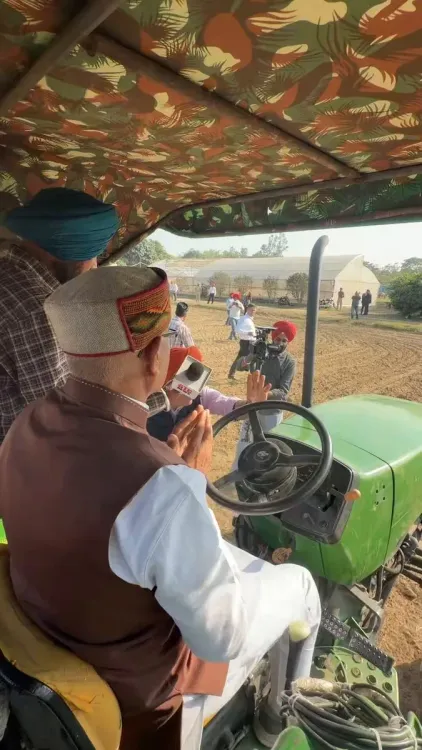
A tractor rolling across a field with no one at the wheel — that image, once science fiction, is now the frame Union Agriculture Minister Shivraj Singh Chouhan is using to describe the future of Indian farming. On Tuesday, November 17, 2026, Chouhan posted a video on X highlighting autonomous tractor technology, calling it a defining step toward Smart Farming.
Posting in Hindi, Chouhan wrote: 'खेती की बदलती तस्वीर — अब ट्रैक्टर बिना चालक के भी खेत की जुताई कर सकता है। यही है Smart Farming की ओर बढ़ता कदम।' — 'The changing face of farming: a tractor can now till the field without a driver. This is the step forward toward Smart Farming.'
From Drones to Driverless: India's Mechanisation Momentum
The post lands within a years-long arc of technology push in Indian agriculture. The government rolled out AgriStack in 2021 — a digital public infrastructure layer covering farmer registries and data-driven services — laying the groundwork for precision tools. Around the same time, drone technology for crop spraying and monitoring was scaled under the Sub-Mission on Agricultural Mechanisation, with subsidies flowing to states to lower the entry cost for farmers. Autonomous ground machinery is the logical next chapter. Labour shortages in rural areas, driven partly by migration to urban centres, have made mechanisation not merely desirable but structurally necessary for large swathes of Indian farmland. A driverless tractor addresses that pressure directly — operating on pre-programmed field paths, reducing human fatigue, and enabling round-the-clock tillage during critical sowing windows.What Smart Farming Actually Means on the Ground
Smart Farming, as framed by the Ministry of Agriculture and Farmers Welfare, increasingly bundles together sensors, AI-driven advisory platforms, satellite imagery, and now autonomous machinery into a single productivity push. The goal is to close the gap between India's vast cultivated area and its comparatively low per-hectare yields — a gap that neither seeds nor fertiliser alone can bridge. Chouhan's ministry has been vocal about positioning India as a country where the small and marginal farmer, who holds the majority of agricultural land, can access cutting-edge tools through shared service models and cooperative frameworks rather than individual ownership. Driverless tractors, deployed through custom hiring centres or agri-tech service providers, fit neatly into that model. State-level pilots on autonomous machinery and their eventual integration into existing mechanisation subsidy frameworks will be the real test of whether this vision moves from minister's feed to farmer's field.Point of View
He aligns the BJP government with a modernisation story that appeals to both investors in agri-tech and aspirational younger farmers. The optics are carefully chosen: Smart Farming sounds progressive without requiring an immediate policy commitment. The harder question — whether mechanisation subsidies will actually reach the small and marginal farmer who holds most of India's cultivated land — remains the metric that will define the ministry's legacy on this front.
NationPress
17 Nov 2026
Frequently Asked Questions
What did Agriculture Minister Shivraj Singh Chouhan say about driverless tractors?
Chouhan posted a video on November 17, 2026 showing a tractor tilling a field without a driver, describing it as a step toward Smart Farming in India.
Is driverless tractor technology available for Indian farmers?
Autonomous tractor technology is at a demonstration and pilot stage in India. No specific large-scale government deployment scheme has been announced; integration into existing mechanisation subsidy frameworks is the next step being watched.
What is Smart Farming in the context of Indian agriculture?
Smart Farming in India refers to the use of digital tools, sensors, drones, AI-driven platforms, and now autonomous machinery to improve productivity, reduce labour dependence, and enable data-driven decisions for farmers.
What is AgriStack and how does it relate to this?
AgriStack, launched in 2021, is a digital public infrastructure project building farmer registries and data services. It forms part of the foundational layer enabling precision and smart farming technologies to be deployed at scale.
How can small farmers benefit from driverless tractors?
The government's model for expensive machinery involves custom hiring centres, where farmers rent equipment rather than own it, making autonomous tractors financially accessible to small and marginal landholders.