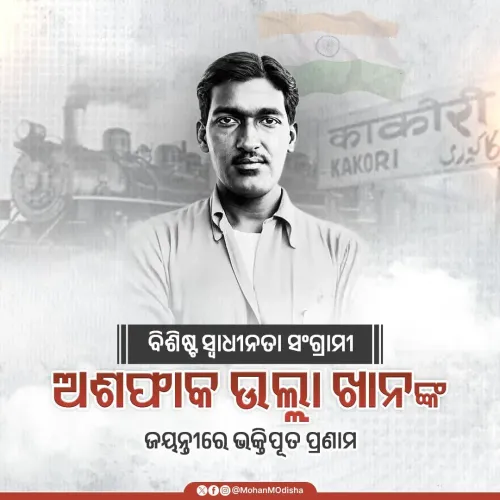
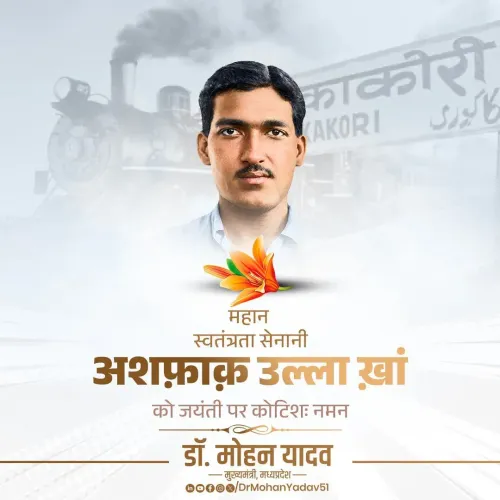
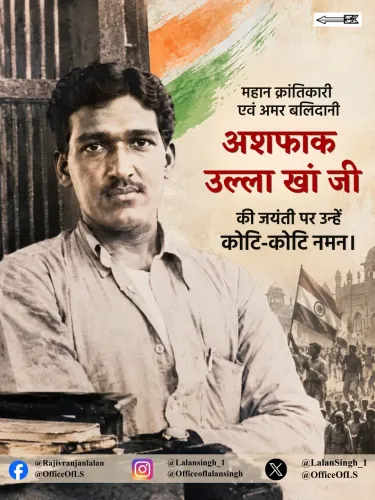
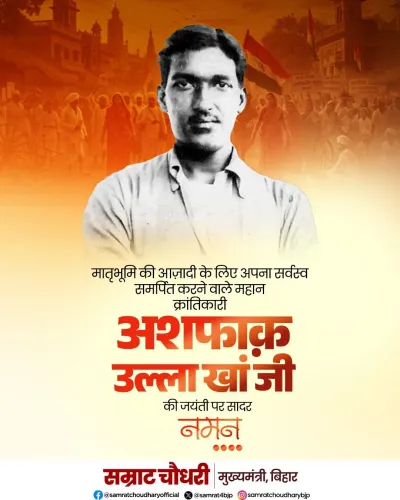
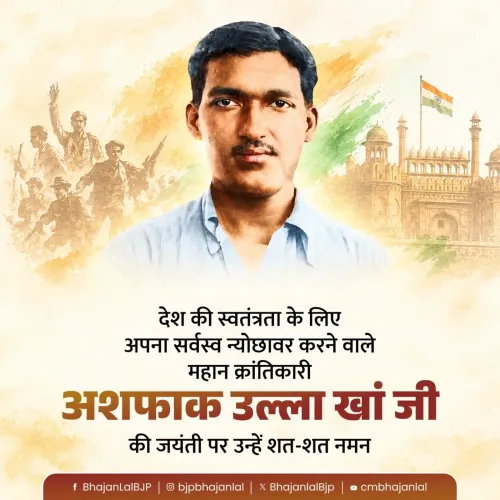
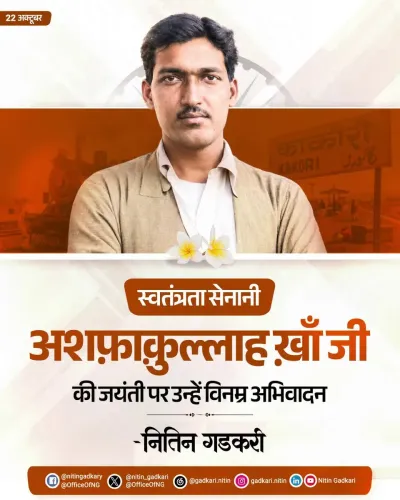
Shivraj Singh Chouhan Pays Tribute to Revolutionary Ashfaqulla Khan
Synopsis
Union Agriculture Minister Shivraj Singh Chouhan marked the birth anniversary of revolutionary martyr Ashfaqulla Khan on 22 October 2026, saluting his sacrifice in the Kakori conspiracy and urging India's youth to draw inspiration from his life of national service.
Key Takeaways
Shivraj Singh Chouhan posted a tribute to revolutionary martyr Ashfaqulla Khan on his birth anniversary, 22 October 2026 .
Ashfaqulla Khan was a member of the Hindustan Republican Association and a key figure in the Kakori train robbery of 1925 .
He was executed by British authorities on 19 December 1927 at Faizabad Jail , aged 27 .
Chouhan's tribute highlighted Khan's 'joyful self-sacrifice' and called his ideas a lasting inspiration for India's youth toward national service.
As a Muslim revolutionary who died alongside Hindu comrades, Ashfaqulla Khan is widely invoked as a symbol of India's composite freedom struggle.
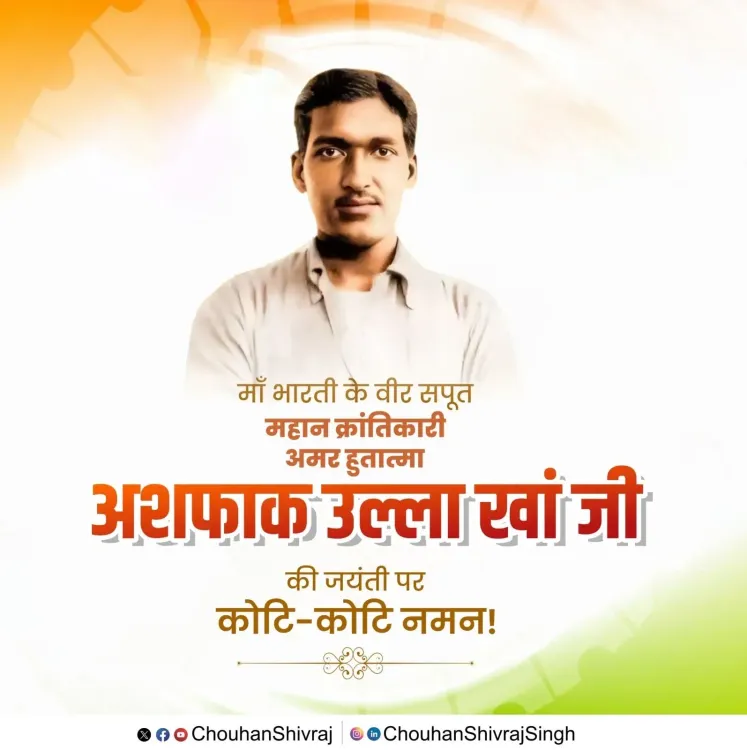
A revolutionary who laughed his way to the gallows rather than bow to colonial rule — Union Agriculture Minister Shivraj Singh Chouhan invoked that spirit on Thursday, 22 October 2026, marking the birth anniversary of Ashfaqulla Khan with a tribute on X that called the freedom fighter's life and ideals a perennial source of inspiration for India's youth.
In his post, Chouhan wrote — 'माँ भारती के पैरों में पड़ी परतंत्रता की बेड़ियों को तोड़ने के लिए हंसते-हंसते प्राणोत्सर्ग कर देने वाले महान क्रांतिकारी' ('the great revolutionary who joyfully sacrificed his life to break the chains of slavery at Mother India's feet') — offering 'countless salutes' to the martyr and affirming that his dedicated life and 'powerful ideas' would forever inspire young Indians toward national service.
Who Was Ashfaqulla Khan?
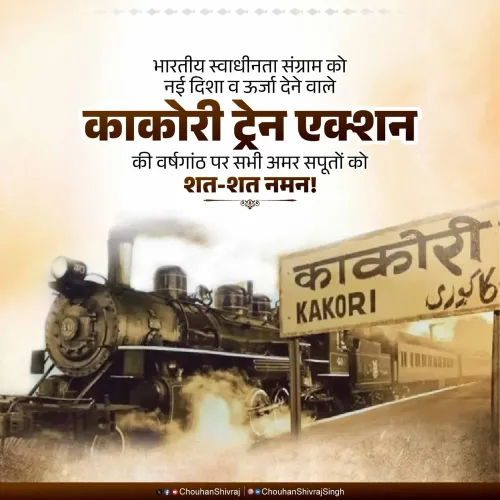
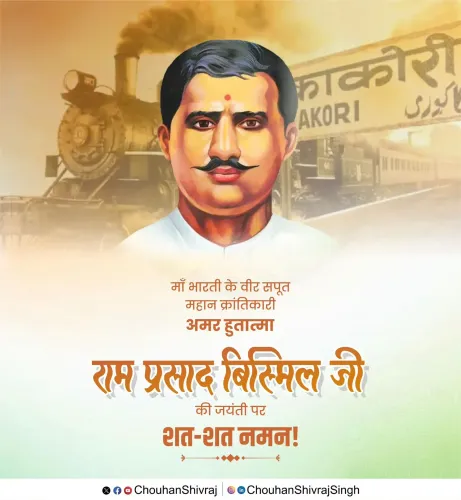
Ashfaqulla Khan was born on 22 October 1900 in Shahjahanpur, Uttar Pradesh, into a family whose patriotism ran deep. A member of the Hindustan Republican Association, he became one of the principal architects of the Kakori train robbery of 1925 — a daring operation in which revolutionaries looted a British government treasury train to fund the armed independence movement. Close friends with fellow revolutionary Ram Prasad Bismil, Ashfaqulla Khan represented a bond across religious lines that became emblematic of the plural spirit of India's freedom struggle.
British authorities arrested him after a months-long manhunt. He was tried, convicted, and executed by hanging on 19 December 1927 at Faizabad Jail — months after Bismil was hanged at Gorakhpur. He was 27 years old. His composure at execution, consistent with the 'haste-haste' ('smilingly') that Chouhan's tribute invokes, has become a defining element of how India remembers him.
Why His Memory Carries Political Weight Today
Indian political figures across the spectrum regularly mark the birth anniversaries of independence-era revolutionaries, and tributes to Ashfaqulla Khan carry a particular symbolic charge: as a Muslim revolutionary who died alongside Hindu comrades for an undivided India, he is frequently cited as proof of the composite, multi-faith character of the freedom struggle. Senior leaders invoking his legacy — especially on his jayanti — are consciously anchoring themselves to that narrative of shared sacrifice. For Chouhan, a four-term former Chief Minister of Madhya Pradesh and a senior figure in the BJP, the tribute also connects to a broader governmental push to place lesser-celebrated revolutionary heroes alongside Mahatma Gandhi and Jawaharlal Nehru in the national memory.
The call to youth embedded in the post — 'your life and spirited ideas will always inspire the young toward serving the nation' — reflects a pattern seen across commemorative messaging: framing historical sacrifice not merely as past history but as a live moral charge for the present generation.
Point of View
With figures like Ashfaqulla Khan serving as potent symbols of cross-communal sacrifice. The deliberate invocation of a Muslim martyr by a senior BJP leader underscores a strategic interest in demonstrating the party's embrace of India's plural freedom-struggle heritage. Framing historical sacrifice as a live challenge for today's youth also allows government figures to tie commemoration to contemporary calls for nation-building. How official curriculum and commemorative events evolve around such figures over the coming months will signal how deep that embrace actually runs.
NationPress
22 Oct 2026
Frequently Asked Questions
Who was Ashfaqulla Khan?
Ashfaqulla Khan was an Indian revolutionary born on 22 October 1900 in Shahjahanpur, Uttar Pradesh . A member of the Hindustan Republican Association , he was a key participant in the Kakori train robbery of 1925 and was executed by British authorities on 19 December 1927 at Faizabad Jail at the age of 27.
What was the Kakori train robbery?
The Kakori train robbery took place on 9 August 1925 , when members of the Hindustan Republican Association — including Ashfaqulla Khan and Ram Prasad Bismil — looted a British government treasury train near Kakori, Uttar Pradesh , to fund their armed independence movement.
Why did Shivraj Singh Chouhan pay tribute to Ashfaqulla Khan?
22 October marks the birth anniversary of Ashfaqulla Khan . Union Agriculture Minister Shivraj Singh Chouhan posted a tribute on X saluting Khan's sacrifice and calling his ideals a lasting inspiration for India's youth.
What is Ashfaqulla Khan's significance in India's freedom struggle?
Ashfaqulla Khan is celebrated as a symbol of India's composite freedom struggle: a Muslim revolutionary who fought and died alongside Hindu comrades like Ram Prasad Bismil , demonstrating the cross-communal unity at the heart of the independence movement.
What did Shivraj Singh Chouhan say in his tribute to Ashfaqulla Khan?
Chouhan described Khan as a 'great revolutionary who joyfully sacrificed his life to break the chains of slavery at Mother India's feet,' offering 'countless salutes' and stating that Khan's life and 'spirited ideas' would forever inspire young Indians toward national service.