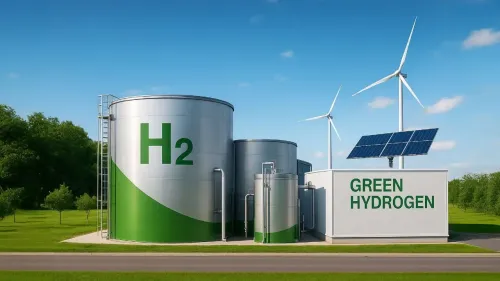
Should the Government Implement Green Hydrogen Mandates to Boost Demand?

Synopsis
As the call for Green Hydrogen mandates grows, the CII emphasizes the need for government action to stimulate demand and establish a sustainable green hydrogen economy, paving the way for India's energy future.
Key Takeaways
Green Hydrogen mandates are essential for stimulating demand.
Incentives can help bridge the cost gap between green and grey hydrogen .
Phased mandates could provide certainty to producers.
Robust public procurement can anchor demand.
A rapid shift to green technologies is necessary for market competitiveness.
New Delhi, Jan 14 (NationPress) The Confederation of Indian Industry (CII) has called on the government to consider implementing Green Hydrogen mandates to stimulate demand and foster a dynamic green hydrogen economy.
The industry body highlighted that greening mandates supported by incentives are essential to bridge the considerable cost disparity between green hydrogen and grey hydrogen.
“The suggested Green Hydrogen Blending could be initiated for industries like refining, fertilizer, and natural gas, utilizing cost-offset mechanisms,” the statement noted.
According to CII, sectors that rely heavily on grey hydrogen are ideally positioned to lead the way in creating substantial demand for green hydrogen. Greening mandates can provide assurance to producers, allowing for quicker reductions in costs through economies of scale.
The apex industry organization has advocated for phased mandates coupled with cost-offset strategies, such as carbon credit allocations for emissions reductions, cross-subsidies in the fertilizer sector, and offering cheaper natural gas when blended with green hydrogen.
Moreover, CII has emphasized the need for viability gap funding to alleviate the financial burden on consumers and businesses.
Chandrajit Banerjee, Director General of CII, expressed that India must advance its green technology initiatives following a historic year in clean energy in 2025, which saw non-fossil fuel installed capacity reach 266.78 GW.
This increase represented a 22.6% rise from 2024, with an addition of 49.12 GW of new non-fossil capacity over the 217.62 GW that was added in 2024.
CII pointed out that strong demand will arise from mandating public procurement in government projects, requiring 10–15% of infrastructure-related materials like steel and ammonia to come from green hydrogen-based production.
Mandating green procurement could create reliable, established demand, thereby reducing the prices of green products through increased scale, according to the statement.
The industry body urged for a swift transition to green steel and ammonia within export-driven sectors to maintain India’s access to premium markets, catalyzing domestic green hydrogen demand and enhancing cost-efficiency and value chain maturity.
Point of View
The government could not only meet energy demands but also enhance sustainability efforts across sectors.
NationPress
30 Sept 2026
Frequently Asked Questions
What are Green Hydrogen mandates?
Green Hydrogen mandates are regulations proposed to encourage the production and use of green hydrogen, which is produced using renewable energy sources, in various industries.
Why is there a need for Green Hydrogen?
Green Hydrogen is crucial for reducing carbon emissions and transitioning to a sustainable energy economy, particularly in sectors that currently rely on grey hydrogen.
How can the government support Green Hydrogen production?
The government can support Green Hydrogen through mandates, incentives, and cost-offset mechanisms that improve economic viability for producers and consumers.
What impact could this have on the economy?
Implementing Green Hydrogen mandates could lead to job creation, technological advancements, and a significant reduction in carbon emissions, enhancing India's energy security.
Which sectors could benefit from Green Hydrogen?
Sectors such as refining, fertilizer production, and natural gas could greatly benefit from the incorporation of Green Hydrogen into their processes.