CJI Highlights Forensic Science as Justice's 'Protective Shield' at NFSU Convocation

Synopsis
At the NFSU convocation, CJI Surya Kant emphasized the crucial role of forensic science as the 'protective shield' of justice, addressing the impact of technology-driven crimes and inspiring graduates to uphold scientific integrity.
Key Takeaways
Forensic science is essential in modern justice.
1,799 degrees awarded, including 17 PhDs .
International representation with 98 students from 21 countries .
The IDDRC aims to enhance dispute resolution.
NFSU has trained nearly 28,000 professionals .
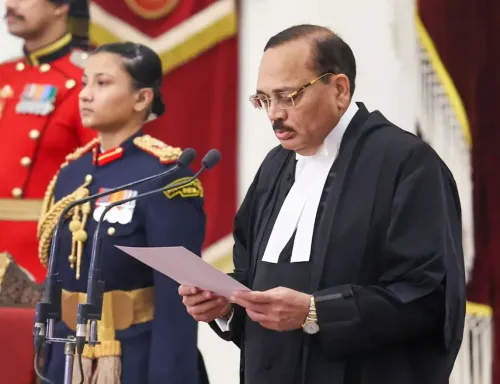
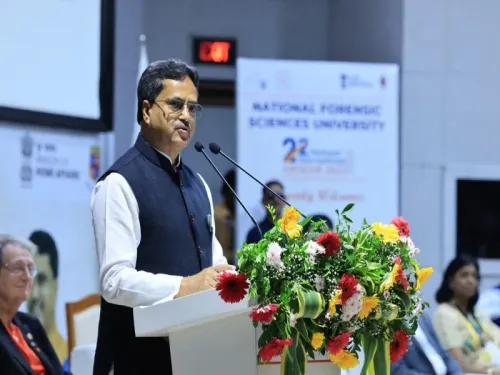
Gandhinagar, Feb 27 (NationPress) During the fourth convocation of the National Forensic Sciences University (NFSU) held in Gandhinagar, Chief Justice of India Surya Kant referred to forensic science as the “protective shield” of justice amidst the rise of technology-driven crimes.
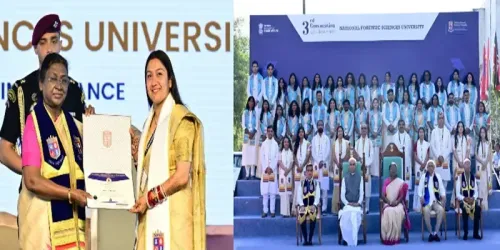
At this ceremony, a total of 1,799 students received their degrees, which included 17 PhD scholars. In recognition of their academic achievements, 52 students were awarded gold medals.
The graduating class featured individuals from 66 specialized programs, and included 98 international students hailing from 21 different countries.
In his address, the Chief Justice elaborated on the expanding significance of forensic science within the justice system. He noted, “In the era of technology-driven crime, forensic science serves as a protective shield for justice.”
He encouraged the graduates to meld their sense of purpose with their scientific passion and highlighted that forensic reports have far-reaching implications beyond the laboratory.
According to him, “The reports created by forensic scientists have an impact that extends beyond the lab, affecting everyone involved.”
Justice Surya Kant emphasized that the justice delivery system in India must uphold principles of precision and must be firmly based on evidence derived from scientific objectivity and fairness.
He remarked, “The judiciary increasingly relies on expert opinions to navigate modern crimes. The signature of an expert on a report is not just a professional formality; it's a mark of credibility.”
He characterized justice delivery as a collaborative effort involving judges, lawyers, experts, and investigators.
During the event, the Chief Justice also inaugurated the International Digital Dispute Resolution Centre (IDDRC), a new initiative aimed at improving accessibility and effectiveness in dispute resolution both in India and globally.
In his address, Founder-Vice Chancellor J.M. Vyas described the convocation as a pivotal event for enhancing justice rooted in scientific truth in India.
He stated, “Under the leadership of Prime Minister Narendra Modi, NFSU is dedicated to integrity and national service to foster global security and justice founded on scientific evidence.”
Additionally, he mentioned that the ceremony exemplified India’s commitment to an evidence-based justice system and the enhancement of forensic capabilities.
Statistics from the university reveal that approximately 7,932 NFSU graduates are currently working as forensic experts in various investigative agencies, laboratories, courts, and security organizations worldwide. The institution has trained nearly 28,000 professionals, which includes 5,400 judicial officers and international personnel.
The ceremony was attended by Deputy Chief Minister Harsh Sanghavi, Gujarat High Court Chief Justice Sunita Agarwal, senior Supreme Court judges, international representatives from Zimbabwe and Saudi Arabia, high-ranking law enforcement officials, judicial officers, members of the university’s Board of Governors and Academic Council, faculty, students, and their families.
Point of View
Reflecting a commitment to integrating scientific evidence into the judicial process. This event not only celebrates academic achievements but also highlights the evolving landscape of crime and justice in India.
NationPress
20 Sept 2026
Frequently Asked Questions
What is the significance of forensic science in today's justice system?
Forensic science acts as a protective shield by providing scientific evidence that is crucial in solving modern technology-driven crimes.
How many students graduated from NFSU?
A total of 1,799 students graduated from NFSU, including 17 PhD scholars and 52 gold medalists.
What new initiative was inaugurated at the NFSU convocation?
The International Digital Dispute Resolution Centre (IDDRC) was inaugurated to improve accessibility and effectiveness in dispute resolution.
How many professionals has NFSU trained to date?
NFSU has trained nearly 28,000 professionals, including 7,932 graduates currently serving as forensic experts.
Who attended the NFSU convocation?
The event was attended by various dignitaries including Deputy Chief Minister Harsh Sanghavi and Gujarat High Court Chief Justice Sunita Agarwal.