CJI Surya Kant in Moscow: India, Russia share justice system challenge
Synopsis
Chief Justice of India Surya Kant travelled to Moscow to meet the head of Russia's Supreme Court, framing the two nations' judicial systems as facing identical existential pressures — public trust and technological disruption. His call for joint training programmes and research partnerships signals a quiet but meaningful expansion of India-Russia institutional ties beyond trade and defence.
Key Takeaways
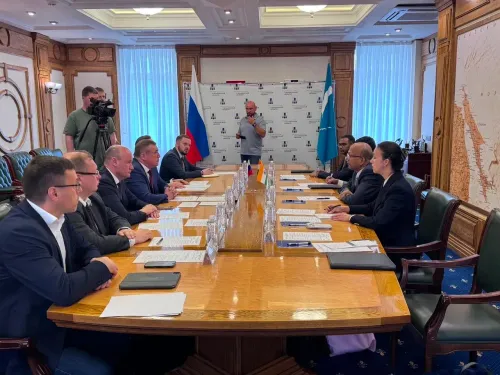
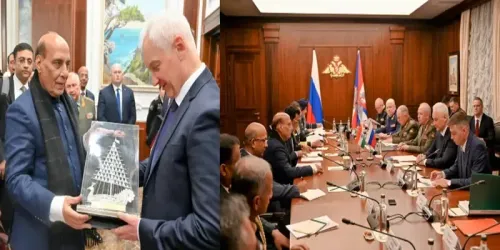
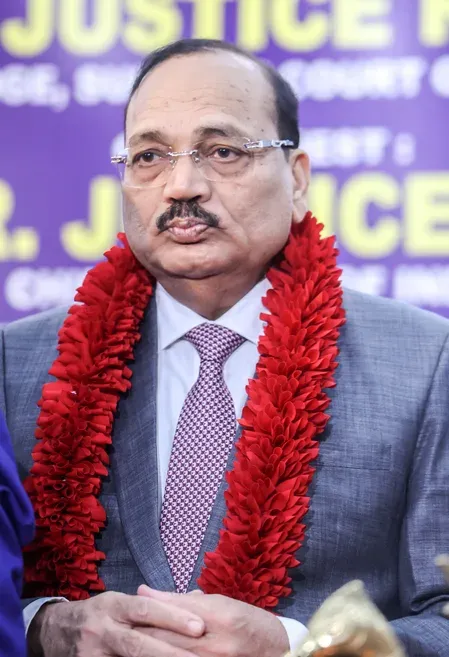
CJI Surya Kant met Igor Krasnov , Chairman of the Supreme Court of the Russian Federation , in Moscow on Tuesday, 23 June .
He highlighted that both courts serve societies of 'immense scale and diversity' and share the challenge of maintaining public confidence in justice.
India's judicial tech initiatives cited include e-filing , virtual hearings , AI-enabled translation tools , and virtual judicial assistance platforms .
CJI proposed collaboration via judicial academy exchanges , joint training programmes , and research partnerships .
The visit follows CJI Surya Kant's earlier trip to Russia for the BRICS Chief Justices Conference in Sochi in 2024 .
Chief Justice of India (CJI) Surya Kant on Tuesday addressed a meeting with Igor Krasnov, Chairman of the Supreme Court of the Russian Federation, in Moscow, asserting that despite evolving through distinct legal traditions, the Supreme Courts of India and Russia confront a shared imperative — preserving public confidence in the administration of justice amid a rapidly changing world.
Shared Challenges Across Two Legal Traditions
Drawing on his earlier visit to Russia during the BRICS Chief Justices Conference in Sochi in 2024, CJI Surya Kant noted a compelling parallel between the two apex courts. 'The Supreme Court of India and the Supreme Court of the Russian Federation serve societies of immense scale and diversity. Although our legal traditions have evolved along different historical paths, we share a common challenge: how to preserve public confidence in the administration of justice while adapting to a rapidly changing world,' he said.
Both nations govern vast, diverse populations, and their highest courts bear the weight of maintaining institutional legitimacy across complex social and political landscapes. This is not a ceremonial observation — it reflects a structural reality that judiciaries in large federal or quasi-federal democracies routinely navigate.
Technology in Courts: Opportunity and Responsibility
CJI Surya Kant devoted significant attention to the growing role of technology in judicial systems, emphasising that modern judiciaries must harness innovation responsibly. 'The future of justice will depend upon our ability to combine technological innovation with enduring human values,' he said, cautioning that efficiency gains must not come at the cost of judicial integrity.
He outlined India's own digital transformation journey — encompassing e-filing, virtual hearings, digitisation of court records, AI-enabled translation tools, and virtual judicial assistance platforms. The guiding principle, he stressed, has been that technology should expand access to justice rather than supplant the fundamentally human character of judicial decision-making.
Investment in People at the Core
Beyond infrastructure and technology, CJI Surya Kant underscored that the long-term effectiveness of judicial institutions rests on investment in human capital. Continuous education, structured training, and professional development for judicial officers, he argued, are non-negotiable pillars of a credible justice system.
This emphasis on capacity-building reflects a broader concern within Indian judicial reform discourse — that technology adoption without corresponding upgrades in judicial competency risks creating a two-speed system where access improves on paper but quality of adjudication does not.
Scope for India-Russia Judicial Cooperation
CJI Surya Kant identified concrete avenues for deepening bilateral judicial engagement. 'There is considerable scope for collaboration through exchanges between judicial academies, joint training programmes, research partnerships, and the sharing of best practices between Indian and Russian judiciaries,' he said.
He expressed confidence that sustained dialogue between the two apex courts would reinforce institutional strength in both countries. 'I am confident that continued engagement between the Supreme Court of India and the Supreme Court of the Russian Federation will further strengthen our institutions and enrich the administration of justice in both our countries,' he added.
The visit comes at a moment when India-Russia ties are under renewed scrutiny globally, lending the judicial exchange a broader diplomatic dimension beyond its legal significance. How the two courts translate these stated intentions into operational cooperation will be watched closely by legal scholars and bilateral observers alike.
Point of View
Including India's own. The proposal for joint judicial academy exchanges with Russia is also notable: at a moment of geopolitical friction, institutional-level engagement between the two countries' judiciaries could serve as a durable back-channel. Whether these proposals move beyond the ceremonial stage will depend on follow-through that past bilateral judicial dialogues have not always delivered.
NationPress
22 Sept 2026
Frequently Asked Questions
Why did CJI Surya Kant visit Moscow?
CJI Surya Kant visited Moscow to meet Igor Krasnov, Chairman of the Supreme Court of the Russian Federation, to discuss shared judicial challenges and explore avenues for India-Russia judicial cooperation. The visit builds on his earlier engagement at the BRICS Chief Justices Conference in Sochi in 2024.
What common challenges did CJI Surya Kant identify between India and Russia?
He identified preserving public confidence in the administration of justice and adapting to technological change as the two overriding shared challenges. Despite different legal traditions, both courts serve large, diverse societies where institutional trust is foundational.
What is India's experience with court technology that CJI Surya Kant highlighted?
CJI Surya Kant cited e-filing, virtual hearings, digitisation of court records, AI-enabled translation tools, and virtual judicial assistance platforms as key components of India's digital court transformation. He stressed these were guided by the principle that technology should expand access, not replace human judicial values.
What cooperation did CJI Surya Kant propose between India and Russia?
He proposed exchanges between judicial academies, joint training programmes, research partnerships, and sharing of best practices between the two judiciaries. He expressed confidence that continued dialogue would strengthen institutions in both countries.
What is the significance of this visit in the broader India-Russia context?
The visit comes amid heightened global scrutiny of India-Russia ties, adding a diplomatic dimension to what is formally a judicial exchange. Institutional cooperation at the Supreme Court level can provide a stable channel of bilateral engagement independent of political fluctuations.