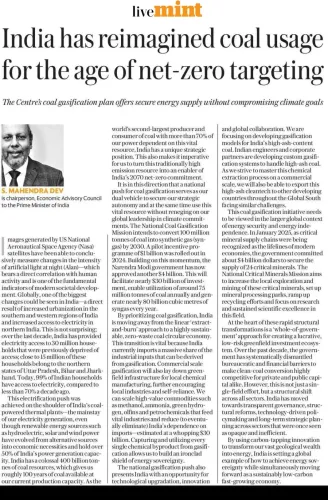
Coal gasification can cut India's ₹2.77 lakh crore import bill, says ex-NITI Aayog member

Synopsis
India spends ₹2.77 lakh crore a year importing LNG, methanol, ammonia, and coking coal — and a panel of top policymakers and researchers argues that coal gasification and coal-to-chemicals pathways could be the strategic lever to change that. The case: use what India already has in abundance, but use it cleanly.
Key Takeaways
Dr VK Saraswat , former NITI Aayog member, called coal gasification a major opportunity to reduce India's ₹2.77 lakh crore import bill for LNG, methanol, ammonia, and coking coal ( FY2025 ).
He called for a 'paradigm shift' in coal use through clean coal technologies , with energy security at the centre of India's transition strategy.
Rupinder Brar , Additional Secretary, Ministry of Coal , said India must define its energy path based on its own resource realities, not frameworks from coal-depleted economies.
ACPET Director Vaibhav Chaturvedi said coal is likely to remain part of India's energy mix for decades , even as renewables expand.
Two publications were released at the event, including CRF's issue brief 'Black Coal, Clean Molecule' on coal-to-hydrogen pathways.
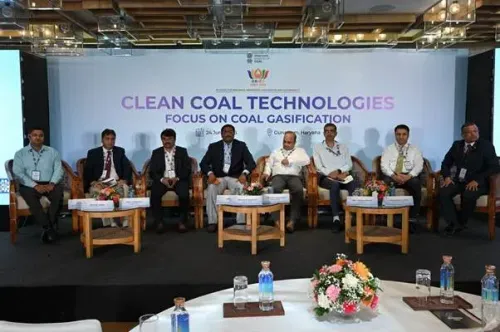
Dr VK Saraswat, former member of NITI Aayog, on 11 June 2025 said that coal gasification and coal-to-chemicals pathways represent a major strategic opportunity for India to reduce its import dependence, which stood at ₹2.77 lakh crore in FY2025 for products including LNG, methanol, ammonia, and coking coal. Speaking at a panel discussion in New Delhi, he called for a fundamental rethink of how the country uses its coal reserves.
The Case for Clean Coal Technologies
Dr Saraswat argued that 'a paradigm shift has to take place in the way we use coal, and that will be through clean coal technologies.' He stressed that energy security must remain at the centre of India's transition strategy, and that coal gasification and coal-to-chemicals routes offer a path to simultaneously reduce costly imports and support industrial decarbonisation.
Government's Position on India's Energy Realities
Rupinder Brar, Additional Secretary at the Ministry of Coal, emphasised that innovation must drive India's energy transition. She noted that negative portrayals of coal in global climate discourse have often come from countries that had already depleted much of their own coal reserves. India, she argued, must chart its energy course based on its own resource realities and developmental priorities — not on frameworks designed for economies at a different stage.
Coal's Role Alongside Renewables
Vaibhav Chaturvedi, Director of the Ashoka Centre for a People-centric Energy Transition (ACPET), acknowledged that renewable energy will be central to India's energy future, but cautioned that coal is likely to remain a significant part of the country's energy mix for decades. He underlined the importance of exploring how India's abundant domestic coal resources can contribute to energy security, economic growth, and net-zero objectives simultaneously.
Dr Debajit Palit, Centre Head at the Centre for Climate Change and Energy Transition, Chintan Research Foundation (CRF), described coal as 'buried sunshine' — arguing that India's energy future requires both renewable resources and the efficient use of domestic fossil reserves. He said coal gasification offers a rare opportunity to advance both economic security and environmental goals at once.
Publications and Policy Dialogue
The panel discussion was jointly organised by CRF and ACPET, bringing together policymakers, industry leaders, and researchers to examine the opportunities and challenges of scaling coal gasification and its downstream applications. The event also saw the release of two publications: a joint CRF-ACPET compilation of critical perspectives on coal gasification, and CRF's issue brief titled 'Black Coal, Clean Molecule', which lays out the strategic case for coal-to-hydrogen pathways in India.
As India weighs its energy transition commitments against energy security imperatives, the debate over clean coal technologies is set to intensify in the months ahead.
Point of View
And a credible one given India's coal endowment. The harder question is execution: India has discussed coal gasification for years with limited commercial scale-up. Without a clear policy mandate, dedicated financing, and technology partnerships, this risks remaining a conference-circuit idea rather than a supply-chain reality.
NationPress
26 Oct 2026
Frequently Asked Questions
What is coal gasification and why is India interested in it?
Coal gasification converts coal into synthetic gas (syngas), which can then be used to produce chemicals, hydrogen, methanol, and fertilisers. India is interested because it could replace costly imports of LNG, methanol, and ammonia, reducing a foreign exchange outflow of ₹2.77 lakh crore recorded in FY2025.
What did Dr VK Saraswat say about clean coal technologies?
Dr VK Saraswat, former NITI Aayog member, said a 'paradigm shift' is needed in how India uses coal, and that clean coal technologies — particularly coal gasification and coal-to-chemicals pathways — are the vehicle for that shift. He stressed that energy security must remain central to India's transition strategy.
What is India's current import bill for energy-related products?
India's import bill for products such as LNG, methanol, ammonia, and coking coal stood at ₹2.77 lakh crore in FY2025, according to figures cited at the panel discussion. Coal gasification is being proposed as a domestic alternative to reduce this dependence.
What publications were released at the CRF-ACPET event?
Two publications were released: a joint CRF-ACPET compilation of critical perspectives on coal gasification, and CRF's issue brief 'Black Coal, Clean Molecule', which examines the strategic case for coal-to-hydrogen pathways in India.
Will coal be phased out as India expands renewable energy?
Experts at the panel, including ACPET Director Vaibhav Chaturvedi, said coal is likely to remain a significant part of India's energy mix for decades even as renewables grow. The argument is not coal versus renewables, but how to use coal more cleanly while the transition unfolds.