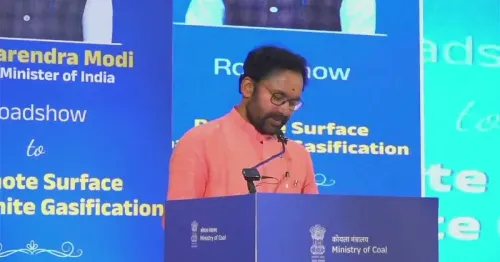
Kishan Reddy Addresses Coal Gasification Roadshow in Delhi
Synopsis
Union Coal and Mines Minister G. Kishan Reddy addressed a roadshow in New Delhi on 28 May 2026 to promote surface coal and lignite gasification projects, reaffirming India's commitment to clean coal technologies and its target of 100 million tonnes of gasification capacity by 2030.
Key Takeaways
Union Coal and Mines Minister G.
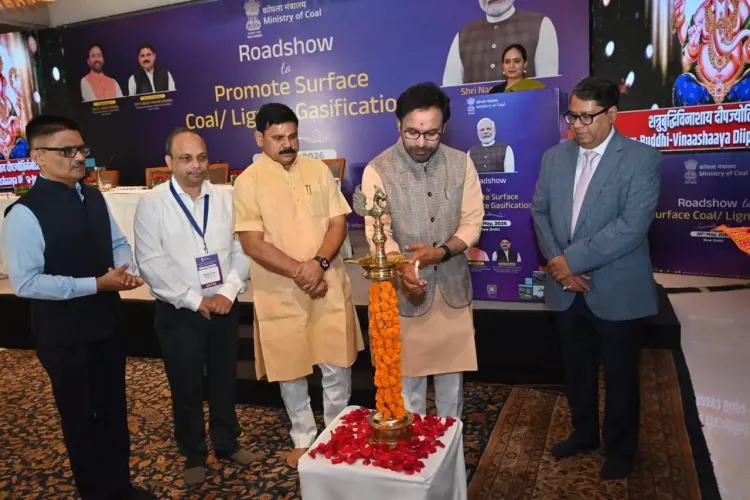
Kishan Reddy addressed the Roadshow on Promotion of Surface Coal/Lignite Gasification Projects in New Delhi on 28 May 2026 .
The minister highlighted the government's commitment to coal gasification, clean coal technologies, energy security, and sustainable industrial growth.
India has set a target of 100 million tonnes of coal gasification capacity by 2030 , with supporting policies introduced around 2022 .
The gasification mission aims to convert domestic coal reserves into syngas, reducing dependence on imported crude oil and natural gas.
Key beneficiary sectors include coal mining companies and the chemical and fertilizer industries , which rely on syngas as an industrial feedstock.
The roadshow is part of a broader outreach to attract private investment alongside public-sector participation in surface and lignite gasification projects.
Union Coal and Mines Minister G. Kishan Reddy addressed the Roadshow on Promotion of Surface Coal/Lignite Gasification Projects in New Delhi on Thursday, 28 May 2026, highlighting the government's commitment to advancing coal gasification, clean coal technologies, energy security, and sustainable industrial growth.
Context
The roadshow brought together stakeholders from the coal, chemical, and fertilizer sectors to build awareness and attract investment for surface coal and lignite gasification initiatives. Minister Reddy underscored that the government views gasification as a strategic lever to convert India's vast domestic coal reserves into syngas — a versatile industrial feedstock — while reducing dependence on imported petroleum products and natural gas.
In his address, Reddy reaffirmed the Ministry of Coal's intent to push clean coal technologies as a bridge between India's current energy mix and its longer-term sustainability goals.
Policy Backdrop
The roadshow sits within a policy arc that dates to 2020, when Prime Minister Narendra Modi announced a national push for coal gasification to produce chemicals and reduce import dependence. The government subsequently set an ambitious target of 100 million tonnes of coal gasification capacity by 2030, backed by supporting policy measures introduced around 2022.
India is the world's second-largest coal producer, and the gasification mission is designed to leverage those reserves domestically rather than rely on costlier imports of crude oil or natural gas. The strategy is framed as a way to simultaneously serve energy security and industrial feedstock needs without waiting for a full renewable transition.
The Ministry of Coal has positioned surface gasification — converting coal at the surface rather than underground — and lignite gasification as commercially scalable routes that can attract private investment alongside public-sector participation.
Stakeholders and Impact
Coal mining companies stand to gain new downstream revenue streams if gasification projects scale, while chemical and fertilizer industries would benefit from a domestic syngas supply that could replace imported feedstocks such as naphtha or LNG. Both sectors have been closely watching the government's policy signals and investment incentives.
For industrial consumers, successful gasification projects could translate into more stable input costs and reduced exposure to global commodity price swings. For the government, progress on the 100 million tonne gasification target would serve as a visible marker of its 'Aatmanirbhar Bharat' energy self-reliance agenda.
What's Next
Observers will watch for tender announcements, pilot project allocations, and any new fiscal incentives that may follow the roadshow's deliberations. Regulatory updates and budget provisions in upcoming fiscal planning cycles will be key signals of how quickly the gasification pipeline can move from policy commitment to on-ground capacity.
With G. Kishan Reddy personally anchoring the outreach effort, the ministry appears intent on sustaining momentum and keeping investor attention focused on the 2030 gasification capacity milestone.
Point of View
Reddy reinforces political ownership of the 2030 capacity target at a time when the government needs visible progress to back its 'Aatmanirbhar Bharat' energy narrative. The outreach to chemical and fertilizer industries is strategically significant — these sectors represent large, captive demand that could make gasification projects commercially viable at scale. Whether investor commitments follow the ministerial rhetoric will be the true test of the policy's traction.
NationPress
11 Oct 2026
Frequently Asked Questions
What is coal gasification and why is India promoting it?
Coal gasification converts coal into syngas — a mixture of hydrogen and carbon monoxide — that can be used as industrial feedstock or fuel. India is promoting it to reduce dependence on imported crude oil and natural gas while utilising its large domestic coal reserves.
What is India's coal gasification target by 2030?
The government has set a target of 100 million tonnes of coal gasification capacity by 2030 , backed by policy measures introduced around 2022 following Prime Minister Modi's 2020 announcement.
What did Kishan Reddy say at the coal gasification roadshow?
Minister G. Kishan Reddy highlighted the Government of India's commitment to advancing coal gasification, clean coal technologies, energy security, and sustainable industrial growth at the roadshow held in New Delhi on 28 May 2026.
Who benefits from India's coal gasification projects?
Coal mining companies gain new downstream revenue streams, while chemical and fertilizer industries benefit from a domestic syngas supply that can replace costlier imported feedstocks such as naphtha or LNG.
What is surface coal gasification?
Surface coal gasification refers to converting coal into syngas at surface-level facilities, as opposed to underground coal gasification. It is considered a commercially scalable route that can attract private investment for industrial energy use.