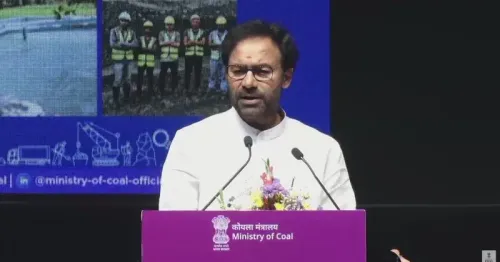
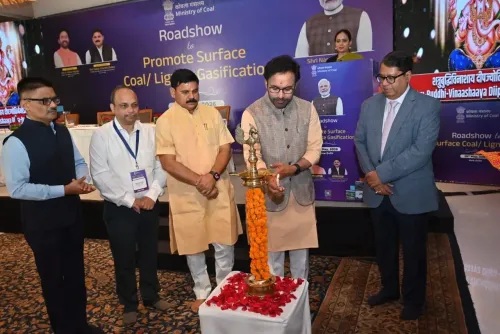
Kishan Reddy Addresses Coal Gasification Roadshow in Hyderabad

Synopsis
Union Coal and Mines Minister G. Kishan Reddy addressed a Surface Coal and Lignite Gasification roadshow in Hyderabad on June 12, 2026, calling for innovation and investment to advance India's energy security. The event aligns with the government's target to gasify 100 million tonnes of coal by 2030 under the Atmanirbhar Bharat framework.
Key Takeaways
Kishan Reddy , Union Minister of Coal and Mines, addressed a Surface Coal and Lignite Gasification roadshow in Hyderabad on June 12, 2026 .
The event convened energy investors, coal industry stakeholders, and chemical manufacturers to accelerate gasification technology adoption.
India has a national target to gasify 100 million tonnes of coal by 2030 , set in 2020 under the Atmanirbhar Bharat framework.
NITI Aayog's 2022 vision document mapped out a commercial roadmap for surface coal gasification to produce syngas for chemicals and fertilisers.
Surface gasification is positioned as a route to monetise India's large coal reserves while reducing dependence on imported fuels.
Upcoming tenders for pilot gasification plants and potential fiscal incentives will be key markers of policy follow-through.
Union Coal and Mines Minister G. Kishan Reddy on Friday, June 12, 2026, addressed a roadshow on Surface Coal and Lignite Gasification held in Hyderabad, underscoring the centrality of innovation and investment in advancing India's energy security and self-reliance goals. The event convened key industry stakeholders to accelerate the adoption of gasification technologies and strengthen the country's domestic energy framework.
Context
Speaking at the roadshow, Kishan Reddy highlighted that surface coal and lignite gasification represents a strategic lever for building an 'energy-secure and self-reliant India' — language that directly echoes the Atmanirbhar Bharat framework launched by the central government in 2020. The Hyderabad event brought together energy investors, coal industry representatives, and chemical manufacturers to explore pathways for scaling gasification technology commercially. Roadshows of this kind are a deliberate policy tool used by the Ministry of Coal to signal stability and attract private capital.
Policy Backdrop
The government set a national target in 2020 to gasify 100 million tonnes of coal by 2030, positioning the technology as a domestic alternative to imported fuels. NITI Aayog's vision document of 2022 laid out a commercial roadmap for surface coal gasification, with syngas production earmarked for the chemicals and fertilisers sectors — industries that currently rely heavily on imported feedstocks. Together, these policy anchors have given gasification a firm place in India's medium-term energy planning.
Surface coal gasification converts coal into syngas — a mixture of hydrogen and carbon monoxide — that can substitute for natural gas in industrial processes. For a country sitting on some of the world's largest coal reserves, the technology offers a route to monetise existing assets while reducing the import bill. The approach is also presented by policymakers as compatible with longer-term decarbonisation commitments, particularly when paired with carbon capture measures.
Stakeholders and Impact
The Hyderabad roadshow drew participation from across the energy investment and manufacturing ecosystem. Chemical manufacturers stand to benefit most directly, as syngas is a primary feedstock for ammonia, methanol, and fertiliser production — sectors where India spends heavily on imports each year. Energy investors, meanwhile, are watching for concrete project tenders and fiscal incentives before committing capital to demonstration plants.
Telangana, where Kishan Reddy also serves as BJP state president, has emerging significance in the energy sector conversation, and hosting such a roadshow in Hyderabad adds a regional dimension to what is otherwise a nationally driven policy push. The Ministry of Coal's involvement signals that the central government is actively seeking to translate policy targets into investable projects on the ground.
What's Next
Observers will watch closely for the award of tenders or pilot-project contracts for surface gasification demonstration plants, which would mark a transition from policy articulation to on-ground implementation. Any fresh fiscal incentives — such as viability gap funding, accelerated depreciation, or production-linked benefits — announced through upcoming budget cycles or Ministry of Coal notifications would be a key indicator of how seriously the government intends to push the 100 million tonne by 2030 target. The pace at which private technology partners and domestic coal companies formalise agreements following events like this Hyderabad roadshow will ultimately determine whether India's gasification ambitions move from roadmap to reality.
Point of View
Broadening its appeal beyond specialist audiences. With the 2030 gasification target now in its second half of the decade, pressure is building on the ministry to show tangible project progress rather than policy reiteration. The choice of Hyderabad as venue also carries a dual signal: it is both an industrially credible location and politically relevant territory for the minister as BJP's Telangana state chief.
NationPress
26 Oct 2026
Frequently Asked Questions
What is surface coal gasification and why is India promoting it?
Surface coal gasification converts coal into syngas — a hydrogen and carbon monoxide mixture — that can be used as an industrial fuel and chemical feedstock. India is promoting it to reduce dependence on imported oil and gas by monetising its large domestic coal reserves, in line with the Atmanirbhar Bharat energy security agenda.
What is India's coal gasification target for 2030?
The Indian government set a target in 2020 to gasify 100 million tonnes of coal annually by 2030, as part of a broader push to develop domestic alternatives to imported fuels.
What did G. Kishan Reddy say at the Hyderabad gasification roadshow?
Kishan Reddy addressed the roadshow on June 12, 2026, highlighting the role of innovation and investment in building an energy-secure and self-reliant India, and called on stakeholders to accelerate gasification technology adoption.
What industries benefit from coal gasification in India?
Chemical manufacturers, fertiliser producers, and energy-intensive industries stand to benefit most, as syngas produced through coal gasification can substitute for imported natural gas used as a feedstock in ammonia and methanol production.
What should investors watch for after the Hyderabad coal gasification roadshow?
Investors should watch for the award of tenders or pilot-project contracts for surface gasification demonstration plants, as well as any new fiscal incentives — such as viability gap funding or production-linked benefits — announced through budget cycles or Ministry of Coal notifications.