Coal gasification gets ₹46,000 crore push to cut India's import bill

Synopsis
India is backing coal gasification with ₹46,000 crore — including a ₹37,500 crore Cabinet-approved surface gasification scheme — to convert coal into syngas, urea, ammonia and methanol by 2030. Simultaneously, the government is mining Argentina's lithium belt and building a four-state rare earth corridor, signalling an all-fronts push on energy and mineral self-reliance.
Key Takeaways
Coal and Mines Minister G Kishan Reddy announced a ₹46,000 crore outlay for coal gasification on 23 October 2026 in New Delhi .
The Union Cabinet has approved a surface coal gasification scheme worth ₹37,500 crore , the largest single component of the push.
India targets gasifying 100 million tonnes of coal by 2030 to produce syngas, urea, ammonia, and methanol domestically.
Coal currently meets 55% of India's primary energy needs and generates 74% of its electricity.
MECL signed an MoU with Argentina's Catamarca province in 2025 for critical mineral exploration, including lithium.
A rare earth element corridor is being developed across Kerala, Tamil Nadu, Andhra Pradesh , and Odisha .
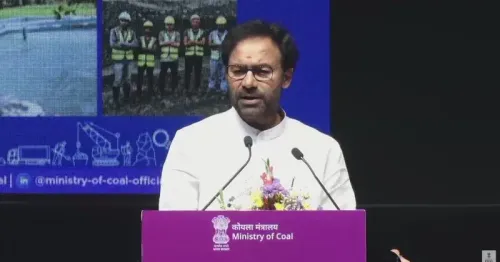
Coal and Mines Minister G Kishan Reddy on Friday, 23 October 2026, announced that India is fast-tracking coal gasification projects with a total outlay of ₹46,000 crore, aiming to reduce the country's dependence on imported fertilisers, liquefied natural gas (LNG), and chemicals. The announcement was made at the Agrasar Bharat Manch event in New Delhi.
What the Push Involves
The government's plan centres on converting coal into value-added products — syngas, ammonia, urea, and methanol — through commercial-scale coal gasification. Reddy described coal as a critical industrial raw material, noting that it currently meets 55% of India's primary energy needs and accounts for 74% of its electricity generation.
The Union Cabinet has recently cleared a dedicated scheme for the promotion of surface coal gasification projects with a financial outlay of ₹37,500 crore — the single largest component of the broader ₹46,000 crore commitment. The scheme is designed to advance the national target of gasifying 100 million tonnes (MT) of coal by 2030.
Why It Matters for Energy Security
India is among the world's largest importers of urea, ammonia, and methanol — commodities that can, in principle, be produced domestically if coal gasification scales up. By substituting imports with domestically produced syngas-derived chemicals, the government hopes to cut the foreign exchange burden and stabilise fertiliser supply chains that are sensitive to global commodity price swings.
This is not India's first push on coal gasification — successive governments have flagged the technology as a priority since at least 2021 — but the Cabinet-backed financial outlay marks a more concrete commitment than earlier policy statements. Notably, this comes amid a broader national energy transition debate, where coal's long-term role is contested even as it continues to dominate India's power grid.
Critical Minerals: India Eyes Argentina and Beyond
Reddy also outlined parallel efforts to secure critical mineral supplies. He said the government is evaluating overseas mining assets for exploration and extraction, with negotiations currently underway with Argentina and several other countries.
'We are currently exploring the mines of Argentina and simultaneously having discussions with other countries,' Reddy said. 'The government is also encouraging Indian entrepreneurs to go abroad for the purpose of exploration and processing of critical minerals,' he added.
In 2025, Mineral Exploration and Consultancy Limited (MECL), a public sector undertaking under the Ministry of Mines, signed a memorandum of understanding (MoU) with the provincial government of Catamarca in Argentina for deeper collaboration in critical mineral resource development. Argentina holds vast lithium reserves, making it a strategic partner for India's electric vehicle battery and renewable energy storage ambitions.
Rare Earth Corridor Planned Across Four States
On the domestic front, Reddy said the government is developing a rare earth element corridor spanning Kerala, Tamil Nadu, Andhra Pradesh, and Odisha. He expressed confidence that India would achieve self-sufficiency in rare earth elements in the near term — a goal that, if realised, would significantly reduce dependence on China, which dominates global rare earth processing.
Rare earth elements are critical inputs for electric vehicles, telecommunications, solar power units, and defence hardware, making domestic supply a strategic as much as an economic priority.
What to Watch Next
The government has indicated that commercial-scale coal gasification projects will be pushed in the near future, with the Cabinet scheme providing the financial framework. Industry observers will be watching for project timelines, bidding processes, and whether private sector participation materialises at the scale needed to hit the 100 MT gasification target by 2030.
Point of View
000 crore figure is significant, but the harder question is execution. India has flagged coal gasification as a priority for years without commercial-scale projects to show for it; the Cabinet-backed scheme is the most financially grounded commitment yet, but timelines and private sector uptake remain untested. Simultaneously pursuing critical minerals in Argentina and a domestic rare earth corridor reflects a genuine strategic pivot — yet both tracks face long lead times that sit awkwardly against urgent EV and defence supply-chain needs. The real measure of this announcement will come when the first gasification tender is floated and the first mine in Catamarca moves from MoU to actual extraction.
NationPress
23 Oct 2026
Frequently Asked Questions
What is India's ₹46,000 crore coal gasification plan?
It is a government programme to convert domestic coal into syngas, urea, ammonia, and methanol at commercial scale, reducing India's reliance on imports of these products. The plan includes a Cabinet-approved scheme worth ₹37,500 crore for surface coal gasification projects, with a national target of gasifying 100 million tonnes of coal by 2030.
Why is the government pushing coal gasification now?
India imports significant volumes of urea, ammonia, LNG, and methanol — all of which can be produced from coal through gasification. Scaling up domestic production is intended to cut the import bill, stabilise fertiliser supply chains, and strengthen energy security amid volatile global commodity prices.
What is India doing to secure critical minerals abroad?
Coal and Mines Minister G Kishan Reddy said India is exploring overseas mining assets, with active discussions underway with Argentina and other countries. MECL, a government PSU, signed an MoU with Argentina's Catamarca province in 2025 for critical mineral exploration, particularly lithium needed for EV batteries and renewable energy storage.
What is the rare earth element corridor being planned in India?
The government is developing a rare earth element corridor across Kerala, Tamil Nadu, Andhra Pradesh, and Odisha. Reddy said India aims to become self-sufficient in rare earth elements, which are critical inputs for EVs, solar power, telecommunications, and defence hardware.
How important is coal to India's energy mix today?
Coal currently meets 55% of India's primary energy needs and accounts for 74% of its electricity generation, according to figures cited by Minister Reddy. This dominant role underpins the government's strategy of gasifying coal into cleaner and more versatile chemical feedstocks rather than phasing it out entirely in the near term.