CM Assam Office: Flood Relief Ops Continue Across State
Synopsis
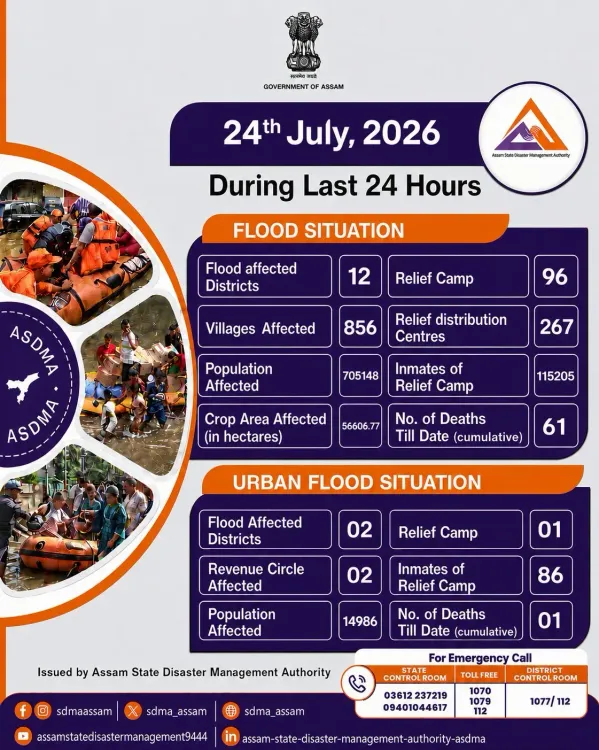
The Chief Minister's Office of Assam confirmed on 24 July 2026 that rescue teams, relief camps and distribution centres are working round the clock to aid flood-affected communities, as the state's annual monsoon emergency response remains in full operation along the Brahmaputra basin.
Key Takeaways
The Chief Minister's Office of Assam issued a flood situation update dated 24 July 2026 , confirming active relief operations statewide.
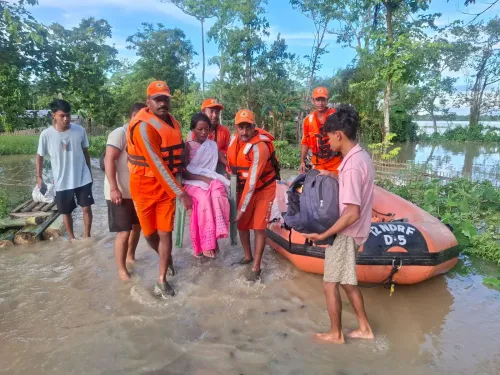
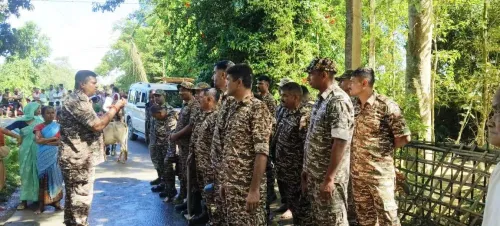
Rescue teams, relief camps , and distribution centres are functioning round the clock to support affected communities.
The Brahmaputra River and its tributaries are the primary drivers of Assam's recurring annual flooding during the June–September monsoon.
The Assam State Disaster Management Authority (ASDMA) and the National Disaster Response Force (NDRF) are the key agencies coordinating the response.
Flood-affected rural households and farmers are among the most vulnerable groups receiving relief assistance.
Further district-wise impact data and central assistance updates are expected in subsequent official situation reports.
The Chief Minister's Office of Assam issued a flood situation update on 24 July 2026, confirming that rescue teams, relief camps, and distribution centres are operating round the clock to support communities affected by the ongoing monsoon flooding across the state.
Context
The update, posted on 25 July 2026, states that 'relief efforts continue across Assam with rescue teams, relief camps and distribution centres working round the clock to support flood-affected communities.' The announcement reflects the active phase of the state's emergency response machinery, mobilised as floodwaters from the Brahmaputra River and its tributaries inundate low-lying districts during the peak monsoon season.
Assam experiences predictable and severe annual flooding between June and September, with the Brahmaputra's swelling waters displacing thousands of rural households and farmers every year. The 2026 season follows this established pattern, prompting the state government to activate its full disaster-response apparatus.
Policy Backdrop
The Assam State Disaster Management Authority (ASDMA) serves as the nodal body coordinating relief camps, supply distribution, and inter-agency response across affected districts. The National Disaster Response Force (NDRF), a central agency, is routinely deployed alongside state teams for rescue and evacuation operations during such events.
Assam's flood-response framework has been activated consistently across multiple monsoon seasons, drawing on central funding mechanisms such as the National Disaster Response Fund for immediate relief and longer-term rehabilitation. Chief Minister Himanta Biswa Sarma, who has helmed the state since 2021, has overseen this annual cycle of emergency mobilisation, combining immediate relief with ongoing embankment and river-management initiatives.
Stakeholders and Impact
The primary beneficiaries of the current relief operations are flood-affected communities across Assam, including rural households and farming families whose livelihoods and homes are directly threatened by rising waters. Relief camps provide shelter, food, and essential supplies to displaced persons, while distribution centres extend support to those who remain in partially inundated areas.
The round-the-clock operational tempo signals the scale of the ongoing emergency, with multiple agencies — state, central, and local — coordinating logistics to ensure continuous aid delivery. Farmers face particular vulnerability, as floodwaters damage standing crops and agricultural infrastructure during the critical kharif season.
What's Next
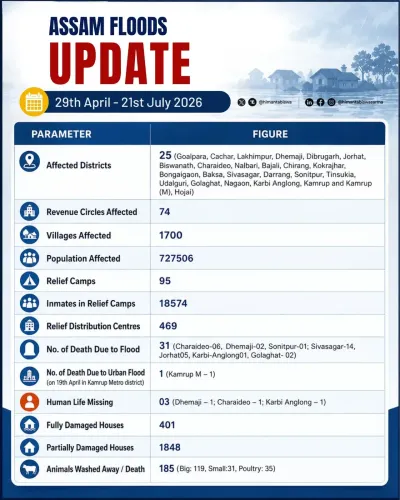
Subsequent daily situation reports from the Chief Minister's Office of Assam are expected to detail district-wise impact figures, camp occupancy numbers, and any requests for additional central assistance. Authorities will also be monitoring the pace of floodwater recession to begin assessing damage to embankments, roads, and agricultural land.
Longer-term, the state's flood-mitigation agenda — encompassing embankment repair timelines and river-management budgets — will come into sharper focus once the immediate emergency phase subsides. The 2026 flood season underscores the persistent need for durable infrastructure investment along the Brahmaputra basin to reduce the annual human and economic toll on Assam's most vulnerable communities.
Point of View
Reflecting a governance model that treats annual Brahmaputra flooding as a managed emergency rather than an exceptional crisis. The activation of ASDMA and NDRF assets signals that the 2026 monsoon has reached a threshold requiring full state mobilisation, though the absence of district-level figures in this update limits an assessment of the flood's comparative severity. For Chief Minister Himanta Biswa Sarma, visible and continuous communication of relief operations serves both an administrative and a political function — demonstrating state capacity during a period of acute public vulnerability. The broader policy question of whether Assam's embankment and river-management investments are reducing long-term flood exposure remains open, and will be tested once damage assessments are completed after the waters recede.
NationPress
25 Jul 2026
Frequently Asked Questions
What is the current flood situation in Assam in July 2026?
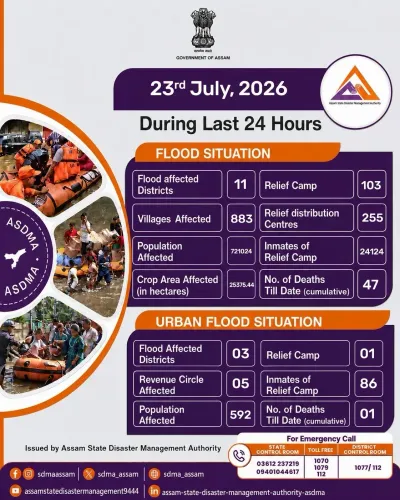
As of 24 July 2026 , the Chief Minister's Office of Assam confirmed that flood-affected communities across the state are being supported by rescue teams, relief camps and distribution centres operating round the clock. District-wise impact figures are expected in subsequent official updates.
Which agencies are handling Assam flood relief operations in 2026?
The Assam State Disaster Management Authority (ASDMA) is the nodal state body coordinating relief, while the National Disaster Response Force (NDRF) provides central rescue and evacuation support. Both agencies work alongside district administration teams during the monsoon emergency.
Why does Assam flood every year?
Assam floods annually because the Brahmaputra River and its numerous tributaries overflow during the June–September monsoon season, inundating low-lying districts across the state. The river's high sediment load and the topography of the Brahmaputra valley make large-scale flooding a recurring seasonal phenomenon.
What relief is available for flood-affected people in Assam?
The state government operates relief camps providing shelter, food and essential supplies for displaced persons, along with distribution centres that extend aid to communities in partially inundated areas. Post-flood rehabilitation is also supported through central funding mechanisms such as the National Disaster Response Fund .
Who is responsible for Assam's flood management?
Chief Minister Himanta Biswa Sarma heads the state government's overall disaster response, with the Assam State Disaster Management Authority handling operational coordination. The central government provides additional support through the NDRF and national disaster funding schemes.