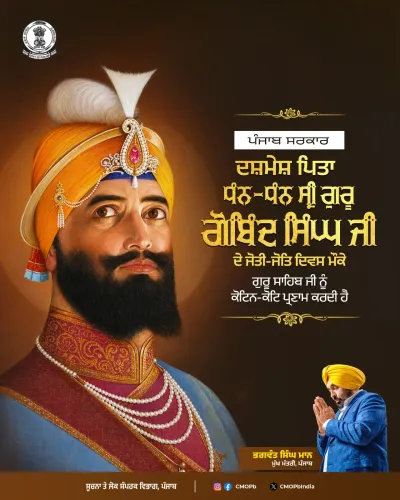
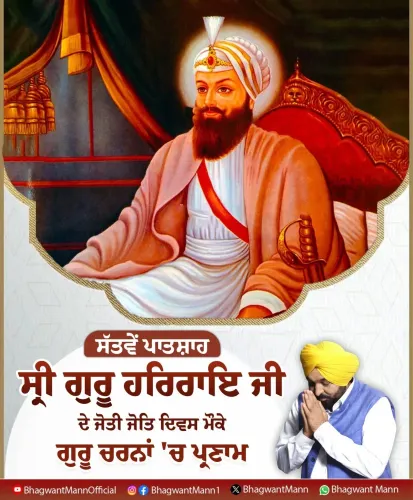
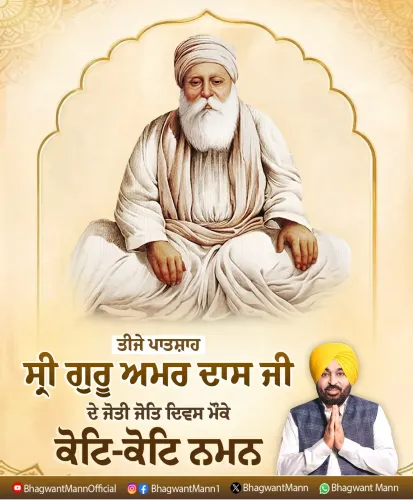
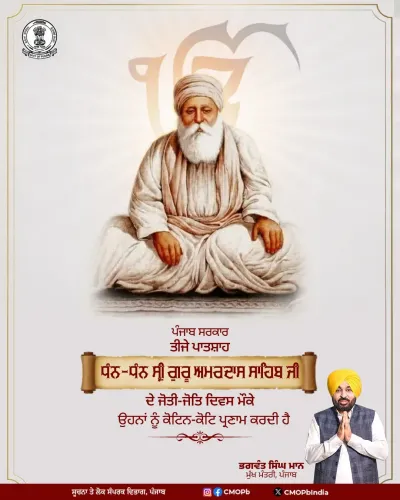
CM Bhagwant Mann pays tribute on Guru Gobind Singh Jyoti Jot Divas
Synopsis
Punjab Chief Minister Bhagwant Mann marked Guru Gobind Singh Ji's Jyoti Jot Divas with a tribute invoking the tenth Sikh Guru's verse on universal human equality and calling on citizens to pledge themselves to the saint-soldier ideal of truth, justice, and resistance to oppression.
Key Takeaways
Punjab Chief Minister Bhagwant Mann paid tribute to Guru Gobind Singh Ji on Jyoti Jot Divas, 14 November 2026 .
He highlighted the Guru's verse 'Manas ki jaat sabai ekai pehchanbo' — 'Recognise the entire human race as one' — as a timeless message of equality.
Guru Gobind Singh , the tenth Sikh Guru, founded the Khalsa Panth in 1699 and established the saint-soldier ( Sant-Sipahi ) ideal.
Mann called on citizens to uphold the saint-soldier philosophy and pledge to stand for truth and justice against oppression and injustice.
Public tributes by Punjab leaders on major Sikh Guru anniversaries reflect the state's established tradition of linking religious heritage with governance values.
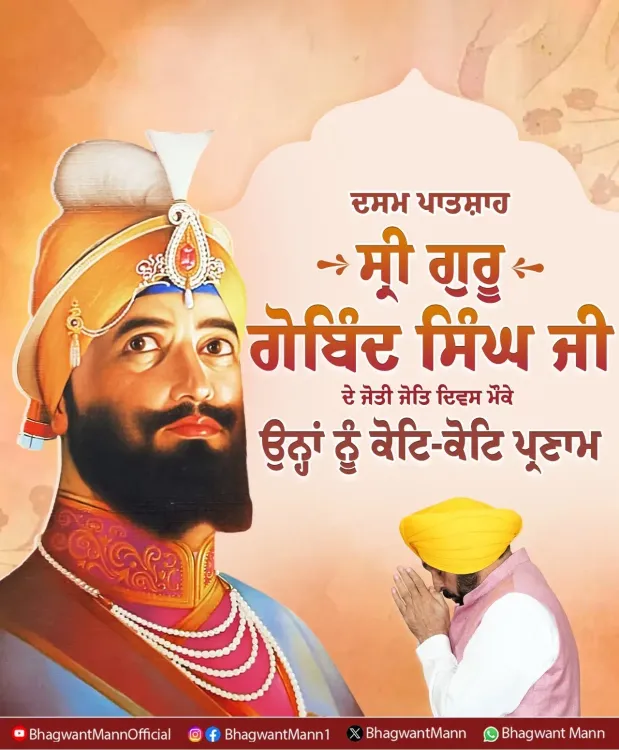
On the solemn occasion of Guru Gobind Singh Ji's Jyoti Jot Divas — the day marking the passing of the tenth Sikh Guru into eternal light — Punjab Chief Minister Bhagwant Mann offered reverential homage, invoking the Guru's timeless teaching of universal human equality and calling on all to uphold the saint-soldier ideal.
Posting in Punjabi on Saturday, 14 November 2026, Mann bowed in koti-koti pranam (countless salutations) at the feet of Sahib-e-Kamaal Guru Gobind Singh Ji, the founder of the Khalsa Panth. He spotlighted the Guru's celebrated verse — 'Manas ki jaat sabai ekai pehchanbo' — 'Recognise the entire human race as one' — describing it as a supreme message of equality gifted to all of humanity.
The saint-soldier philosophy Guru Gobind Singh bequeathed
Guru Gobind Singh, the tenth of the ten Sikh Gurus, founded the Khalsa in 1699, establishing a community rooted equally in spiritual discipline and the courage to resist oppression. The saint-soldier concept — Sant-Sipahi — remains one of his most enduring contributions: the idea that devotion and righteous defiance are not opposites but inseparable duties.
The Guru's verse on universal human oneness, drawn from the Akal Ustat, has echoed across centuries as a rebuttal to caste, creed, and division. Mann's post leans directly on that lineage, urging citizens to pledge themselves to truth, justice, and unyielding resistance to tyranny and injustice — framing these not as political positions but as obligations rooted in Sikh teaching.
Mann's call to pledge on this day of remembrance
Closing his message with a collective resolve, the Chief Minister wrote: 'Aao, Guru Sahib vallon bakhshe Sant-Sipahi vale falsafe 'te pahra dindian hakk-sach lai ate zulam te ania virudh hamesha datne da pran kariye' — 'Come, let us vow, while upholding the saint-soldier philosophy bestowed by Guru Sahib, to always stand firm for truth and justice, and against oppression and injustice.'
It is a register well established in Punjab's public life: chief ministers and senior leaders have long marked major Sikh Guru anniversaries with messages that tie religious heritage to contemporary governance values. Mann's framing follows that tradition while keeping the emphasis squarely on the spiritual legacy rather than partisan messaging.
Three centuries on, Guru Gobind Singh's injunction to see one human race — and to defend it — remains as pointed as the day it was spoken.
Point of View
The Chief Minister frames his administration's posture as spiritually rooted rather than merely political. This is a durable tactic in Punjab's political culture, where Sikh heritage provides moral authority that transcends partisan lines. For the AAP government in Punjab, regularly invoking Gurbani and Sikh history signals cultural fluency to a majority Sikh electorate while reinforcing an identity distinct from both Congress and BJP. The choice of the saint-soldier ideal — discipline plus defiance — also quietly echoes AAP's own brand of confrontational governance.
NationPress
14 Nov 2026
Frequently Asked Questions
What is Jyoti Jot Divas of Guru Gobind Singh?
Jyoti Jot Divas marks the day Guru Gobind Singh Ji, the tenth Sikh Guru, passed into eternal light. It is observed by the Sikh community with prayers and tributes to honour his life and teachings.
What does 'Manas ki jaat sabai ekai pehchanbo' mean?
The phrase, drawn from the Guru's composition Akal Ustat, means 'Recognise the entire human race as one.' It is Guru Gobind Singh's teaching of universal human equality, transcending caste, religion, and creed.
Who founded the Khalsa Panth and when?
Guru Gobind Singh founded the Khalsa Panth in 1699 at Anandpur Sahib, establishing an initiated Sikh community committed to both spiritual discipline and the courage to oppose injustice.
What is the Sant-Sipahi or saint-soldier philosophy?
The Sant-Sipahi ideal, introduced by Guru Gobind Singh, holds that true devotion and righteous resistance to oppression are inseparable duties — a Sikh must be both a saint in spirit and a soldier in defence of justice.
Why do Punjab leaders mark Sikh Guru anniversaries publicly?
Punjab's political leaders regularly issue tributes on major Sikh anniversaries because Sikh heritage is central to the state's cultural identity. Such statements connect governance messaging to religious tradition and resonate with Punjab's majority Sikh population.