CM Bhajan Lal Marks International Cooperative Day, Hails Amit Shah

Synopsis
Rajasthan CM Bhajan Lal Sharma marked International Cooperative Day on 4 July 2026, invoking the 'Sahakar se Samridhi' vision and praising Union Minister Amit Shah's leadership in taking India's cooperative movement to new heights and empowering the rural economy.
Key Takeaways
Rajasthan CM Bhajan Lal Sharma extended greetings on International Cooperative Day , observed on the first Saturday of July each year.
He invoked the national policy slogan 'Sahakar se Samridhi' (Prosperity through Cooperation), aligning with the Union government's cooperative agenda.
The Ministry of Cooperation was established as a separate central ministry in July 2021 under Amit Shah , a first in post-independence India.
The Multi-State Cooperative Societies (Amendment) Act, 2023 was passed to improve transparency and governance across cooperative societies.
Computerisation of Primary Agricultural Credit Societies (PACS) and formation of new multi-state cooperatives in dairy, seeds and exports are key planks of the policy.
Rural farmers and cooperative societies in Rajasthan are among the primary beneficiaries targeted by this policy framework.
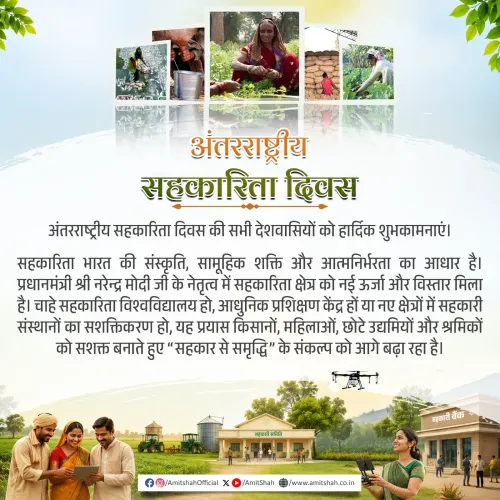
Rajasthan Chief Minister Bhajan Lal Sharma on Saturday, 4 July 2026 extended greetings on International Cooperative Day, reaffirming the government's commitment to the cooperative movement and crediting Union Home and Cooperation Minister Amit Shah for elevating it to new heights.
Context
In his post, CM Sharma wrote: 'सहकार से समृद्धि' ['Prosperity through cooperation'], conveying the resolve to bring positive change in the lives of crores of people. He extended warm wishes on International Cooperative Day, observed annually on the first Saturday of July to highlight the cooperative movement's role in sustainable development and economic inclusion.
The Chief Minister called on citizens to collectively strengthen the spirit of cooperation, saying: 'Let us together make the cooperative spirit even stronger.' The post reflects a broader alignment between Rajasthan's state government and the Union government's cooperative policy agenda.
Policy Backdrop
The Ministry of Cooperation was carved out as a separate central ministry in July 2021, the first time in India's post-independence history that cooperatives received a dedicated policy ministry. Before this, cooperative affairs were handled as a division under another ministry, limiting focused attention and resources.
Under Amit Shah's stewardship, the ministry has pursued a multi-pronged agenda: computerisation of Primary Agricultural Credit Societies (PACS), formation of new national-level multi-state cooperatives in dairy, seeds and exports, and passage of the Multi-State Cooperative Societies (Amendment) Act, 2023 to improve transparency and governance. These steps are aimed at reducing farmers' dependence on middlemen and strengthening rural credit and marketing infrastructure.
The phrase 'सहकार से समृद्धि' — 'Prosperity through cooperation' — has become the policy slogan anchoring this entire vertical, frequently invoked by BJP leaders at both the national and state levels.
Stakeholders and Impact
Rural farmers and cooperative societies across Rajasthan stand as the primary stakeholders in this agenda. The state, with its large agrarian economy, has significant presence of agricultural credit cooperatives and dairy cooperatives that stand to benefit from digitalisation and improved governance frameworks.
Strengthening cooperatives is seen as a direct intervention in rural livelihoods — providing farmers access to affordable credit, better input supply chains, and improved market linkages without the margin losses associated with private intermediaries. For a state like Rajasthan, where agriculture supports a large share of the population, this policy thrust carries considerable economic weight.
What's Next
The rollout of computerisation and model bye-laws for PACS in Rajasthan will be a key indicator of how effectively the state translates central cooperative policy into ground-level outcomes. Any announcements in the Rajasthan state budget for 2026-27 related to cooperative infrastructure investment will be closely watched by rural economy observers.
As the cooperative movement gains renewed institutional momentum under a dedicated ministry, the alignment between state governments and the Union's policy direction will determine how quickly the benefits reach the crores of rural households the framework is designed to serve.
Point of View
Sharma signals both ideological alignment and political deference to the cooperative ministry's leadership. The 'Sahakar se Samridhi' framing is significant: it positions cooperatives not as a legacy socialist institution but as a modern, BJP-led rural empowerment instrument. The real test for Rajasthan will be in implementation metrics — PACS computerisation coverage and state budget allocations — rather than in ceremonial messaging.
NationPress
4 Jul 2026
Frequently Asked Questions
What is International Cooperative Day and when is it celebrated?
International Cooperative Day is an annual global observance held on the first Saturday of July to highlight the role of cooperative societies in sustainable development and economic inclusion. In 2026 it falls on 4 July.
What is the meaning of 'Sahakar se Samridhi'?
'Sahakar se Samridhi' is a Hindi phrase meaning 'Prosperity through Cooperation.' It serves as the central policy slogan of India's Union Ministry of Cooperation, launched under Minister Amit Shah since 2021.
When was India's Ministry of Cooperation created?
The Ministry of Cooperation was established as a separate central ministry in July 2021 by the Government of India, making it the first dedicated cooperative ministry in the country's post-independence history.
What has Amit Shah done for the cooperative sector in India?
Under Amit Shah's leadership, the Ministry of Cooperation has pursued computerisation of Primary Agricultural Credit Societies, formed new multi-state cooperatives in dairy, seeds and exports, and overseen passage of the Multi-State Cooperative Societies (Amendment) Act, 2023 to improve governance.
How does the cooperative movement benefit farmers in Rajasthan?
Cooperatives provide rural farmers in Rajasthan with access to affordable credit, better input supply chains, and improved market linkages, reducing their dependence on private middlemen and strengthening the rural economy.