CM Bhajan Lal Marks National Statistics Day, Hails Data-Led Governance
Synopsis
Rajasthan Chief Minister Bhajan Lal Sharma marked National Statistics Day on 29 June 2026 by honouring Prof. P. C. Mahalanobis and asserting that data-driven policymaking and scientific thinking are essential pillars of transparent and sustainable governance.
Key Takeaways
Rajasthan CM Bhajan Lal Sharma paid tribute to Prof.
Mahalanobis on his birth anniversary, 29 June 2026 .
National Statistics Day is observed annually on 29 June to honour Mahalanobis, who founded the Indian Statistical Institute in 1931 .
CM Sharma called data-based policymaking and a scientific outlook the 'strong foundation of good governance, transparency, and sustainable development.' The message was addressed to all residents of Rajasthan , extending greetings on the national observance.
Mahalanobis shaped India's Second Five-Year Plan and developed the widely used Mahalanobis distance statistical measure.
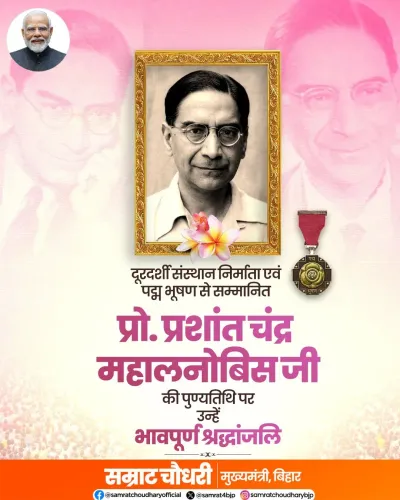
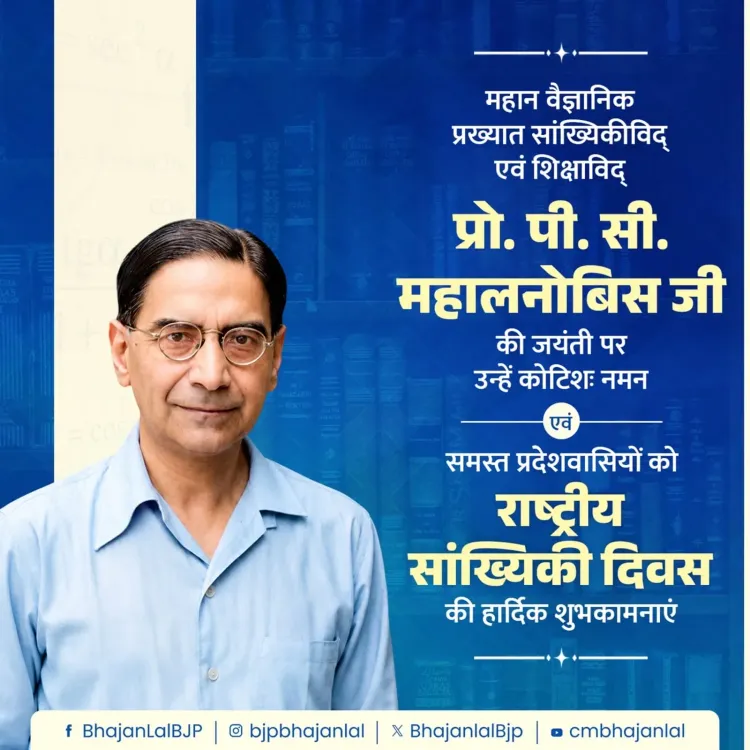
Rajasthan Chief Minister Bhajan Lal Sharma on Monday, 29 June 2026, paid tribute to eminent scientist and statistician Prof. P. C. Mahalanobis on his birth anniversary and extended greetings to the people of Rajasthan on National Statistics Day. The Chief Minister used the occasion to underline the importance of data-driven policymaking as the foundation of good governance and sustainable development.
Context
National Statistics Day is observed every year on 29 June to mark the birth anniversary of Prof. Prasanta Chandra Mahalanobis (1893–1972), one of India's most celebrated statisticians. Mahalanobis is best known for founding the Indian Statistical Institute (ISI) in Kolkata in 1931 and for developing the Mahalanobis distance, a widely used statistical measure. The Government of India designated 29 June as National Statistics Day in 2007 to honour his lasting contributions to statistical science and economic planning.
CM Sharma's post, written in Hindi, read: 'महान वैज्ञानिक, प्रख्यात सांख्यिकीविद् एवं शिक्षाविद् प्रो. पी. सी. महालनोबिस जी की जयंती पर उन्हें कोटिशः नमन' — translated as: 'Countless salutations to the great scientist, renowned statistician and educationist Prof. P. C. Mahalanobis on his birth anniversary.' He also wished all residents of Rajasthan a heartfelt National Statistics Day.
Policy Backdrop
The Chief Minister's message went beyond ceremonial tribute. He stated that 'data-based policymaking and a scientific outlook are the strong foundation of good governance, transparency, and sustainable development.' This framing aligns with a broader national push — led by the Ministry of Statistics and Programme Implementation (MoSPI) — to improve the quality, timeliness, and accessibility of official data across government departments.
Prof. Mahalanobis played a pivotal role in shaping India's Second Five-Year Plan (1956–61), which adopted a heavy-industry-led growth model partly informed by his statistical modelling. His legacy is inseparable from the idea that rigorous, evidence-based analysis must underpin state planning — a principle that successive governments have invoked when framing welfare schemes and infrastructure programmes.
Stakeholders and Impact
The message is addressed to 'samast pradeshwasiyon' — all residents of Rajasthan — signalling a broad public outreach on a day that typically sees awareness events in schools, universities, and government offices. Statistical literacy campaigns on National Statistics Day are coordinated by state directorates of economics and statistics across India.
For Rajasthan, where large-scale welfare schemes in agriculture, health, and rural employment depend on accurate beneficiary data, the Chief Minister's emphasis on transparency and data integrity carries administrative relevance. Accurate enumeration directly affects fund allocation under centrally sponsored schemes such as PM-KISAN, MGNREGS, and the Ayushman Bharat health cover programme.
What's Next
National Statistics Day observances typically include seminars, data-literacy workshops, and release of state-level statistical reports. It remains to be seen whether the Rajasthan government will announce any specific data-governance or open-data initiatives in line with the Chief Minister's stated commitment to evidence-based policymaking. The day also serves as a reminder for state statistical departments to accelerate pending surveys and publication of socio-economic indicators.
Point of View
Positioning data and scientific rigour as hallmarks of the current administration's approach. By invoking Mahalanobis, a figure associated with Nehruvian planning yet universally respected across party lines, Sharma sidesteps political controversy and plants a neutral, forward-looking flag. The emphasis on 'transparency' is notable in Rajasthan's context, where welfare-scheme delivery and beneficiary verification have been recurring administrative challenges. Whether the rhetoric translates into measurable data-governance reforms will be the real test of this stated commitment.
NationPress
29 Jun 2026
Frequently Asked Questions
Why is National Statistics Day celebrated on 29 June?
National Statistics Day is celebrated on 29 June every year to mark the birth anniversary of Prof. Prasanta Chandra Mahalanobis , the pioneering Indian statistician who founded the Indian Statistical Institute. The Government of India designated this day in 2007 to recognise his contributions to statistical science and national planning.
Who was Prof. P. C. Mahalanobis?
Prof. Prasanta Chandra Mahalanobis (1893–1972) was an eminent Indian scientist and statistician who founded the Indian Statistical Institute (ISI) in Kolkata in 1931 . He is known for the Mahalanobis distance and played a key role in shaping India's Second Five-Year Plan .
What did Rajasthan CM Bhajan Lal Sharma say on National Statistics Day 2026?
CM Bhajan Lal Sharma paid tribute to Prof. P. C. Mahalanobis and extended greetings to all Rajasthan residents on National Statistics Day, 29 June 2026 . He stated that data-based policymaking and a scientific outlook are the foundation of good governance, transparency, and sustainable development.
What is the theme or significance of National Statistics Day in India?
National Statistics Day promotes awareness of the role of statistics in socio-economic planning and policy. It is observed with seminars, workshops, and data-literacy events across government departments, universities, and schools throughout India.
How does data-driven governance affect welfare schemes in Rajasthan?
Accurate data and beneficiary enumeration directly determine fund allocation for major schemes in Rajasthan such as PM-KISAN , MGNREGS , and Ayushman Bharat . Improved statistical systems help ensure that welfare benefits reach eligible residents without leakage or duplication.