CM Bhajan Lal Marks Partition Remembrance Day
Synopsis
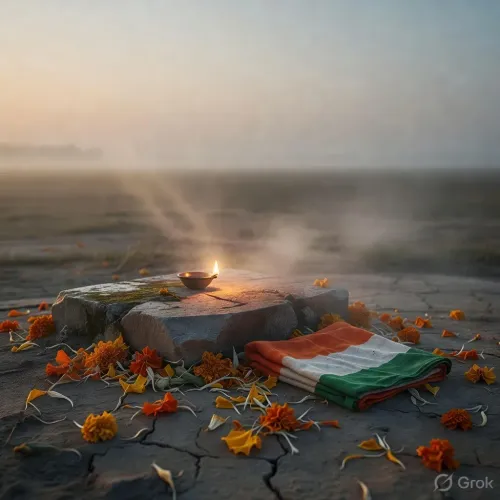
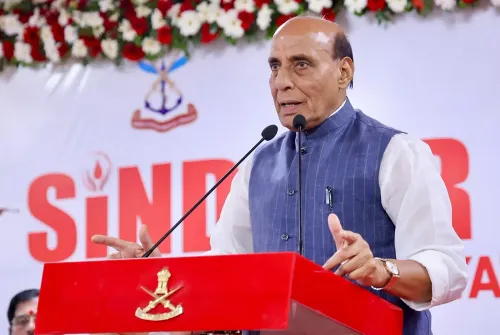
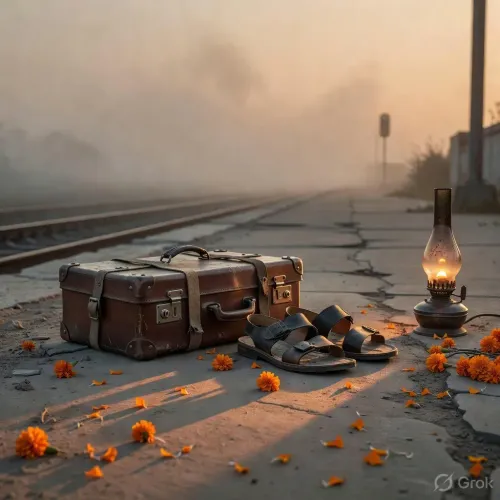
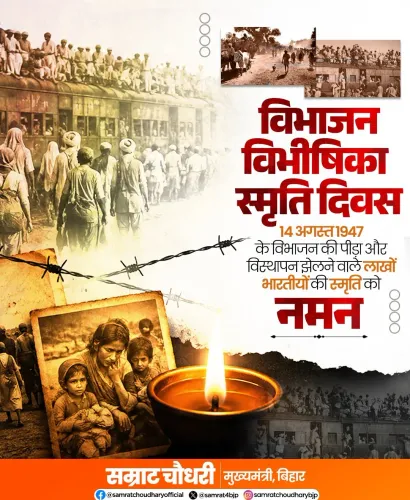
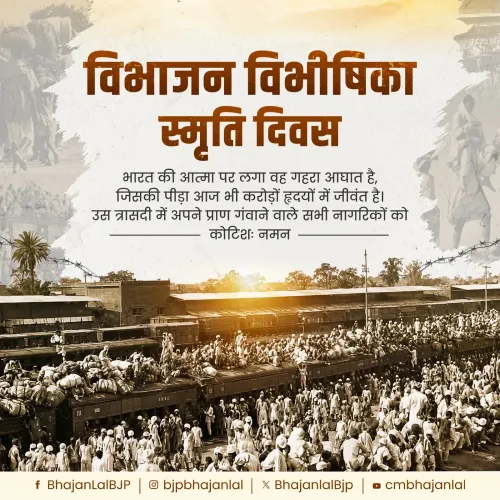
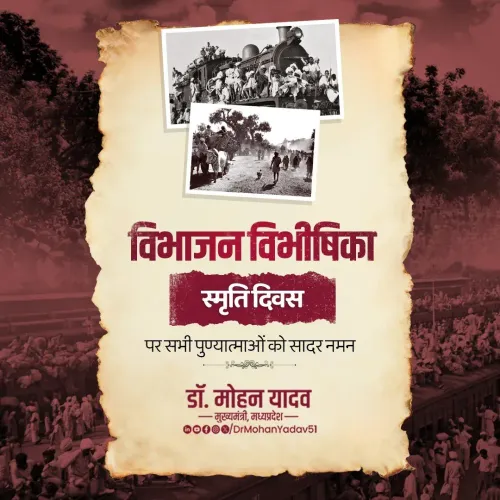
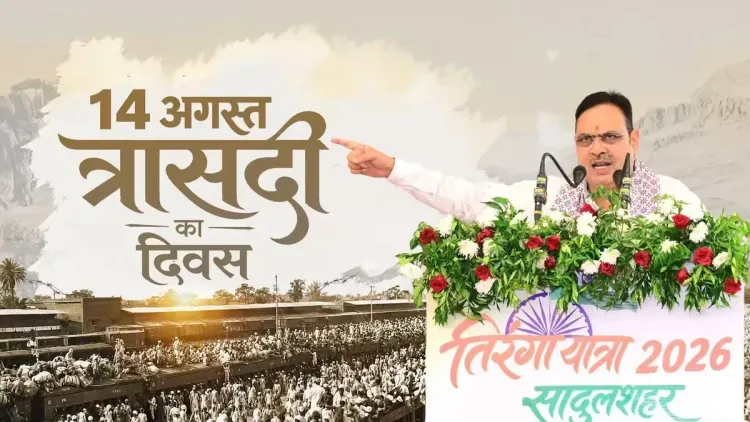
On Partition Horrors Remembrance Day, Rajasthan Chief Minister Bhajan Lal Sharma honoured the millions of families who suffered displacement and loss in the 1947 Partition, calling 14 August a memory of boundless pain and sacrifice — not merely a date.
Key Takeaways
Rajasthan CM Bhajan Lal Sharma posted a tribute on 14 August 2026 marking Partition Horrors Remembrance Day .
He described the day as a memory of 'boundless pain, sacrifice, and struggle' for millions of families separated by the 1947 Partition .
The Government of India declared 14 August as Partition Horrors Remembrance Day in 2021 .
Rajasthan received large numbers of refugees from Sindh and Punjab after Partition, giving the state a direct community connection to the event.
The statement aligns with a broader BJP pattern of foregrounding Partition memory in public discourse around Independence Day.
Seventy-seven years after the subcontinent was torn apart, the wounds of 1947 have not fully healed — and Rajasthan Chief Minister Bhajan Lal Sharma made that plain on 14 August 2026, the day India observes Partition Horrors Remembrance Day.
In a post on X, CM Sharma wrote: '14 अगस्त का दिन केवल एक तारीख नहीं' — '14 August is not merely a date, but the memory of boundless pain, sacrifice, and struggle of millions of families who lost their own in the tragedy of Partition.' The words are spare, but the weight behind them is enormous.
Why Rajasthan feels Partition's echo most
Rajasthan is not an incidental voice on this subject. The state absorbed vast waves of refugees from Sindh and Punjab after August 1947, and entire communities — in cities like Jodhpur, Bikaner, and Jaipur — trace their family histories directly to that displacement. For many Rajasthanis, Partition is not history; it is a grandparent's story told at the dinner table.
How 14 August became a day of remembrance
In 2021, the Government of India formally declared 14 August as Partition Horrors Remembrance Day — a national acknowledgement of the suffering endured by an estimated 10–20 million displaced persons and the hundreds of thousands who died in the violence that accompanied the divide. The date was chosen deliberately: the eve of Independence Day, a reminder that freedom and tragedy arrived together.
Since then, the day has become a recurring moment for leaders across the country to place on record the human cost of that political rupture — a cost that no census figure fully captures.
CM Sharma's statement fits that pattern, but it also carries the particular resonance of a leader whose state lived the displacement firsthand. The kicker is this: as long as Rajasthan's Sindhi and Punjabi communities keep their memories alive, 14 August will never be just the day before Independence Day.
Point of View
Particularly within the BJP, of anchoring national identity to the trauma of Partition — framing 14 August as a day of grief as much as anticipation before Independence Day. For Rajasthan, this is not abstract: the state's Sindhi and Punjabi diaspora communities carry living memory of displacement, making such statements politically resonant at the ground level. The formal institutionalisation of Partition Remembrance Day in 2021 gave leaders a sanctioned calendar moment to reinforce this narrative annually. Over time, the cumulative weight of these tributes shapes how younger generations relate to a foundational rupture they did not personally witness.
NationPress
14 Aug 2026
Frequently Asked Questions
What is Partition Horrors Remembrance Day?
Partition Horrors Remembrance Day is observed every year on 14 August to commemorate the suffering of millions of people displaced or killed during the 1947 Partition of British India into India and Pakistan. The Government of India declared it in 2021 .
Why did Bhajan Lal Sharma post about 14 August?
Rajasthan CM Bhajan Lal Sharma posted on X to mark Partition Horrors Remembrance Day , calling the date a memory of boundless pain and sacrifice for families who lost loved ones in the 1947 Partition .
Why is Rajasthan particularly connected to the 1947 Partition?
Rajasthan absorbed large numbers of refugees from Sindh and Punjab after the 1947 Partition , and cities like Jodhpur , Bikaner , and Jaipur have sizable communities with direct family histories of displacement.
When was 14 August declared Partition Horrors Remembrance Day?
The Government of India declared 14 August as Partition Horrors Remembrance Day in 2021 , choosing the eve of Independence Day to acknowledge that freedom and tragedy arrived together in 1947.
Who is Bhajan Lal Sharma?
Bhajan Lal Sharma is a BJP politician who has served as Chief Minister of Rajasthan since December 2023 .